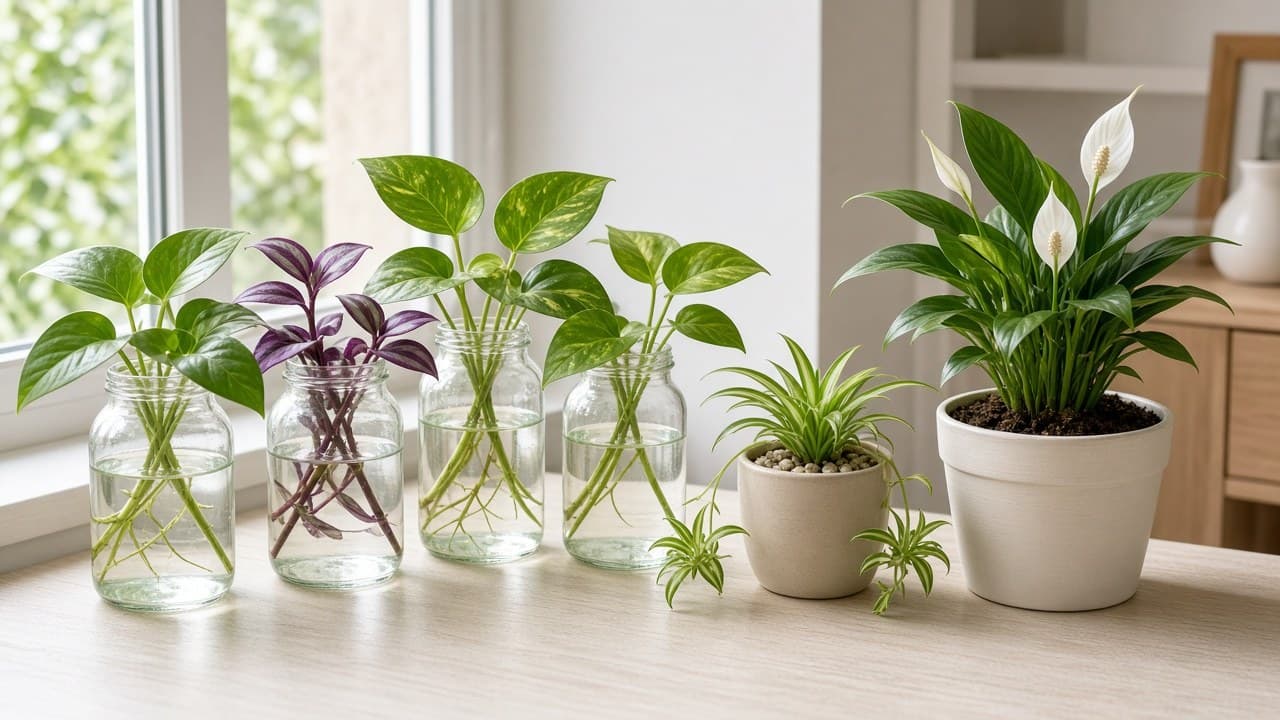
If you want a first indoor win, pick a plant that already matches an easy method: a soft stem with a node, a leaf that builds plantlets in mix, or a clump you can split. This list is a beginner chooser for houseplants. Method depth lives on water propagation, soil propagation, and air layering. Full indoor index and method chooser: plant propagation.
Outdoor herbs, basil, and garden perennials are out of scope here.
When a jar stalls, change water on a steady cadence with the propagation water change calculator. When the window is weak and cuttings stall while the jar or pot stays clean, check daily light with the propagation light DLI calculator.
Soft stems that root from a node (water or moist mix)
These are the classic beginner cuttings. Keep at least one node wet. Keep leaves out of the water or buried mix.
Pothos (Epipremnum aureum)
Devil’s ivy / golden pothos. Clemson: stem cuttings root easily in water or soil when a node is present. A leaf with no node usually fails (UAEX marks leaf cuttings as no for pothos). Iowa State: change jar water about one to two times each week; pot near about 1 inch of roots on that general stem-tip protocol.
Species guide: how to propagate pothos.
Heartleaf philodendron (Philodendron hederaceum)
Trailing heartleaf types are the forgiving jar examples on UMD and Iowa State. NCSU Recommended Propagation Strategy for P. hederaceum is stem cutting. Iowa State: trailing types, stem sections about 3 to 6 inches with lower leaves removed, root readily in water.
Species guide: how to propagate philodendron.
Tradescantia (inch plant / wandering dude)
Tradescantia zebrina, T. fluminensis, and related trailing houseplants. UF/IFAS: stem cuttings root easily. Missouri Botanical Garden: very easy; may be rooted in water. NCSU: nodes sit about an inch apart; stems root at those nodes.
Species guide: how to propagate tradescantia.
Coleus (Coleus scutellarioides)
Herbaceous cutting that roots readily indoors. Missouri Botanical Garden: root in water, easiest of all on that herbaceous-cutting note. UMN: 4 to 6 inches off the top, leaves off the bottom half, water covering the stripped nodes; roots in 2 to 3 weeks, then soil. UF/IFAS: cuttings as short as 2 inches from new shoots in plain water.
Species guide: how to propagate coleus.
Arrowhead plant / syngonium (Syngonium podophyllum)
UF/IFAS EP244: nodal cutting, tip cuttings, or air layers; simplest home idea is a single node or single eye with an attached leaf into a rooting medium. Prefer the EP244 single-node note over general sheets that want two nodes for unnamed vines.
Species guide: how to propagate syngonium.
Jar hygiene shared across these vines: water propagation, including jar water cadence. Next water change: water change calculator.
Soil and leaf starts (skip the forever jar)
Some beginners do better in moist mix than in water. Iowa State says most succulents do not root well in a glass of water. Snake plant leaf sections and many peperomias also build in media.
Snake plant (Dracaena trifasciata, formerly Sansevieria)
Division gives a finished plant with roots already attached. Leaf sections build new plantlets at the buried basal edge and take longer. NCSU names division among recommended strategies; Iowa State lists the former Sansevieria group for division and leaf cuttings. Preferred sources do not print a water-jar recipe for this plant.
Species guide: how to propagate a snake plant.
Peperomia
NCSU: propagate by leaf cuttings, stem cuttings, or divisions, depending on the species. Clemson: for stem types, a three-to-five-inch piece, strip the lower third, optional hormone, into potting soil or a rooting medium under clear plastic out of direct sun. Clemson also names water for some species, including baby rubber plant (P. obtusifolia).
Species guide: how to propagate a peperomia.
Succulents (leaf, stem, or offsets)
Iowa State: most succulents propagate vegetatively by offsets, stem cuttings, or leaf cuttings depending on species; most do not root well in a glass of water. Leaf cuttings work well for genera such as Graptopetalum, Pachyphytum, Sedum, Crassula, and Kalanchoe on that Iowa State page. Let cut surfaces callus before sticking in a fast-draining mix (soil propagation).
Species guide: how to propagate succulents.
Division, pups, and offsets (new plant already started)
When the mother plant makes plantlets or a clump you can split, you skip waiting for a bare cutting to invent roots.
Spider plant (Chlorophytum comosum)
Iowa State marks Chlorophytum for layering, division, and offsets/plantlets, not leaf cuttings. RHS: detach good-sized offsets once they have their own roots. Wisconsin Horticulture: pot a plantlet that has already started roots, or pin it while still attached until it anchors. Water or moist mix both appear on the sources we cite for plantlets.
Species guide: how to propagate spider plant.
Peace lily (Spathiphyllum)
Iowa State, UNL, NCSU, UF/IFAS, and Illinois all point at division. Illinois lists only division for Spathiphyllum, not stem or leaf cuttings. Iowa State: early spring is ideal; each piece needs healthy leaves, stems, and roots; larger pieces recover faster.
Species guide: how to propagate a peace lily.
ZZ plant (Zamioculcas zamiifolia)
NCSU Recommended Propagation Strategy is division and leaf cutting. RHS: single leaflets. Division gives an established plant with rhizomes already present. Leaf cuttings build a new rhizome first and take longer; preferred sources do not print a home week clock or a water-rooting protocol. For a first ZZ, prefer division.
Species guide: how to propagate a ZZ plant.
Boston fern (Nephrolepis exaltata ‘Bostoniensis’)
Wisconsin Horticulture: most gardeners find it much easier to divide than to grow named cultivars from spores. Repot and/or divide every few years in spring, cutting the root ball into sections. Wisconsin, UAEX, Texas A&M, Cornell, UNL, and UGA name division and/or runners (stolons) as the home methods.
Species guide: how to propagate Boston fern.
What to skip for a first try
Woody indoor figs such as fiddle leaf fig (Ficus lyrata) often need air layering on thick trunks or careful stem tips with a node. That is doable, but it is not the same “stick a soft vine in a jar” path as pothos. Bird of paradise and similar hard woody starts also wait until you have a win on the list above.
After you pick a plant
- Open the species guide for that plant and follow the attributed steps there.
- Soft node cuttings: water propagation for jars, soil propagation for mix.
- Dim room or short days: DLI calculator and best grow lights for indoor propagation.
- Division and pups: follow the species pages linked above for now. A dedicated indoor division method guide is next; until then, peace lily, spider plant, ZZ, snake plant, and Boston fern carry the clump steps.
People also ask
What are the easiest indoor plants to propagate?
Soft node vines (pothos, heartleaf philodendron, tradescantia, coleus, syngonium), soil or leaf starters (snake plant, many peperomias, many succulents), and ready plantlets or clumps (spider plant, peace lily, ZZ by division, Boston fern). Details and sources sit on each species guide above.
Is water or soil better for beginners?
Both work for many soft vines. UCANR, Clemson, UMD, and Iowa State pages support water for common node cuttings; media avoids a jar transplant and suits succulents and snake-plant leaf sections. Match the plant: Iowa State says most succulents do not root well in a glass of water.
Can I start with one leaf?
Only when the species guide says so. Pothos needs a node (Clemson; UAEX marks leaf-only as no). Peperomia and many succulents have real leaf-cutting paths on NCSU / Iowa State / RHS notes. Spider plant wants a plantlet, not a lone leaf blade.
Do I need grow lights?
Often when days are short or the room is dim. Check daily light with the propagation light DLI calculator. Fixture distance and hours: best grow lights for indoor propagation.