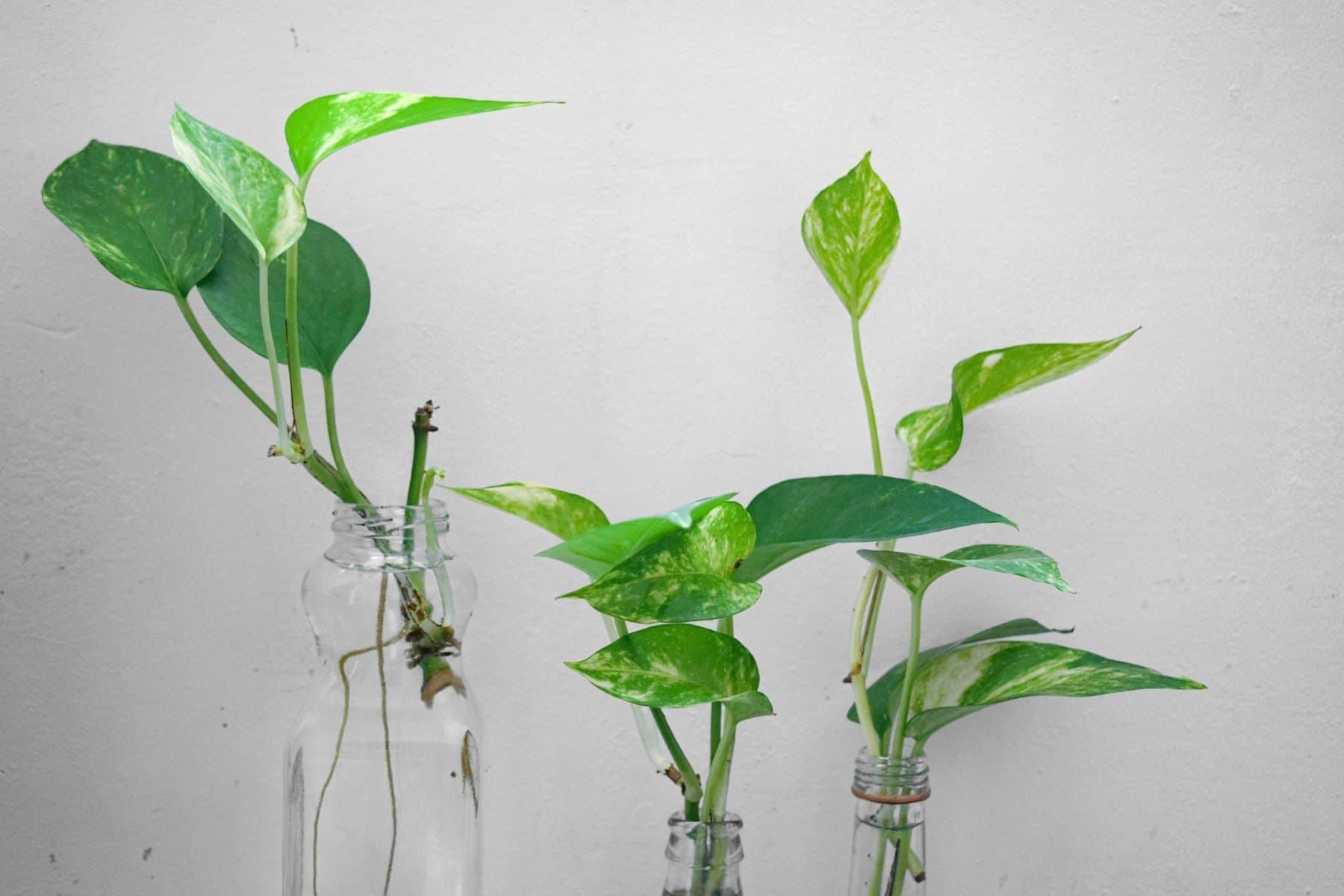
Pothos is Epipremnum aureum. Labels may say devil’s ivy or golden pothos. Clemson also lists Hunter’s Robe. Same plant. Family Araceae. UF/IFAS EP151: only commercial interiorscape species in the genus is E. aureum; older labels sometimes used Pothos aureus, Scindapsus aureus, or Raphidophora aurea.
Wild vines climb and can grow very large leaves. Indoors, leaves stay smaller and heart-shaped (UF/IFAS EP151: interiorscape leaves seldom more than about 6 inches; wild leaves can reach about 3 feet with holes). Native-range notes disagree across sources (Clemson lists China, India, and Southeast Asia; UF/IFAS lists the Solomon Islands).
This guide is about stem cuttings with a node, in water or moist mix. It is not a separate cultivar factory for Marble Queen, Neon, or N’Joy. Those variegated forms follow the same node rule when the label is still E. aureum. Satin pothos is different: Scindapsus pictus, not true pothos (Clemson). See how to propagate satin pothos for that plant. Heartleaf philodendron is another common lookalike. Clemson: pothos petioles are grooved; philodendron petioles are smooth.
Pet and kid toxicity
Clemson: all parts are mildly toxic if ingested. Calcium oxalate crystals can irritate the mouth and throat and cause vomiting or difficulty swallowing. Keep cuttings and jars away from children and pets. If ingestion is suspected, contact a veterinarian or poison control. Do not use this site as medical advice.
Materials
- Clean scissors or pruners
- Clear jar of clean room-temperature water, or a small drained pot with moist, well-draining mix
- Healthy pothos stem with at least one node (Clemson minimum)
- Optional: rooting hormone for soil or single-eye starts (UAEX and Iowa State: helpful, not required for many houseplants)
- Optional: clear bag or dome for soil starts (UAEX rooting bag; Iowa State humidity cover, not sealed airtight)
Node vs leaf-only
Clemson: stem cuttings root in soil or water, but they must have at least one node to root properly.
UAEX methods table for pothos: terminal cuttings yes; single-eye best; leaf cuttings no. That matches the home failure mode: a leaf with no stem node usually sits and fails.
Iowa State’s general stem-tip protocol (species list includes Epipremnum aureum): cut stems about 3 to 6 inches long with at least two nodes, and stick with at least one node buried and no leaves in the media. Prefer that length when you can. Clemson’s one-node minimum still stands if the piece is shorter but includes a joint.
UF/IFAS EP151 commercial recipe: 1 to 1½-inch stem cuttings with a node and an attached leaf. That is a short commercial cutting, still node-plus-leaf, not a leaf alone.
Water method
Clemson: cuttings root easily in water or soil when a node is present.
Iowa State water protocol for houseplant stem tips (pothos is on the suited list and appears in the water-rooting photo context on that page):
- Cut so a node will sit underwater. Prefer about 3 to 6 inches with at least two nodes when possible.
- Strip leaves that would be submerged.
- Stand or suspend the cutting so the node stays wet and foliage stays dry.
- Change water about one to two times each week. Never let the waterline drop so roots dry in air.
- Move to a small drained pot when roots are about 1 inch long. Water-formed roots are coarser and may show wilt, leaf drop, browning, or tip dieback after potting until they adapt. Keep the mix lightly moist and the light bright and indirect while they settle.
Jar hygiene beyond the weekly change (cloudy water, when to empty a filmed jar) lives on water propagation, including jar water: cadence and warning signs. UMD and Illinois cloudy-water notes on that guide apply to pothos jars Illinois Good Growing names among successful water rooters.
When to change the jar: propagation water change calculator.
UAEX and UF/IFAS EP151 don’t describe rooting pothos in a jar of water. Use Clemson for water-or-soil permission, Iowa State for the jar cadence and ~1 inch potting target, and the water-propagation guide for shared jar technique.
Soil, tip cuttings, and single-eye
Clemson: soil works when the node is in contact with moist mix.
Tip / terminal cuttings (UAEX)
UAEX: tip or terminal cuttings are used on vining plants such as pothos. Ideal terminal cutting on that page: healthy stem about 2 to 4 inches long with about 4 to 6 leaves; cut just below a node; remove the lowest pair of leaves; insert into moist sterile potting soil. Optional plastic bag over the pot with a wire hoop so plastic stays off the leaves; warm place, good light, not direct sun; leave sealed until rooted (UAEX: usually 4 to 6 weeks).
UAEX also notes sticking several cuttings per pot (their philodendron example uses 6 to 10) for a fuller starter plant. Same vining tip-cutting idea applies when you want a bushier pot from the start.
Single-eye cuttings (UAEX)
UAEX marks single-eye as best for pothos in its methods table. Single-eye: stem about 1 to 2 inches long with a leaf attached; the bud at the leaf base forms the new shoot. Named for alternate-leaf vines including pothos and philodendron.
Iowa State media sticking
Iowa State media protocol on the same stem-tip page: containers at least about 2 inches deep; moisten media before use; bury at least one node; no leaves in the media; optional rooting hormone; roots often in 3 to 6 weeks; pot on when roots are about 1 inch long or more. Air about 65°F to 75°F; optional heat mat toward about 75°F to 80°F media. High humidity helps; do not seal a bag so tightly that condensation never vents.
For general stick-in-mix technique and soil-versus-water tradeoffs, see soil propagation and water propagation.
Commercial timing (UF/IFAS EP151)
UF/IFAS EP151: commercial 1 to 1½-inch cuttings with a node and leaf show bud break in about 2 to 3 weeks and rooting in about 3 to 4 weeks under production conditions. That is the most pothos-specific timing in these sources. Home jars and pots often track Iowa State’s broader 3 to 6 week stem-tip band and the ~1 inch root target instead.
Light for cuttings
Iowa State: cuttings need about 4 to 6 hours of bright indirect light. Too little light slows root formation; cuttings may rot or dry before roots form. Too much light can burn foliage, especially under bags or domes.
UAEX rooting bag: warm place, good light, not direct sun.
Clemson parent-culture band (context for where cuttings sit): bright indirect light; nights about 60°F to 70°F and days about 70°F to 85°F; humidity often preferred around 50% to 70%.
UF/IFAS EP151 production shade notes (commercial, not a home jar recipe): shadehouse about 70°F to 90°F; decline if days stay above about 95°F or nights below about 65°F. Established interiorscape plants can hold at low light, but color and leaf size suffer at about 50 foot-candles; about 150 foot-candles or more helps maintain color and size. Variegation can fade under heavy shade (UF/IFAS: variegation fades above about 80% shade in production language).
If the window is weak and cuttings stall or rot while the jar stays clean, check daily light with the propagation light DLI calculator. Fixture distance and setup notes: best grow lights for indoor propagation.
Common mistakes
- Taking a leaf with no node. Clemson requires a node; UAEX marks leaf cuttings as no for pothos.
- Leaving leaves underwater or buried in mix until they rot (Iowa State, and the shared water-propagation hygiene notes).
- Skipping water changes until the jar clouds (Iowa State 1–2× cadence; change earlier when cloudy on the water-propagation guide).
- Starting from a soft, already rotting vine.
- Low light on cuttings (Iowa State: slow roots, then rot or dry-out).
- Cooking a jar or bagged pot in hot direct sun (UAEX; Iowa State burn note under covers).
- Treating satin pothos (Scindapsus pictus) as Epipremnum aureum. Clemson: not true pothos; slower; less tolerant of overwatering.
- Confusing pothos with heartleaf philodendron. Clemson: check the petiole groove.
- Expecting a set feeding schedule for pothos kept in water long term. Sources don’t give one. Mobot’s general water guide (on the water-propagation page) notes many cuttings can sit in water for extended periods; Iowa State, UMD, and NCSU Wayne County treat water mainly as a rooting step toward potting.
People also ask
Can pothos live in water forever?
Clemson confirms water rooting. Iowa State treats water as a rooting step and then potting, with coarser water roots that may struggle after the move. These sources don’t describe feeding pothos kept in water long term. For water-versus-soil tradeoffs, see water propagation.
How long do pothos cuttings take to root?
UF/IFAS EP151 commercial cuttings: bud break about 2 to 3 weeks; rooting about 3 to 4 weeks. Iowa State general stem tips: many houseplants root in about 3 to 6 weeks in media; pot near about 1 inch of roots. UAEX rooting bag: usually 4 to 6 weeks until rooted.
How many nodes does a cutting need?
At least one node must touch water or moist mix (Clemson). Iowa State prefers about two nodes on a 3 to 6 inch tip when you can take that length. UF/IFAS short commercial cuttings still carry one node plus a leaf. UAEX single-eye uses a 1 to 2 inch stem with the leaf and its bud.
Why is my cutting rotting?
Common causes on these sources: no node or a soft stem from the start; leaves submerged; water left stagnant; too little light (Iowa State). Remove a failed cutting, take a fresh piece with a clean cut just below a node, and return to clean water or moist mix. Jar restart detail: water propagation.
Is pothos toxic to cats and dogs?
Clemson: all parts mildly toxic if ingested; calcium oxalate; mouth and throat irritation, vomiting, difficulty swallowing; keep away from children and pets.
Is satin pothos the same plant?
No. Clemson: Scindapsus pictus is often sold as satin pothos and is not true pothos. Silvery markings, broader leaves, slower growth, more pest and disease pressure, and less tolerance for overwatering than E. aureum. Use how to propagate satin pothos.
Will variegation stay on the cutting?
UF/IFAS EP151: low light and heavy shade can reduce variegation and leaf size on established plants (about 50 foot-candles can mean smaller leaves and lost variegation; about 150 foot-candles or more helps hold color). Give cuttings the Iowa State bright-indirect band so they are not rooting in a dim corner. The sources do not promise every cultivar keeps identical patterning on every cutting.