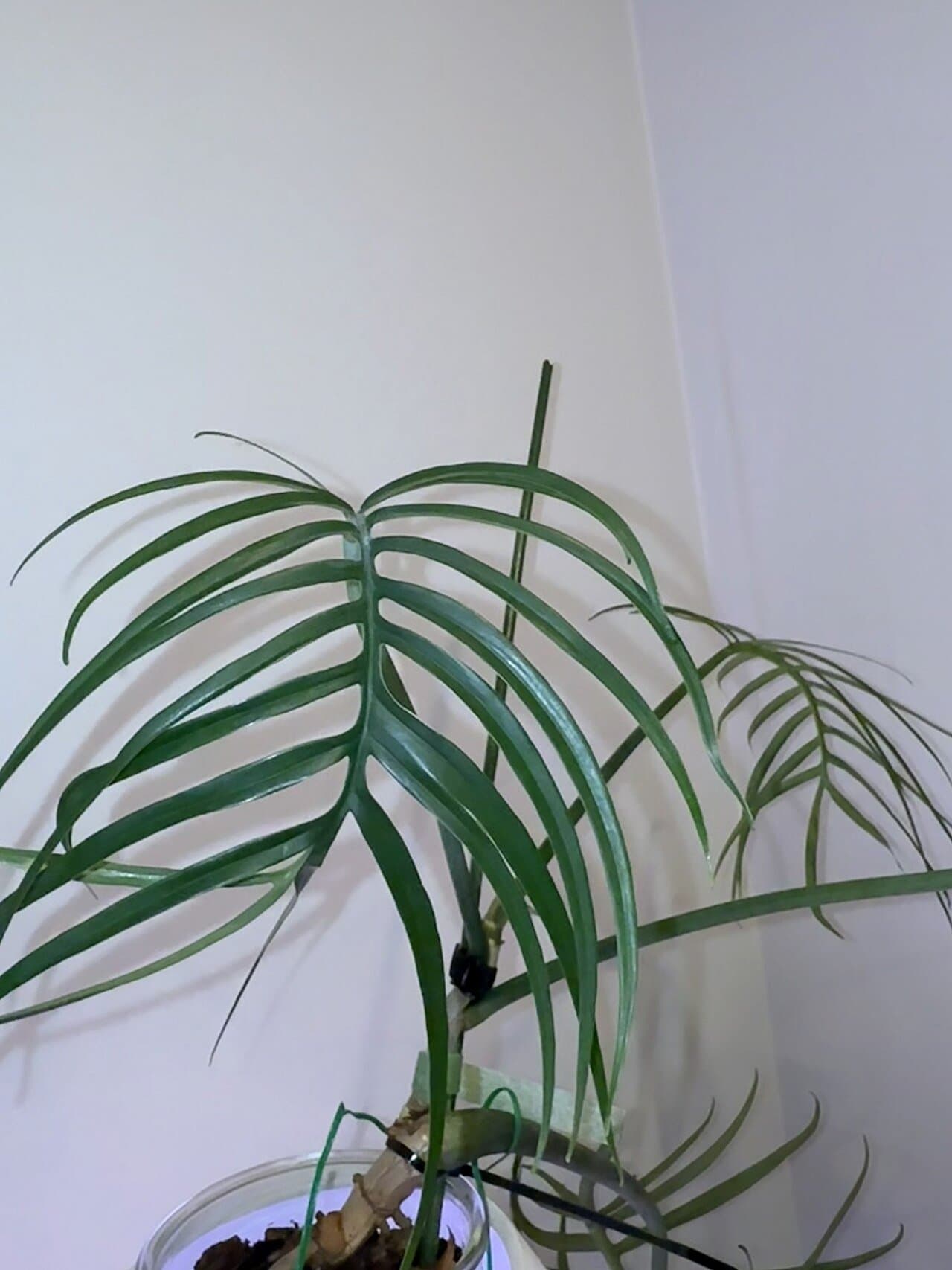
Philodendron on this guide means the genus Philodendron (Araceae), especially common indoor heartleaf types such as Philodendron hederaceum (also labeled P. scandens, sweetheart plant, parlor ivy, or cordatum). NCSU: genus of over 600 species of herbaceous perennials from tropical forests of Central and South America; name from Greek phileo (to love) and dendron (tree). Houseplants in temperate climates. Climbing or vining types have aerial roots that attach to a pole or trellis (examples: P. hederaceum, P. erubescens). Non-climbing or self-heading types grow upright with short stems and leaves in a rosette (examples: P. bipinnatifidum / tree philodendron, and hybrids such as 'Birkin' and 'Moonlight'). Clemson and Iowa State use the same climbing vs self-heading split.
Distinct from golden pothos (Epipremnum aureum). NCSU distinguishes heartleaf philodendron from E. aureum by conspicuous stipules on new growth, messy falling stipules on older growth, and non-grooved petioles. Clemson: pothos petioles are grooved; philodendron petioles are smooth; philodendron new leaves have a sheath that later dries and falls; pothos new leaves do not. Also distinct from Monstera deliciosa, often sold as split-leaf philodendron. Clemson: Monsteras are not true philodendrons; Monstera leaves develop holes and deep cuts, while philodendron cut leaves lack those holes. Iowa State lists pothos, Scindapsus, Monstera, and Rhaphidophora as related lookalikes that share similar care niches but stay on their own guides.
Can you propagate a philodendron? Yes. NCSU Recommended Propagation Strategy for P. hederaceum is stem cutting. Trailing heartleaf types root readily from node-bearing stem sections in water or media (UMD; Iowa State; RHS; Mobot). Self-heading types use stem cuttings with at least two nodes, offsets, or air layering (Iowa State; Clemson; UAEX). A bare leaf without a node or bud usually fails.
Indoor foliage focus. Trailing heartleaf types are the forgiving jar examples on UMD and Iowa State, and they sit on easiest indoor plants to propagate. Self-heading and tree types follow Iowa State's two-node / offset / aerial-root notes and Clemson / UAEX layering notes rather than a single blog recipe. For mix after potting: soil propagation. Jar technique: water propagation. Bright-indirect hours, stall cues, and the DLI tool live under Light while propagating.
Best way indoors (water vs soil)
| Situation | Method the sources support | Why |
|---|---|---|
| Trailing heartleaf tip with a node | Water jar (UMD; Iowa State; RHS; Mobot) or moist mix / perlite (Iowa State; UF; UAEX) | Easy first wins. Water shows roots; media skips a transplant and often makes stronger roots (Iowa State: water-formed roots are coarser). |
| Self-heading / upright stem | Stem piece with at least two nodes in water or media; sections with aerial roots root more reliably (Iowa State) | Single-node water tips that work on trailers are a weaker match. Offsets can be separated instead. |
| One leaf + bud on a short stem | Leaf-bud / single-eye (RHS; Wisconsin 4-H; UAEX) | Still needs the dormant bud at the leaf joint. Not a bare blade. |
| Tree / thick stem you do not want as a bare stick | Air layering (Clemson; UAEX; RHS hederaceum air-layer note; NCSU layering) | Wrap steps on air layering. |
Sources give different rooting times, so follow one source's steps.
Node, leaf joint, and aerial roots
Wisconsin 4-H: nodes are where leaves attach; buds often form there; internodes are the spaces between nodes. RHS: a node is where new growth sprouts; for nodal stem cuttings, trim just below a node at the base. Mobot water guide: cut just below where a leaf attaches; roots grow easiest there; leaving a long stub below the node often leads to rot. UMD: node is the point at which a leaf emerges from the stem.
Aerial root bumps near nodes help (Iowa State: stem sections with aerial roots tend to root more reliably on non-trailing types) but do not replace the node. A leaf blade with no stem bud is not a complete plant on the node-cutting sources above.
Where to cut (lengths differ by source): UMD 3 to 5 inches with at least one node; Iowa State trailing 3 to 6 inches; RHS about 10 cm (4 in) just below a leaf joint; Wisconsin / Mobot 4 to 6 inches; UAEX ideal tip 2 to 4 inches with four to six leaves, cut just below a node.
Stem cuttings in water
UMD Extension Maryland Grows (names Heartleaf Philodendron and Golden Pothos): cut a 3-to-5 inch stem from a healthy plant, leaving at least one node and some leaves at the tip; place in clean tap water with no leaves submerged; bright light but not direct sun; about 70°F; keep away from cold drafts. Change water at least twice a week or when cloudy. Adventitious roots can take several weeks. After roots form, leave them in water another week or two, then pot into a small well-draining container; keep medium moist until new leaf initiation, then ease watering.
Iowa State Growing Philodendrons / FAQ: trailing types, stem sections 3 to 6 inches with lower leaves removed, root readily in water; change water frequently until new roots that are several inches long form, then pot in regular potting soil.
Iowa State stem-tip how-to (lists Philodendron hederaceum): many houseplants root in a jar of water; change water one to two times each week; never let developing roots dry in air; transplant when roots are about 1 inch long; water-formed roots are coarser and may show transplant stress until they adapt. The about-1-inch figure comes from that general stem-tip protocol. Iowa State's philodendron FAQ says several inches.
RHS How to grow philodendrons: about 10 cm (4 in) stem, cut just below a leaf joint; strip lower leaves; stand in a glass of water; roots in a couple of weeks; pot when well rooted into a free-draining mix (RHS example: two parts orchid compost to one part peat-free ericaceous compost).
Wisconsin 4-H: heartleaf stem cutting 4 to 6 inches; root in sand or water; pot after it roots. No days-to-root number on that species note.
Missouri Botanical Garden Rooting Cuttings in Water (names philodendrons among easy water rooters): cuttings 4 to 6 inches; cut just below a node; remove lower leaves; roots generally in 3 to 4 weeks for that general guide; pot when roots are 1 to 2 inches long or longer; many rooted cuttings will survive in water for extended periods.
SDSU Extension: stem cuttings in water until roots begin to form, then transfer to potting mix. No inch target on that page.
When to change the jar: propagation water change calculator. Shared cadence and cloudy-water notes: water propagation.
Stem cuttings in soil or media
Iowa State: trailing types also root in perlite or well-drained potting soil; rooting hormone can accelerate perlite starts. Non-trailing: sections with at least two nodes in water or media such as perlite; stem sections with aerial roots tend to root more reliably; rooting hormone increases the rate of new roots.
Iowa State stem-tip how-to (lists P. hederaceum): cuttings 3 to 6 inches with at least two nodes; stick with at least one node in media and no leaves buried; bright indirect light and high humidity (dome or bag). Bright-indirect hours, temperature band, stall and burn cues, and the DLI tool live under Light while propagating. Most houseplant stem cuttings form roots in 3 to 6 weeks; pot when roots are about 1 inch long or more. Early spring is ideal; most houseplants can be propagated any time of year if the parent is healthy.
UF/IFAS Gardening Solutions: short stem cuttings in clean potting media for heartleaf.
UAEX FSA2095: terminal tip cuttings for vining plants such as pothos and philodendron; ideal tip 2 to 4 inches with four to six leaves; cut just below a node; remove lowest leaves; insert into moist sterile potting soil; rooting bag method usually four to six weeks on that general protocol. Stick several cuttings per pot for a fuller plant sooner.
Wisconsin 4-H: 4 to 6 inch heartleaf cutting in sand (or water). Leaf-bud method for Philodendron: cut at an internode so one leaf and its bud remain; bury the bud about one-half inch deep in moist rooting mix.
Clemson: propagate at any season from stem cuttings. No cutting length on the HGIC 1509 page.
NCSU: Stem Cutting as Recommended Propagation Strategy for P. hederaceum; genus also names Layering. No inch length or days-to-root on those toolbox pages.
Leaf-bud / single-eye cuttings
RHS P. hederaceum var. hederaceum: stem-tip or leaf bud cuttings in summer.
Wisconsin 4-H: Philodendron named for leaf-bud cuttings; one node and a short stem piece; bud buried about one-half inch.
UAEX FSA2095 single-eye technique for alternate-leaf plants such as philodendron and pothos: stem piece an inch or two long with a leaf attached; stem roots and the bud at the leaf base forms the new shoot; cluster six to ten single-eye cuttings for a fuller pot.
Offsets, layering, and air layering
Iowa State: non-trailing types may form offsets that can be separated and potted.
Clemson: some philodendrons produce offsets; air layering named with stem cuttings.
NCSU genus: Layering among Recommended Propagation Strategies.
RHS hederaceum var. hederaceum: layer or air-layer in spring.
Missouri Botanical Garden simple-layering visual guide uses a cascading philodendron as the example plant: pin a stem section with root initiatives into moist potting soil while still attached; keep damp; rooting may take 1 to 2 months; sever when firmly rooted. Bright light but not direct sun for those philodendrons on that guide.
UAEX FSA2095: air layering named for tree philodendrons (with weeping fig, schefflera, dumbcane); wound, moist sphagnum ball, wrap; roots often after two to four months on that general air-layer protocol, then sever below the root ball.
Full wrap recipes live on air layering.
Light while propagating
Philodendron cuttings need bright, indirect light while they root, not a dark shelf and not a cooked windowsill.
Iowa State’s stem-tip page (species list includes Philodendron hederaceum) wants 4 to 6 hours of bright indirect light, with air 65°F to 75°F. An optional heat mat can raise media toward 75°F to 80°F on that protocol. Too little light slows root formation. Cuttings may rot or dry before roots form. Too much can burn foliage, especially under a bag or dome. UMD wants bright light but not direct sun, about 70°F, away from cold drafts. Missouri Botanical Garden’s simple-layering guide (cascading philodendron example) keeps those plants in bright light but not direct sun.
Adult heartleaf often tolerates low light on care pages (NCSU, Clemson, UF/IFAS). That adult tolerance does not replace the bright-indirect band the cutting protocols cite. If a jar stays clear or mix stays evenly moist while roots stall for weeks, check light before blaming the plant (Iowa State).
If you meter PPFD at the jar or pot, use the propagation light DLI calculator. Fixture distance when windows fail: best grow lights for indoor propagation. Light here is about rooting pace and rot risk, not fixture shopping.
Troubleshooting (won't root, rot, mushy stem)
No node or leaf joint. UMD, Iowa State, RHS, and Mobot require a node for roots and new shoots. Restart with stem tissue that includes a node, or use leaf-bud / single-eye (leaf + bud on a short stem).
Leaves underwater or buried. UMD, Iowa State, Mobot, and RHS keep foliage above the water or media line.
Jar cloudy, smells, or stem turns mushy. UMD: change water at least twice a week or when cloudy; bacterial growth leads to rotting. Iowa State: change one to two times each week. Empty and restart in a clean jar if the stem is soft and brown. Next-step check: propagation water change calculator. Cadence depth: jar water cadence.
Soggy mix after potting. RHS: pot only a few centimetres larger; wet compost risks root rot. Clemson and Iowa State: never leave plants standing in water.
Light too low. Iowa State notes that too little light slows root formation. Cuttings may rot or dry before roots form. Adult heartleaf tolerates low light (NCSU, Clemson, UF/IFAS). Cuttings still need the bright-indirect band under Light while propagating. Weak window with a clean jar or even mix: DLI calculator.
Upright type treated like a heartleaf water tip. Iowa State: non-trailing types want at least two nodes or offsets; aerial roots help. Check node count and media moisture before deciding an upright philodendron is just slow.
Cold drafts on jars. UMD: about 70°F; keep away from cold drafts. Iowa State stem-tip air about 65°F to 75°F.
Common mistakes
- Confusing this plant with pothos (Epipremnum) or Monstera and ignoring NCSU / Clemson lookalike marks (petiole groove, stipules / leaf sheath, leaf holes).
- Taking a piece with no node. UMD, Iowa State, RHS, Mobot water guide, and Clemson pothos page (node rule for related vine cuttings) all require a node or leaf joint for roots and new shoots.
- Leaving leaves underwater or buried. UMD, Iowa State, Mobot, and RHS strip or keep foliage above the water or media line.
- Stagnant jars. UMD: change water at least twice a week or when cloudy; bacterial growth leads to rotting. Iowa State: change one to two times each week.
- Expecting a single root-inch target. Iowa State stem-tip protocol (lists P. hederaceum) says about 1 inch; Mobot water guide (names philodendrons) says 1 to 2 inches or longer; Iowa State philodendron care/FAQ says several inches for water before potting.
- Copying trailing jar steps onto self-heading types without Iowa State's two-node / offset / aerial-root notes.
- Low light on cuttings. Iowa State notes that too little light slows roots. Cuttings may rot or dry first. See Light while propagating.
- Oversized wet pots after transplant. RHS: pot only a few centimetres larger; wet compost risks root rot. Clemson and Iowa State: never leave plants standing in water.
- Leaving cuttings where pets or children chew. Toxicity is calcium oxalate across NCSU, Clemson, Iowa State, RHS, UF/IFAS, ASPCA, and SDSU.
People also ask
Can you propagate a philodendron?
Yes. Node-bearing stem cuttings in water or moist mix for trailing heartleaf types (UMD; Iowa State; RHS; Mobot). Self-heading types: at least two nodes, offsets, or air layering (Iowa State; Clemson; UAEX). Leaf-bud / single-eye keeps the bud on a short stem. A bare leaf without a node usually fails.
What is the best way to propagate philodendron indoors?
For heartleaf trailers, water or moist mix both work; pick water to watch roots or mix to skip a transplant. For upright types, prefer multi-node media cuts, offsets, or air layer. See the table under Best way indoors.
Is philodendron the same as pothos for propagation?
Method is similar: node-bearing stem cuttings in water or media. Plants differ. Philodendron is Philodendron; golden pothos is Epipremnum aureum. NCSU and Clemson give petiole, stipule / sheath, and leaf-texture marks. Both groups contain calcium oxalate and are toxic (Clemson for both; ASPCA for heartleaf philodendron). Cutting recipes for pothos stay on the pothos guide.
Can philodendron stay in water forever?
Missouri Botanical Garden water guide: many rooted cuttings will survive in water for extended periods. UMD, Iowa State, RHS, and SDSU pages describe water as a rooting step, then potting. Sources don't describe long-term care for philodendrons kept in water. See water propagation for general jar technique and soil propagation for potting up.
How do I know a node from an internode?
Wisconsin 4-H: nodes are where leaves attach; buds often form there; internodes are the spaces between nodes. RHS: a node is where new growth sprouts (leaves, buds, side-shoots, or roots); for nodal stem cuttings, trim just below a node at the base. Mobot water guide: cut just below where a leaf attaches; roots grow easiest there; leaving a long stub below the node often leads to rot. UMD: node is the point at which a leaf emerges from the stem. Aerial root bumps near nodes are useful (Iowa State) but do not replace the node requirement.
Why won't my cutting root, or why is the stem mushy?
Check node first, then jar or mix hygiene, then light and temperature. See Troubleshooting. Cloudy jars: water change calculator. Dim rooms: DLI calculator.
Why won't my upright philodendron root?
Iowa State: trailing types propagate easily from 3 to 6 inch cuttings; non-trailing types use stem cuttings with at least two nodes or offsets; sections with aerial roots tend to root more reliably; rooting hormone increases the rate of new roots. The sources do not publish a week-count that upright types are "slower" than trailers. Skip a woody-stem stopwatch those sources do not give. Check node count, media moisture (not soggy), warmth, and bright indirect light (Iowa State stem-tip ranges). Self-heading clumps with offsets can be divided instead of forced as single-node water tips.
Are philodendrons safe for cats?
No. ASPCA (Heartleaf Philodendron, P. hederaceum): toxic to dogs, cats, and horses; insoluble calcium oxalates; oral irritation, pain and swelling of mouth, tongue, and lips, excessive drooling, vomiting (not horses), difficulty swallowing. NCSU: low severity poison characteristics; calcium oxalate crystals; oral irritation, swelling, drooling, vomiting, difficulty swallowing; problem for cats, dogs, and children; contact dermatitis from sap. Clemson: all parts toxic if eaten; same crystal symptoms; keep away from pets or young children. Iowa State: poisonous to humans, dogs, cats, and other animals. RHS: harmful if eaten; skin/eye irritant; gloves when handling; pets harmful if eaten. UF/IFAS Gardening Solutions: toxic to pets; oral pain, drooling, foaming, vomiting, swelling; mild allergic sap rash in people. SDSU: toxic to animals and people if ingested. Keep plants and propagation jars out of reach.
How long until roots?
RHS climbing/trailing water cuttings: roots in a couple of weeks. Mobot general water guide (names philodendrons): generally 3 to 4 weeks. Iowa State stem-tip (lists P. hederaceum): most houseplant stem cuttings 3 to 6 weeks. UMD: several weeks for adventitious roots, then another week or two in water before potting. UAEX rooting bag: usually four to six weeks. Wisconsin and UF don't give a rooting time. Skip tighter blog timelines.