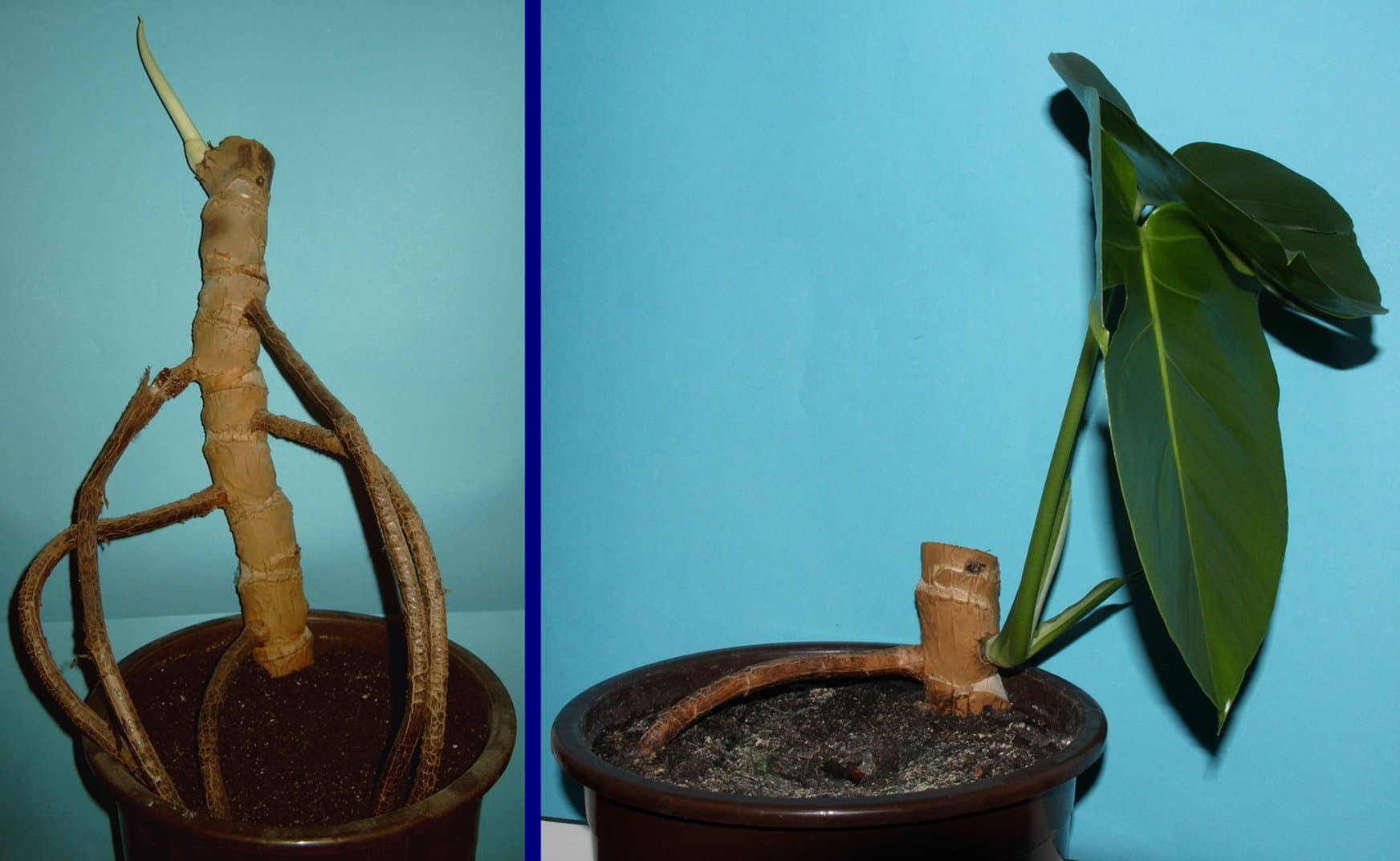
Monstera on this guide means Monstera deliciosa, the large Swiss cheese plant (also called split-leaf philodendron, Mexican breadfruit, hurricane plant, or ceriman). Family Araceae. NCSU: native Mexico to Panama; woody climbing vine; indoor height often about 6 to 8 feet; outdoors much taller. Mature leaves are large, glossy, perforated and deeply lobed. NCSU flags confusion with Rhaphidophora tetrasperma (mini monstera), which is a different genus.
This is not Monstera adansonii (Swiss cheese vine / Mexican breadfruit plant on the smaller houseplant). RHS How to grow Swiss cheese plants: deliciosa is the original large Swiss cheese plant; adansonii is the smaller species. Iowa State lists swiss cheese plant (M. deliciosa) and swiss cheese vine (M. adansonii) separately. Mini monstera stays on its own guide as Rhaphidophora tetrasperma. Use how to propagate Monstera adansonii and how to propagate mini monstera for those plants.
Can you propagate a monstera? Yes. NCSU Recommended Propagation Strategy is layering or stem cutting. UMN: stem cuttings, air layering, or division, each with a node. Wisconsin Hort: stem cuttings, air layering, or simple layering. RHS: stem cuttings (water then pot on the Swiss cheese guide). A leaf alone without a stem node will not produce new growth and ultimately will rot (UMN).
Indoor climbing focus. Soft tip or mid-stem pieces with a node fit soil or water. Thick attached stems you do not want to risk as bare sticks fit air layering. For mix: soil propagation. Jar technique: water propagation. Wrap steps: air layering. Soft vines that are even easier first wins live on easiest indoor plants to propagate; deliciosa needs a real node and more patience than pothos.
Best way indoors (soil, water, or air layer)
Choose by what you can cut safely.
| Situation | Method the sources support | Why |
|---|---|---|
| Soft stem with a node you can spare | Stem cutting in moist media (UMN; Wisconsin Hort; Iowa State stem-tip list includes M. deliciosa) | UMN: roots about 2 to 4 weeks in media care notes; new leaves from propagated nodes can take up to 2 to 3 months. Perlite named most common medium on that page. |
| Soft stem and you want to watch roots | Stem cutting in water (RHS Swiss cheese guide; UMN allows water) | RHS: spring to late summer, stand in water until a good set of roots, then pot. UMN: change water when cloudy; water-grown roots weaker than media-grown. |
| Thick attached stem you do not want as a bare stick | Air layering or simple layering (UMN; Wisconsin Hort; NCSU) | Roots form while still attached. Sever only after a clear root mass (method steps on air layering). |
| Leaf blade only, no node | Not a complete plant (UMN) | New growth comes from axillary buds and nodes on the stem. Leaf-only pieces ultimately rot. |
Do not paste Iowa State's general 3 to 6 week / about-1-inch water figures as if they were UMN deliciosa-only measurements.
Node vs leaf (and fenestration)
UMN: find a node with an axillary bud; cut 1 to 2 inches below the node along the internode. Cuttings that lack a node and axillary bud, such as leaves alone, will not produce new growth and ultimately will rot. Multiple leaves on the cutting promote better rooting through photosynthesis on that page.
Fenestrations (the holes and splits on mature deliciosa leaves) are leaf shape, not a substitute for a node. A beautiful split leaf without stem tissue still fails the UMN leaf-only rule.
Aerial roots help but do not replace the node. Wisconsin Hort: cut the tip just below an aerial root and pot. UMN still requires a node and axillary bud. UF/IFAS: aerial roots take root when they touch the ground. An aerial root is a head start; a node is the requirement for a new shoot system.
UMN on variegated forms such as Thai Constellation: cuttings should have at least one healthy node; seeds do not carry variegation.
Stem cuttings in soil or media
UMN: find a node with an axillary bud; cut 1 to 2 inches below the node along the internode; multiple leaves on the cutting promote better rooting through photosynthesis; optional auxin on the node; insert into moist rooting medium that drains well; keep cuttings moist; check for roots by gently lifting the cutting. Roots form in about 2 to 4 weeks on that page. Propagated nodes can take up to 2 to 3 months before forming new leaves.
UMN rooting media for M. deliciosa: perlite (named as the most common medium for these cuttings), potting soil kept moist but not waterlogged, LECA, or water. Media must hold moisture and support the cutting while draining enough to limit rot.
Wisconsin Hort: cut the tip of the stem just below an aerial root and pot the cutting. For more plants, cut the vine into 1-foot sections, press the sections halfway into a bed of rooting medium such as a mixture of leafmold and sand, then transplant when roots have developed. That 1-foot section length is Wisconsin Hort for M. deliciosa, not a genus-wide aroid rule.
Iowa State stem-tip how-to lists Monstera deliciosa among houseplants suited to stem cuttings: pieces 3 to 6 inches long with at least two nodes; stick with at least one node in media and no leaves buried; bright indirect light and high humidity; roots often in 3 to 6 weeks on that general protocol. Those inches and weeks are Iowa State's general stem-tip guidance, not figures measured on deliciosa alone.
NCSU names stem cutting as a Recommended Propagation Strategy but does not give cutting length or days-to-root on the species page.
Water
UMN: Monstera cuttings can be rooted in plain water; change the water when it becomes cloudy; roots grown in water are weaker than those grown in solid rooting media.
RHS How to grow Swiss cheese plants (names M. deliciosa and M. adansonii): stem cuttings from spring to late summer; stand in a glass of water in a bright location until they produce a good set of roots, then pot up.
Iowa State (general stem-tip protocol; species list includes M. deliciosa): change water one to two times each week; never let developing roots dry in air; transplant when roots are about 1 inch long; water-formed roots are coarser and may show transplant stress until they adapt. Those water notes are general houseplant stem-tip guidance on a page that lists this species.
When to change the jar: propagation water change calculator. UMN already names change when cloudy; the calculator turns days and cloudiness into a next step. Method depth: water propagation.
Air layering and simple layering
UMN names air layering for M. deliciosa alongside stem cuttings and division, always with a node. Wisconsin Hort names air layering or simple layering any time of the year. NCSU lists layering among Recommended Propagation Strategies.
UMN and Wisconsin pages name the methods but do not publish a full sphagnum-wrap recipe with week counts for this species. Site method steps for wound, moss, and wrap live on air layering. Sever and pot only after a clear root mass shows in the wrap, as on that method page.
Wisconsin Hort also describes pressing 1-foot vine sections into rooting medium (simple layering style for multiple sections). UF/IFAS notes long aerial roots that take root when they touch the ground; that is natural rooting behavior, not a substitute for a node on a detached cutting.
Seed and other notes
RHS deliciosa profile and UF/IFAS name seed among options. Wisconsin Hort: plants can be grown from seed, but seedlings need warm temperatures and are slow to develop. UMN: houseplants rarely flower or fruit indoors. UF/IFAS: plants from cuttings may come into bearing in 4 to 6 years in landscape settings; that fruit timeline is landscape crop context, not an indoor houseplant claim.
UMN on variegated forms such as Thai Constellation: cuttings should have at least one healthy node; seeds do not carry variegation.
Light while propagating
A Monstera cutting needs bright, indirect light while the node roots. Iowa State lists Monstera deliciosa among houseplants suited to stem cuttings and pairs bright indirect light with high humidity for that method. Iowa State does not print an hour count for this species.
RHS How to grow Swiss cheese plants wants the stem standing in a glass of water in a bright location until a good set of roots forms, then potted up.
UMN recommends supplemental lighting for cuttings, especially late fall or early winter. UMN does not print an hour target or a fixture type. When days are short and the window is weak, a grow light can cover the gap. Fixture distance is on best grow lights for indoor propagation. If you meter PPFD at the jar or pot, use the propagation light DLI calculator.
When a cutting yellows or drops a leaf, keep bright indirect light and steady moisture. Skip sealed stagnant wet air under plastic in hot sun. High humidity stays with the light Iowa State names. Inch and week ranges on that stem-tip method cover the whole group, not Monstera deliciosa alone. Those conditions change how fast the node roots.
Troubleshooting (won't root, rot, yellow leaves)
No node or axillary bud. A leaf or petiole alone will not make a branching plant (UMN). Start over with stem tissue that includes a node.
Jar cloudy, smells, or roots stall. Change water when cloudy (UMN). Iowa State general cadence: about one to two times each week; never let roots dry in air. Use the propagation water change calculator and jar water cadence.
Soggy media / soft brown roots. UMN flags damping off and soft brown roots from excess moisture. RHS Swiss cheese guide warns against waterlogged compost. Keep media moist but draining (UMN).
Light too low or harsh. UMN recommends supplemental lighting for cuttings, especially late fall or early winter. If the window is weak and the jar or pot stays clean while growth stalls, check daily light with the propagation light DLI calculator. Fixture distance and hours: best grow lights for indoor propagation.
Yellowing or leaf drop on a cutting. Check water extremes and light first (UMN moisture notes; RHS waterlogged compost warning). Keep bright indirect light and steady moisture; skip sealed stagnant wet air under plastic in hot sun.
Waiting past the rooting times without a firm stem. UMN: roots about 2 to 4 weeks in media notes; new leaves from nodes can take up to 2 to 3 months. Iowa State general stem-tip: roots often in 3 to 6 weeks. If the stem turns soft and brown with no node left, restart rather than waiting longer.
Common mistakes
- Confusing this plant with Monstera adansonii or Rhaphidophora tetrasperma (mini monstera) and copying those guides' methods here without saying the plants differ.
- Taking a leaf with no stem node and expecting a new plant. UMN: cuttings that lack a node and axillary bud, such as leaves alone, will not produce new growth and ultimately will rot.
- Following blog week counts or root-length targets that UMN, Wisconsin Hort, NCSU, and RHS don't give for this plant.
- Treating Iowa State's 3 to 6 inch / 3 to 6 week / about-1-inch water-root figures as a deliciosa-only UMN measurement when they sit on a general stem-tip protocol.
- Copying Wisconsin's 1-foot vine sections onto adansonii or mini monstera pages.
- Overwatering cuttings in poorly drained media. UMN flags damping off and soft brown roots from excess moisture; RHS Swiss cheese guide warns against waterlogged compost.
- Skipping light when days are short. UMN recommends supplemental lighting for cuttings, especially late fall or early winter. Grow lights help when windows cannot supply that. If you have a PPFD reading, check daily light.
- Handling sap without gloves when irritation is a concern. NCSU, RHS, Wisconsin Hort, and ASPCA all flag calcium oxalate / oxalic acid toxicity and irritation.
People also ask
Can you propagate a monstera?
Yes. Stem cuttings with a node in soil or water (UMN; RHS; Wisconsin Hort; Iowa State list), or air layering / simple layering on thick attached stems (UMN; Wisconsin Hort; NCSU). A leaf alone without a node will not make a new plant (UMN).
Is this the same as Monstera adansonii or mini monstera?
No. Here we mean Monstera deliciosa, the large Swiss cheese plant. RHS: deliciosa is the original large species; adansonii is smaller. NCSU warns not to confuse deliciosa with Rhaphidophora tetrasperma (mini monstera). Use how to propagate Monstera adansonii and how to propagate mini monstera for those.
What is the best way to propagate monstera indoors?
Match the wood. Soft stem with a node: moist media (UMN prefers solid media for stronger roots; perlite often named) or water (RHS; UMN allows water). Thick attached stem: air layer. See the table under Best way indoors. Leaf-only is not a path.
Can I propagate monstera from a leaf only?
No as a complete new plant. UMN: leaves and petioles will not grow on their own because new growth comes from axillary buds and nodes on the stem; leaf-only pieces ultimately rot. A node on the stem piece is required. Fenestrations on the leaf do not replace that node.
Should I use water or soil?
Both work. RHS Swiss cheese guide supports water, then pot up. UMN supports water and solid media (perlite named most common for these cuttings) and notes water-grown roots are weaker than media-grown roots. Iowa State lists water or media for stem-tip houseplants that include M. deliciosa. See water propagation and soil propagation. Thick attached stems fit air layering.
What about aerial roots?
Useful but not the whole recipe. Wisconsin Hort: cut the tip just below an aerial root and pot. UMN still requires a node and axillary bud. UF/IFAS: aerial roots take root when they touch the ground. An aerial root is a head start; a node is the requirement for a new shoot system.
Why won't my cutting root, or why is it rotting?
Check node first, then jar or mix moisture, then light. See Troubleshooting. Cloudy jars: water change calculator. Dim rooms: DLI calculator.
Is monstera toxic?
Yes for chewing and sap contact. NCSU: needle-like calcium oxalate crystals; mouth and throat burning, nausea, vomiting; contact dermatitis possible. Wisconsin Hort: all parts poisonous except ripe fruits. RHS: poisonous; wear gloves; keep away from children and pets. ASPCA: toxic to dogs and cats; insoluble calcium oxalates; oral irritation, drooling, vomiting, difficulty swallowing. Unripe fruit is not a snack; ripe fruit is a separate edible topic on Wisconsin Hort / UF/IFAS landscape pages.
When do I cut an air layer free?
UMN and Wisconsin Hort name air layering for M. deliciosa but do not state a species-specific root length or week count on those sources. Cut free when a clear root mass shows in the moss wrap, then pot. Full wrap steps live on air layering.
How long until roots or new leaves?
UMN: roots in about 2 to 4 weeks for stem cuttings in media care notes; new leaves from propagated nodes can take up to 2 to 3 months. Iowa State general stem-tip protocol (lists M. deliciosa): roots often in 3 to 6 weeks. Skip tighter blog timelines.