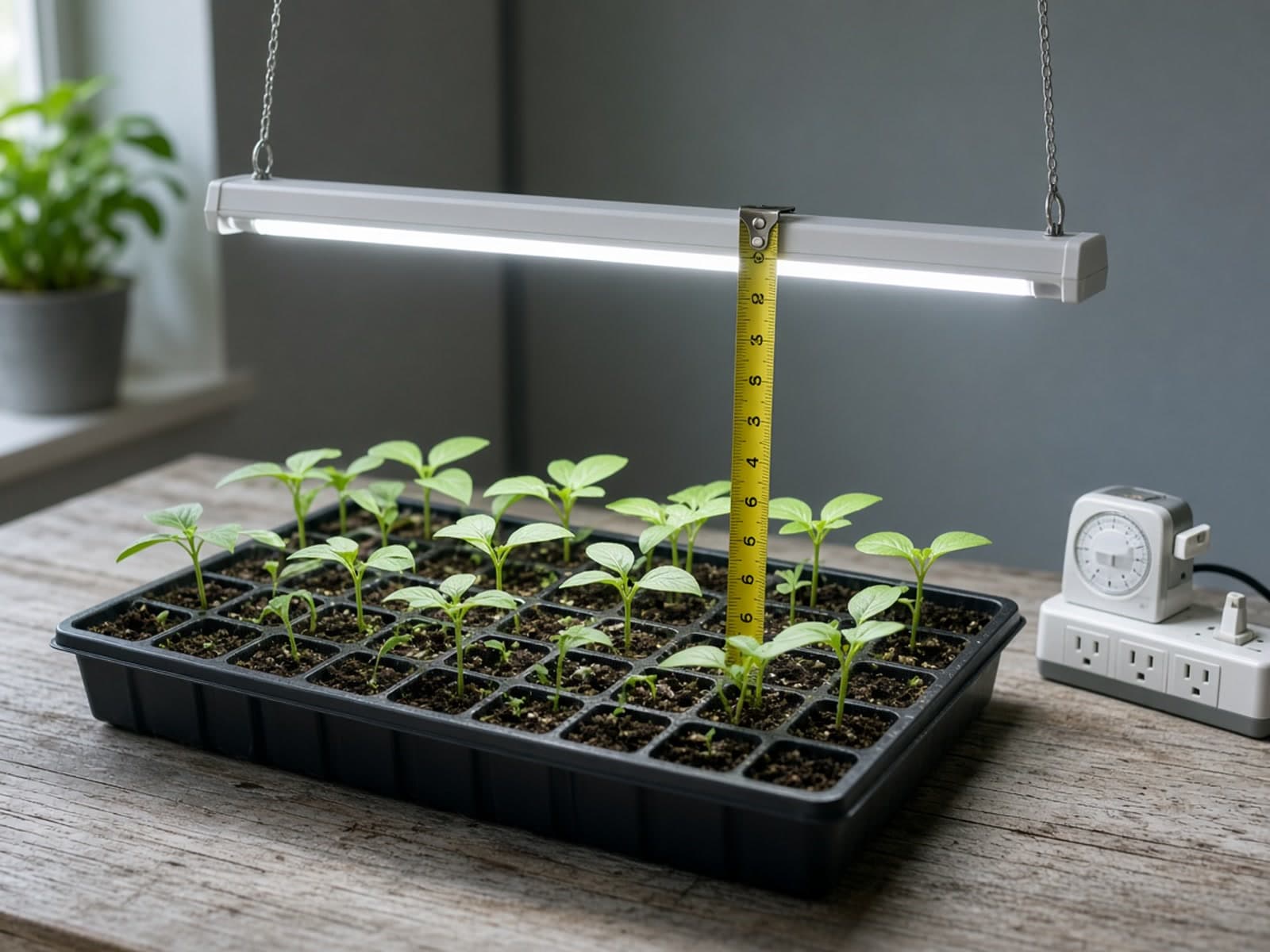
This page covers grow lights for indoor plant propagation: rooting stem or leaf cuttings, and raising seedlings until they can move to stronger light. It is a buying and setup page, not a species how-to. Mix and water methods live on the hub pages linked at the end.
Facts below come from opened university extension pages (Iowa State, Wisconsin Horticulture, University of Minnesota, Clemson HGIC, Illinois Extension, Virginia Tech). Product slots use placeholders. No brand ranking or we-tested claim appears here.
When a grow light helps vs a bright window
Iowa State Extension: light is often the most limiting growth factor indoors for houseplants, seed starting, and other indoor plants. Many indoor plants benefit from supplemental light in winter; many benefit year-round.
University of Minnesota Extension: it is much better to grow seedlings under fluorescent or LED lights than to rely solely on natural light, even in a greenhouse. A windowsill is often a poor seed-start site because night cold and day heat swing hard, and windowsill seedlings tend to be too tall with thin, bent stems. Lack of light is named as the major cause of elongated, skinny stems. Keep lights close (details below). Plants need 12 to 16 hours of light daily and should not run continuously; many plants need a dark period.
Wisconsin Horticulture: bright window light helps, but seedlings need really bright light for thick stems and proper growth. Hang fluorescent or LED lights a few inches above seedlings and raise them as plants grow.
Clemson HGIC: transplants grown indoors need 16 to 18 hours of bright light (natural and artificial) for stocky seedlings. Under low light, vegetable seedlings become leggy, weak, and tip over. Windowsill transplants tend to reach for light and become tall and leggy.
Illinois Extension: inadequate light is a common seed-start failure. Low intensity produces etiolation (leggy, elongated internodes). Even crops that can sit on a bright sill often benefit from supplemental light.
Virginia Tech Extension (SPES-720): eyes are poor judges of plant light. Prefer plant units such as PPFD and daily light integral (DLI). Suggested DLI ranges on that page include seedlings at 5 to 10 mol m-2 d-1 and cuttings at 5 to 10 mol m-2 d-1.
Takeaway: a bright window can work for a few easy starts in strong seasons. For most indoor cuttings trays and seed flats, especially in short-day or cloudy periods, a close, timed supplemental fixture is the attributed path to stockier growth.
Light types for propagation
Iowa State names LED, fluorescent, HID, and (as a poor choice) incandescent for home supplemental light. LED fixtures are the new go-to for many home gardeners: efficient, cooler than fluorescent, long-lived, high output that does not fade like fluorescent tubes. Most LED lights can sit 12 to 24 inches from foliage. Fluorescent fixtures stay cooler than incandescent and should sit within 6 to 12 inches of plants because usable intensity (PPFD) falls off sharply with distance. Iowa State flags watts as an unreliable intensity measure; prefer PPF / PPFD when manufacturers publish them. Lumens measure light to the human eye, not PAR to the plant.
Iowa State on spectrum: plants primarily use red and blue wavelengths within PAR. Full-spectrum (daylight) fixtures, or a mix of warm-white and cool-white tubes, widen usable wavelengths. Fixtures sold as grow lights supply the wavelengths plants need; some LED grow lights look pink or purple because they emphasize red and blue.
Practical home setups named on Iowa State include manufactured grow lights, 4-foot shop fixtures, purchased light shelves / carts / stands, grow tents, and DIY shelves with adjustable chains. Also notes small setups even as small as an LED grow light in a desk lamp, and LED strips or tapes for side light on taller canopies.
Distance (attributed)
| Source | Fixture type | Distance guidance |
|---|---|---|
| Iowa State | Fluorescent (general) | 6 to 12 inches from foliage |
| Iowa State | LED (general) | 12 to 24 inches from foliage |
| Iowa State | Shop LED, full-spectrum, at least 3,000 lumens | 18 inches from foliage (trial setup) |
| Iowa State | Shop fluorescent, 2x40 W T5 HO full-spectrum | 9 inches from foliage (trial setup) |
| Iowa State | Packaged grow light | Follow package directions |
| UMN | Fluorescent or LED over seedlings | No more than 4 inches above tops; 2 inches ideal |
| Wisconsin Hort | Fluorescent over seedlings | Tops about 1 inch from tubes; do not let plants grow into tubes |
| Wisconsin Hort | LED over seedlings | Need not be as close as fluorescent |
| Clemson HGIC | 48-inch, 40 W fluorescent tubes | 2 to 4 inches above seedlings; keep at least 2 inches above tops |
| Clemson build guide | Fluorescent tubes | At least 2 inches above seedling tops; raise daily as plants grow |
Those numbers are not interchangeable. UMN and Clemson seedling distances are tighter than Iowa State general LED band. Match the fixture type and raise or lower the light as plants respond. Iowa State: stretch and spindly growth means increase intensity (often move closer); leaf scorch / bleach / extreme compact growth means decrease intensity (often move farther).
Hours per day (attributed)
| Source | Hours |
|---|---|
| Iowa State (general indoor) | Often 12 to 14 hours; home range about 10 to 16 hours; packaged grow lights in trial setup left on 14 hours |
| Iowa State (timer note for flowering responses) | Adjust without going under 8 or over 16 hours when changing day length for flower/fruit cues |
| Wisconsin Hort | About 16 hours for most crops; spinach exception max 10 to 11 hours to avoid bolting |
| UMN | 12 to 16 hours; do not leave on continuously |
| Clemson HGIC | 16 to 18 hours for stocky transplants; FAQ also states 12 to 16 hours with a timer |
| Illinois Extension | Timer for 16 hours; 18 hours named as maximum for seedlings |
Use a timer. UMN and Iowa State both stress a dark period. Do not invent a 24-hour schedule.
DLI and PPFD (attributed)
Iowa State DLI bands for indoor plants:
- Low: 3 to 6 mol/m2/day (foliage houseplants)
- Medium: 6 to 10 mol/m2/day (foliage and flowering houseplants; vegetative cuttings; starting seedlings on the high side of the range)
- High: 12 to 16 mol/m2/day (flowering houseplants; succulents; starting seedlings on the low side; leafy herbs/vegetables)
- Very high: 18 to 30 mol/m2/day (many fruiting crops and high-light herbs/vegetables)
Virginia Tech: seedlings 5 to 10 and cuttings 5 to 10 mol m-2 d-1 among example crop DLI ranges.
Both Iowa State and Virginia Tech give: DLI = PPFD x hours x 0.0036 (PPFD in umol/m2/s). Virginia Tech example: 200 umol m-2 s-1 for 16 hours approx 12 mol m-2 d-1. Iowa State: measure at foliage level; smartphone apps can be adequate for home gardeners if calibrated for the lamp type.
If you already have a PPFD reading and a daily hours figure, the propagation light DLI calculator does that arithmetic and sets the result next to the attributed bands above. It does not invent a PPFD from fixture type or distance.
No opened preferred extension page on this pass published a single mandatory home-propagator PPFD band for clip lights. Do not invent one. Prefer DLI targets above plus manufacturer PPF / PPFD charts and plant response.
What to buy
Editorial category slots only. Product identity, model numbers, prices, ASINs, and best-overall winners are not invented here. Each slot uses {{AFFILIATE_ASIN_OR_URL}} for later affiliate wiring.
Some links may be affiliate links when product slots are filled; see the affiliate disclosure.
Best adjustable LED bar for a cuttings or seedling tray
Product: {{AFFILIATE_ASIN_OR_URL}}
What to look for: full-spectrum or grow-rated LED bar that hangs or mounts with adjustable height so canopy distance can follow Iowa State LED band (about 12 to 24 inches) or tighter seedling guidance from UMN / Clemson if the fixture runs cooler at close range. Prefer published PPF or PPFD-at-height data over watts alone (Iowa State). Pair with a timer for about 12 to 16 hours (UMN / Iowa State), or 16 to 18 hours when following Clemson transplant guidance.
Best clip light for a single pot or jar of cuttings
Product: {{AFFILIATE_ASIN_OR_URL}}
What to look for: clamp or clip LED that can hold a stable distance over one pot or water jar. Iowa State notes even a desk-lamp LED can be a small setup; still treat watts as a weak proxy and watch for stretch vs scorch as Iowa State adjustment table describes. Full-spectrum or grow-labeled output preferred over warm-only decorative bulbs.
Best full-spectrum shop-style fixture for a shelf
Product: {{AFFILIATE_ASIN_OR_URL}}
What to look for: Iowa State trial setup for non-grow-light shop LED: standard 4-foot plug-in fixture, full-spectrum (daylight), at least 3,000 lumens, about 18 inches from foliage, about 14 hours. Fluorescent alternative on that same page: 4-foot, 2-bulb, 40 W T5 high-output full-spectrum (or one cool white + one warm white), about 9 inches from foliage, about 14 hours. Illinois Extension also supports warm + cool fluorescent mixes and T5 efficiency notes.
Best multi-shelf stand or cart for several trays
Product: {{AFFILIATE_ASIN_OR_URL}}
What to look for: Iowa State describes purchased light shelves, carts, and stands with adjustable LED or fluorescent fixtures and water trays. Criterion: each shelf must let you raise the light as plants grow (UMN hang-from-chains guidance; Clemson raise daily). Enough coverage for tray width without large dark gaps at the edges.
Best timer and height kit add-on (accessory slot)
Product: {{AFFILIATE_ASIN_OR_URL}}
What to look for: simple outlet timer plus adjustable hangers or chains. UMN, Clemson, Illinois, and Iowa State all treat timers as part of a working setup. Height adjustability is required because intensity changes with distance (Iowa State; Virginia Tech height/PPFD note).
Editors: fill each placeholder with a live affiliate ASIN or URL and a short product name only after checking current specs against the look-for lines. Do not add invented rankings.
Common mistakes
- Treating watts as plant light intensity. Iowa State: watts measure energy use, not PAR delivered to leaves.
- Buying by lumens alone without spectrum or PPF context. Iowa State: lumens track human vision; yellow/green can inflate lumen ratings without raising PAR.
- Leaving lights on 24 hours. UMN: many plants need a dark period; do not leave lights on continuously.
- Running fluorescent tubes too far above seedlings. UMN ideal about 2 inches (max 4 inches); Clemson 2 to 4 inches; Wisconsin about 1 inch for fluorescent. Far fixtures drive stretch.
- Ignoring heat when closing the gap. Iowa State: hot fixtures can damage plants if moved too close; fluorescent and LED run cooler than incandescent or many HID setups.
- Assuming any south window replaces a fixture year-round. Clemson, UMN, Wisconsin, and Illinois all flag windowsills and weak natural light as common causes of leggy starts.
- Inventing a single best PPFD for all cuttings number from commercial blogs when opened Iowa State / Virginia Tech pages give DLI bands and calculation methods instead.
- Copying greenhouse HPS foot-candle recipes onto a bedroom shelf without noting context. Prefer the home-extension distance and hours tables above.
- Skipping a timer and guessing hours. Multiple extension pages recommend automatic on/off schedules.
- Using aged fluorescent tubes without replacement. Illinois and Iowa State note fluorescent output drops with age; Iowa State suggests replacement about every one to two years for intensity.
People also ask
Do cuttings and seedlings need a grow light indoors?
Often yes when natural light is weak or days are short. Iowa State treats light as a frequent limiting factor indoors. UMN prefers fluorescent or LED over sole natural light for seedlings. Virginia Tech lists DLI targets for both seedlings and cuttings in the 5 to 10 mol m-2 d-1 example range.
How many hours should a grow light run for propagation?
Opened pages cluster around 12 to 16 hours (UMN, Iowa State home range) with Clemson naming 16 to 18 hours for stocky transplants and Illinois naming 16 hours (maximum 18 for seedlings). Wisconsin uses about 16 hours for most crops. Do not run continuously (UMN).
How far should the light sit above cuttings or seedlings?
Depends on fixture type. Iowa State: fluorescent often 6 to 12 inches; LED often 12 to 24 inches. Seedling-focused pages (UMN, Clemson, Wisconsin) keep fluorescent tubes much closer, commonly about 1 to 4 inches above the canopy. Raise the fixture as plants grow.
Are LED grow lights better than fluorescent for home propagation?
Iowa State presents LED as the current go-to for many home gardeners (efficiency, heat, lifespan, stable output) while still documenting fluorescent shop setups. Illinois notes commercial LED success and falling home prices. Neither page on this pass ranks consumer brands.
Can a bright window replace a grow light?
Sometimes for a few starts in strong light seasons. UMN, Clemson, Wisconsin, and Illinois warn that windowsills and weak daylight commonly produce leggy seedlings. Supplemental light is the attributed fix for stocky indoor starts.
What DLI should cuttings aim for?
Virginia Tech example table: cuttings 5 to 10; seedlings 5 to 10. Iowa State places vegetative cuttings in the medium DLI band (6 to 10) and lists starting seedlings across medium (high side) and high (low side) bands. Calculate with DLI = PPFD x hours x 0.0036 when a meter or reliable PPFD chart is available.
Keep reading
- Plant propagation
- Soil propagation
- Water propagation
- How to propagate ZZ plant
- How to propagate monstera
- How to propagate philodendron
Species links are optional cross-reads for common indoor cuttings that often sit under the same tray lights; this page is not a species protocol.