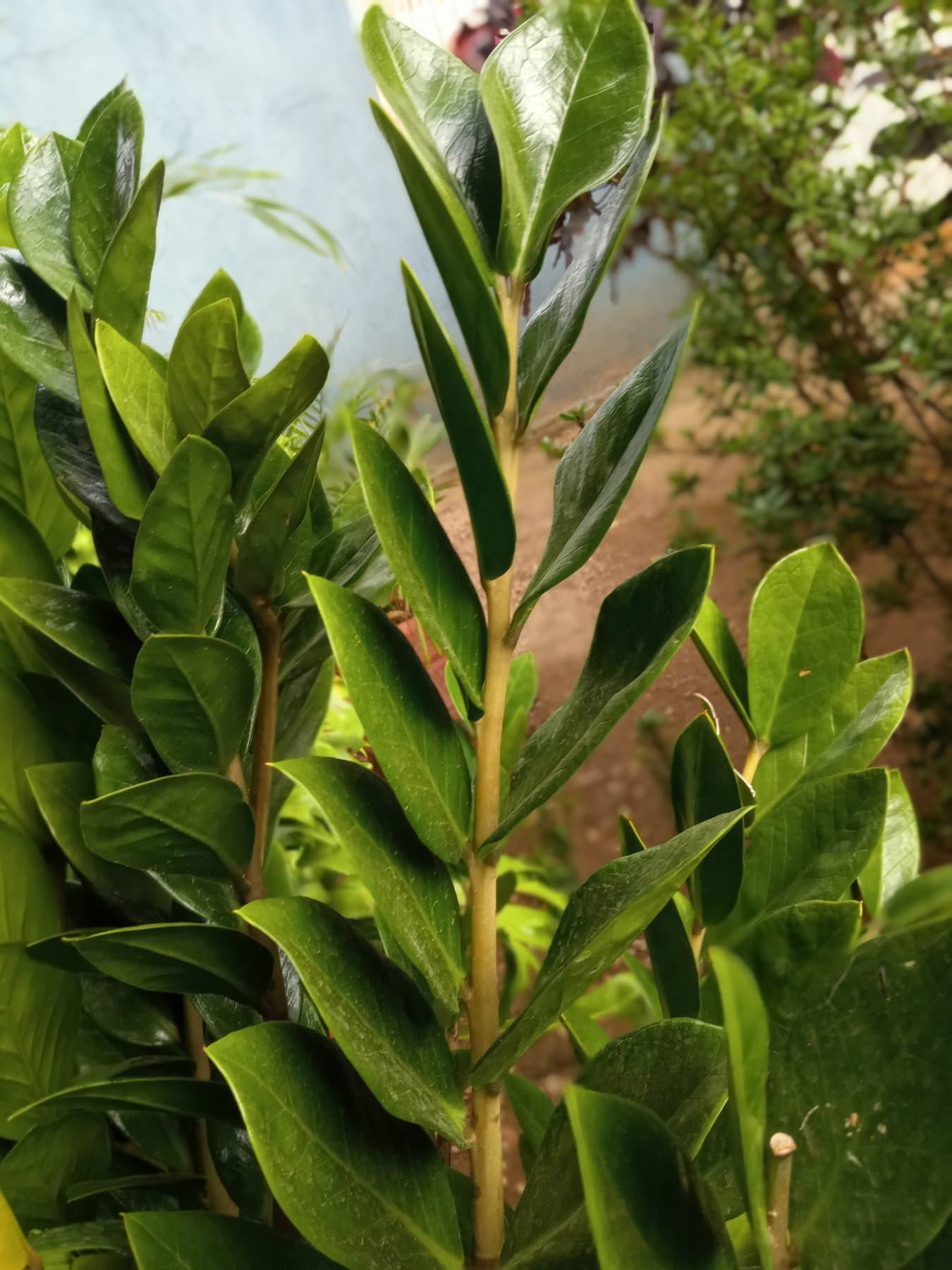
ZZ plant is Zamioculcas zamiifolia. Labels may say Zanzibar gem, eternity plant, aroid palm, or fern arum. Same plant. Family Araceae. Native to eastern and southern tropical Africa (NCSU lists Kenya, KwaZulu-Natal, Malawi, Mozambique, Tanzania, and Zimbabwe; UF/IFAS EP480 lists eastern Africa, Kenya, South Africa, and Tanzania). Rhizomatous evergreen perennial. Thick underground rhizomes store water. Upright pinnately compound glossy leaves rise from those rhizomes. NCSU: slow growth to about 2 to 4 feet tall and wide; leaves to about 2 to 4 feet long with thick petioles; leaflets elliptic, about 1 to 2 inches long. RHS profile: leaves about 40 to 60 cm with six to eight pairs of leaflets. UF/IFAS EP480: stemless; petioles arise directly from the rhizome; leaflets arranged alternately along the petiole.
Distinct from cardboard cycad (Zamia furfuracea) and other Zamia lookalikes. UF/IFAS EP252: morphologically ZZ bears little resemblance to most other aroids and is often compared to cardboard palm for its pinnate look. Still an aroid: Clemson and UF Gardening Solutions place it with peace lily, Chinese evergreen, elephant ear, anthurium, and philodendron, not with true cycads. Distinct from other common indoor aroids that rely mainly on stem cuttings in water: NCSU, RHS, and UF/IFAS commercial pages name division and leaf (leaflet) cuttings for this species.
Can you propagate a ZZ plant? Yes. NCSU Recommended Propagation Strategy is Division and Leaf Cutting. RHS: single leaflets. UF/IFAS EP252: leaf cuttings or division; a rhizome forms at the leaflet base before roots and a new shoot. Iowa State marks leaf, stem, and division in its method table. Sources don’t describe water rooting for ZZ.
Indoor foliage focus. Division gives an established plant with rhizomes already present. Leaf cuttings build a new rhizome first and take longer. UF/IFAS commercial guides show that sequence but don’t give a home timeline for the first shoot. Generic clump steps: how to divide houseplants. ZZ rhizome specifics stay below. For mix after sticking leaflets or potting divisions, see soil propagation. Water technique for other plants lives on water propagation; do not treat a jar as a ZZ recipe. Beginner chooser (ZZ as division-first): easiest indoor plants to propagate.
Best way indoors (division vs leaflet vs stem)
Choose by what you can spare, not by a blog “fastest ZZ” label.
| Situation | Method the sources support | Why |
|---|---|---|
| Crowded clump with rhizomes you can share | Rhizome division (NCSU; UF/IFAS EP252; Iowa State; UF Charlotte) | You get a plant that already has rhizome and shoot potential. Fill-out depends on rhizome size and number (EP252). |
| Single leaflets you can take without wrecking the mother | Single-leaflet cuttings in moist mix (RHS; NCSU leaf cutting; UF/IFAS EP252; UF Gardening Solutions) | EP252 sequence: leaflet, then rhizome at the base, then roots from that rhizome, then a new petiole with leaflets. Slower than division, and sources don’t give a home timeline. |
| Stem pieces | Named on Iowa State’s method table and UF Charlotte (“stem cuttings or rhizome divisions”) | NCSU, RHS, and EP252 don’t give a length, a node count, or a choice between water and soil. Sources name the method without full steps. |
| Jar of water | Not described | NCSU, RHS, EP252/EP480, Clemson ZZ, UF Gardening Solutions, and the Iowa State overview don’t describe water rooting. |
Sources don’t give a home timeline for leaflet roots or the first shoot. EP252’s 8 to 12 months figure is for commercial marketable size after sized rhizomes are potted, not a leaflet stopwatch.
Division (rhizome)
This is the reliable path to a full plant when the clump is large enough to share.
NCSU: Recommended Propagation Strategy includes Division. Propagate by division or leaf cutting (species description).
UF/IFAS EP252: for division, the tuber-like rhizomes can be separated and potted. Rhizome size and number per pot strongly affect how fast a plant fills out in production; more or larger rhizomes lead to more shoots. That page's 8 to 12 month marketable-size table is for commercial potting of sized rhizomes, not a home leaf-cutting timeline.
UF/IFAS Charlotte County Extension: rhizome divisions are named as a practical home method alongside stem cuttings.
Iowa State Propagating Houseplants: ZZ is listed among easy houseplants and marked for division (also leaf and stem). Early spring through summer is the best window for houseplant propagules on that overview page; most houseplants can be propagated any time of year if the parent is healthy.
Generic unpot / cut / pot sequence and aftercare: how to divide houseplants. Keep ZZ mix and wet-feet notes here.
Use a well-drained peat- or bark-based mix (UF/IFAS EP480). Clemson: coarse, well-draining mix such as about 50% peat moss or coir-based potting soil, 25% perlite, and 25% sand. Do not leave divisions sitting in water; Clemson, NCSU, and UF/IFAS all flag wet feet and root rot. Mix habits shared with other media starts: soil propagation.
Leaf cuttings (single leaflets)
Named across NCSU, RHS, UF/IFAS EP252, and UF Gardening Solutions.
RHS: propagate by leaf cuttings, using single leaflets. Other plants that grow from a leaf: leaf cuttings.
UF/IFAS EP252: single leaflets can be inserted into cells of plug trays filled with a potting medium. Keep the medium moist in a shaded greenhouse under about 1,000 to 1,500 foot-candles and about 75°F to 85°F. Figure sequence on that page: leaflet ready for rooting; rhizome formed at the base of the leaflet with roots from the rhizome; then a petiole bearing alternate pinnate leaflets growing up from the rhizome.
UF Gardening Solutions: ZZ can be easily propagated from leaf cuttings (passalong plant note). No petiole length, hormone rate, or days-to-shoot on that page.
NCSU: Recommended Propagation Strategy includes Leaf Cutting. No cutting length or days-to-root on the species page.
Commercial potting mixes UF/IFAS EP252 names for propagation and production include examples such as 60% sphagnum peat, 20% perlite, and 20% vermiculite, or 55% sphagnum peat, 25% pine bark, and 20% perlite, with pH about 6.0 to 7.0. Keep medium moist but not wet during production; interiorscape care later prefers slightly dry media.
The sources do not give a home blog-style weeks to roots / months to shoot number for leaflet cuttings. Expect a rhizome to form before a new upright leaf appears (UF/IFAS EP252 sequence).
Stem cuttings
Iowa State's foliage method table marks stem cuttings for Zamioculcas zamiifolia alongside leaf cuttings and division. UF/IFAS Charlotte County Extension names stem cuttings with rhizome divisions.
NCSU species page, RHS profile, and UF/IFAS EP252 do not give a stem-cutting length, node count, or water-vs-soil recipe for ZZ. Treat stem cuttings as named at the Iowa State / Charlotte County level, not as a fully specified species protocol on NCSU or RHS. Where the node sits on a stem, with a diagram: what is a node on a plant.
Water
NCSU, RHS, UF/IFAS EP252, UF/IFAS EP480, UF Gardening Solutions, Clemson HGIC, and the Iowa State overview don’t describe rooting ZZ leaflets or stems in water. See water propagation for general jar technique on other plants. Prefer soil leaflet sticking and rhizome division above for ZZ. The water change calculator is for jars that belong on that method path, not a substitute ZZ recipe.
Troubleshooting (won't root, rot, no shoot yet)
Leaflet sits for weeks with no upright shoot. UF/IFAS EP252 shows rhizome formation at the leaflet base before roots and a new petiole. Expecting a shoot as fast as pothos is a common mistake, and sources don’t give a home timeline. Check for a firm leaflet and a swelling at the base before discarding.
Soggy mix / rot. Clemson: do not overwater; do not allow the plant to sit in water. NCSU: wet feet are not tolerated. UF/IFAS EP480 and EP252: root rot with poorly drained soil and excessive water; keep production media moist but not wet. Restart with a drained mix (Clemson / EP480 / EP252 recipes above) if the tissue is soft and brown.
Deep shade only. Adult ZZ can hold at low interiorscape light (EP252 cites about 25 foot-candles for more than a year), but EP252’s leaflet recipe uses about 1,000 to 1,500 foot-candles in a shaded greenhouse. Bright indirect light for cuttings. If the window is weak and the mix stays appropriately moist while nothing happens, check daily light with the propagation light DLI calculator. Fixture distance and hours: best grow lights for indoor propagation.
Jar of water as the plan. Sources don’t describe water rooting. Move to moist mix or division instead.
Tiny division with almost no rhizome. EP252: rhizome size and number strongly affect fill-out. Prefer pieces with meaningful rhizome mass (Iowa State: larger pieces recover faster on the general division page).
Fertilizer on unrooted leaflets. Home-care sources fertilize established ZZ lightly once or twice a year (NCSU, Clemson, UF/IFAS EP480). None instruct fertilizing unrooted leaflets. Wait until a rhizome and shoot are growing.
Common mistakes
- Overwatering leaflets, divisions, or parent plants. Clemson: do not overwater; do not allow the plant to sit in water; overwatering can lead to root rot. NCSU: wet feet are not tolerated; allow mix to dry between waterings. UF/IFAS EP480 and EP252: root rot with poorly drained soil and excessive water; keep production media moist but not wet; interiorscape media slightly dry.
- Treating leaf cuttings like fast stem cuttings of pothos. UF/IFAS EP252 shows rhizome formation at the leaflet base before a new shoot; impatience is a real failure mode even though the sources do not publish a home week count.
- Sticking leaflets in very low light and expecting commercial-speed results. Adult ZZ tolerates low interiorscape light (UF/IFAS EP252 cites growth at about 25 foot-candles for more than a year), but EP252's leaf-cutting recipe uses about 1,000 to 1,500 foot-candles in a shaded greenhouse. Bright indirect light for cuttings; grow lights help when windows cannot supply that. If you have a PPFD reading, check daily light.
- Direct sun on cuttings or plants. NCSU and Clemson: scalding, browning, or avoid full sunlight.
- Fertilizing cuttings as if they were hungry landscape shrubs. The sources fertilize established ZZ lightly (NCSU and Clemson: balanced fertilizer once or twice a year; UF/IFAS EP480: low-dose liquid twice per year). None of the home-care sources instruct fertilizing unrooted leaflets.
- Following blog timelines for water roots or leaf cuttings. Extension and RHS sources don’t give them.
- Confusing ZZ with Zamia cycads. UF Gardening Solutions and UF/IFAS EP252: aroid related to philodendron-group plants, not a true cardboard palm.
People also ask
Can you propagate a ZZ plant?
Yes. Division when the clump can share (NCSU; UF/IFAS EP252; Iowa State), or single leaflets in moist mix that form a rhizome first (RHS; EP252). Stem cuttings are named at Iowa State / UF Charlotte table level without a full NCSU or RHS recipe. Sources don’t describe water rooting.
What is the best way to propagate ZZ indoors?
Division for the fastest finished plant when you have rhizome to share. Single leaflets when you only have leaves to spare (EP252 rhizome-first sequence). See the table under Best way indoors. Generic division steps: how to divide houseplants.
How long does ZZ propagation take?
Division yields plants that already have rhizomes and shoots; fill-out speed depends on rhizome size and number (UF/IFAS EP252). Leaf cuttings follow the EP252 sequence: leaflet, then rhizome at the base, then roots, then a new petiole with leaflets. Sources don’t give a home timeline for leaflet roots or the first shoot. EP252's 8 to 12 months figure is for producing marketable plants after sized rhizomes are potted in commercial production, not a leaflet-cutting stopwatch.
Can ZZ root in water?
NCSU, RHS, UF/IFAS EP252/EP480, the Clemson ZZ guide, UF Gardening Solutions, and the Iowa State overview don’t describe water rooting for this plant. Soil leaflet sticking and rhizome division are the methods those pages name.
Is the ZZ plant toxic?
Yes. NCSU: medium severity poison characteristics; toxic principle calcium oxalate; symptoms diarrhea and vomiting if leaves are consumed in quantity; medium toxicity to cats and dogs; poison part leaves. RHS: harmful if eaten; skin/eye irritant; wear gloves and protective equipment when handling; pets harmful if eaten / skin/eye irritant. UF Gardening Solutions: all parts of the plant are toxic if ingested. UF/IFAS Charlotte County: due to calcium oxalate crystals, all parts are considered toxic. Clemson: not pet safe.
Why won't my leaflet root?
Check moisture, light, and whether a rhizome has formed at the base yet (EP252 sequence). See Troubleshooting. Overwet media risk rot (Clemson, NCSU, UF/IFAS). Deep interior shade may sit far below EP252’s cutting light band even though adult ZZ survives low light. Dim room: DLI calculator.
Should I fertilize cuttings?
Home-care sources fertilize established ZZ lightly once or twice a year (NCSU, Clemson, UF/IFAS EP480). None of those pages instruct fertilizing unrooted leaf cuttings. Skip fertilizer until a rooted plant with a formed rhizome is growing on; then follow established-plant rates, not production greenhouse rates from EP252.