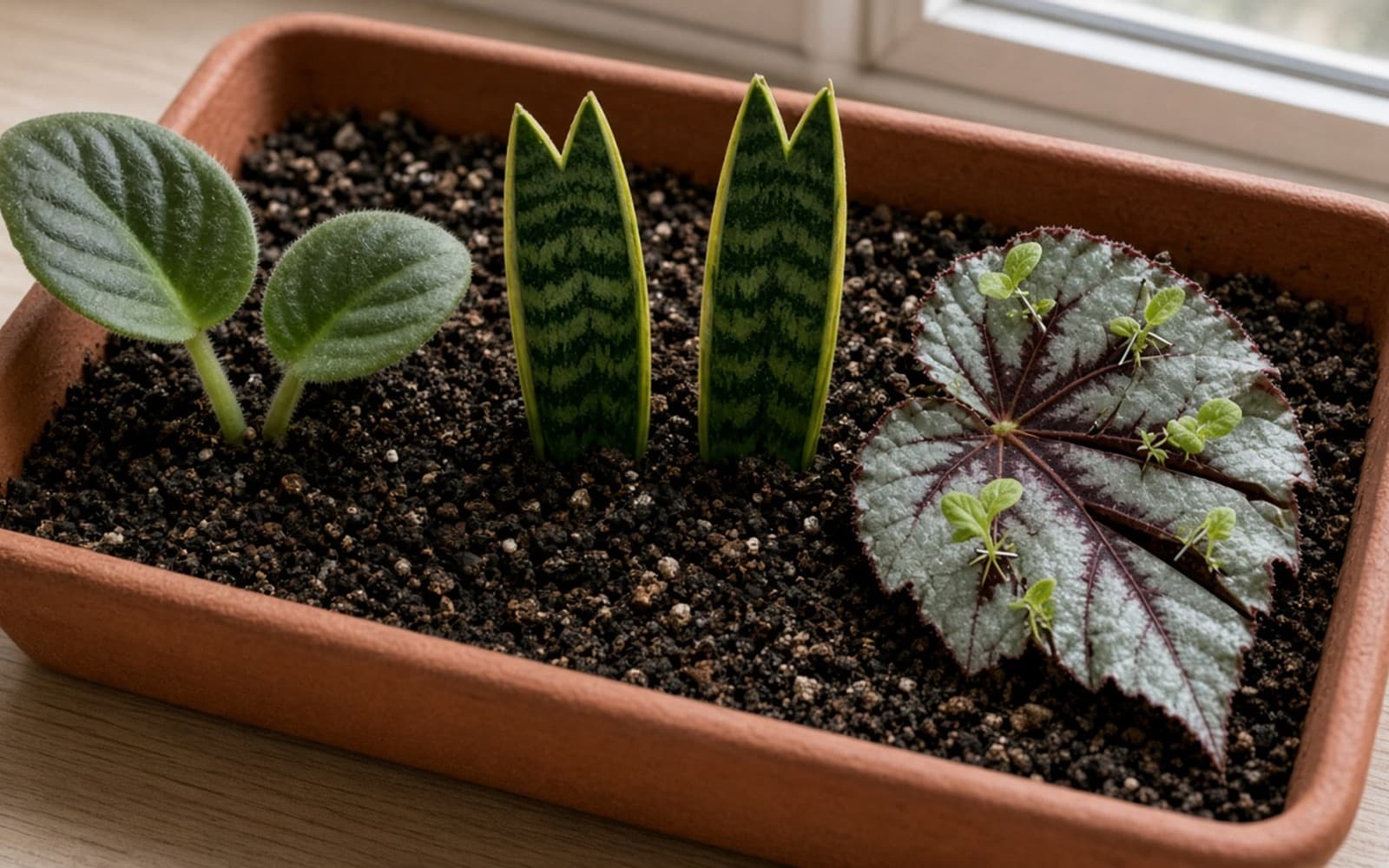
A leaf cutting grows a whole new plant from one leaf, or from a piece of one. University of Florida IFAS (PropG): the leaf has to regenerate both new shoots and new roots, and only a limited number of specialized species can do it. NCSU Extension Gardener Handbook: a leaf cutting includes no axillary bud, so it works only on plants capable of forming adventitious buds. On most other plants, a leaf makes a few roots or simply decays.
Succulent leaves such as echeveria, sedum, and graptopetalum follow their own routine on how to propagate succulents from leaves. Stem pieces with a node root on soil propagation and water propagation.
Which houseplants grow from a leaf
| Plant | Leaf method | Sources | Guide |
|---|---|---|---|
| African violet | Whole leaf with petiole | Iowa State, NCSU, UNL, RHS, Illinois | African violet |
| Peperomia | Whole leaf with petiole | Iowa State, NCSU, UNL, RHS | Peperomia |
| Snake plant | Leaf sections | Iowa State, NCSU, UNL, RHS, Illinois | Snake plant |
| Rex begonia | Split vein or wedges | NCSU, UNL, RHS, Illinois | Begonia |
| Streptocarpus (cape primrose) | Midrib cut or petiole | RHS and Iowa State | |
| Gloxinia (Sinningia) | Whole leaf with petiole, or cut veins | Iowa State and RHS | |
| Flame violet (Episcia) | Whole leaf with petiole | NCSU and Illinois | |
| Jade (Crassula) | Whole leaf | Iowa State, Illinois, RHS | Jade plant |
| ZZ plant | Leaf with petiole | Iowa State | ZZ plant |
| Sedum, echeveria, kalanchoe, graptopetalum | Whole succulent leaf | Iowa State and RHS | Succulents |
| Piggyback plant, orchid cactus (Epiphyllum) | Leaf cutting | Illinois | |
| Kalanchoe daigremontiana, K. pinnata | Plantlets that form on the leaves | UNL |
Plants that will not grow from a leaf alone
Illinois Extension: some plants produce roots from a leaf cutting but fail to produce new stems and leaves. NCSU: most plants produce only a few roots or simply decay. These common houseplants need a stem piece with a node:
- Hoya. Iowa State: leaf cuttings often root but will not form a vine unless a node is attached. Sweetheart hoya (Hoya kerrii) is often sold as a single rooted leaf with the node absent, and it never vines.
- Monstera. UMN: leaves and petioles will not grow on their own, because new growth comes from axillary buds and nodes on the stem.
- Pothos, philodendron, rubber plant, dracaena. NCSU propagates these by single-node cuttings, where the leaf comes with a short piece of stem and its axillary bud.
That single-node cutting, also called a leaf-bud cutting, looks like a leaf cutting but carries the node, which is why it works on pothos and philodendron. The node itself, with a labeled diagram: what is a node on a plant.
The four leaf cutting types
Whole leaf with petiole
Iowa State lists jade, peperomia, African violet, gloxinia, Streptocarpus, and ZZ plant as best propagated this way. NCSU adds Episcia, hoya, and sedum to its petiole list, though Iowa State’s hoya warning above still applies.
Iowa State: select a firm, healthy leaf and cut it off with a sharp knife, leaving 1 to 1½ inches of petiole, or as much as there is if it is shorter. Make a hole with a pencil or chopstick and insert the petiole at a 45 degree angle. If the petiole is too short to hold the leaf upright, a small part of the blade can be buried too. Roots usually form in three to four weeks, and small plantlets appear at the base of the petiole in six to eight weeks. RHS: cut the leaves with the stalk intact and set each one so the base of the leaf just touches the surface.
NCSU: once the new plants have their own roots, the leaf can be severed from them and used again. NCSU also describes a petiole-free option for African violet: remove the petiole and insert the leaf vertically with the midvein buried, and new plants form from the midvein.
Leaf sections (snake plant)
Iowa State: cut the leaf into 3 to 4 inch tall sections. The end closest to the base of the parent plant is the bottom. Cut a notch in the top so the direction stays clear, dip the bottom end in rooting hormone, and insert it 1 to 2 inches deep. New shoots or plantlets should appear at the base in two months. RHS: cut leaves horizontally into 5 cm (2 in) pieces, keep each piece facing the direction it grew, and insert them vertically about 2 cm (¾ in) deep.
Iowa State (succulents) treats snake plant sections a little differently: 3 to 5 inches long, callused for a day before going into a well-drained mix. New roots and leaves develop only on the down side, so a straight cut at the bottom and an angled cut at the top keep track of which end is which. UNL: for leaf sections of rex begonia and snake plant, the edge closest to the base of the parent plant goes into the medium.
Split vein and wedges (rex begonia)
NCSU: detach the leaf, remove the petiole, and cut several prominent veins on the underside. Lay it lower side down on the medium, and new plants form at each cut. If the leaf curls up, cover its margins with rooting medium. A variation cuts the leaf into wedges, each with a main vein. RHS (begonia and gloxinia): cut across the main veins on the underside and pin the leaf cut side down, or cut it into 2.5 cm (1 in) squares, each with a main vein, pinned to the surface. UF IFAS: leaf cuttings usually regenerate from wounds at the main veins or from the base of the leaf.
Midrib cut (Streptocarpus)
RHS: take a full-grown leaf and cut it in half along the midrib, then discard the midrib. Make a shallow trench in a seed tray, insert the leaf halves cut side down, and firm them in.
How to root a leaf cutting
- Time it. RHS: leaf cuttings do best early in the growing season, from spring to early summer, though some can be taken any time of year.
- Hydrate the parent. Iowa State: water parent plants the day before so leaves are fully hydrated, and stick the cuttings as quickly as possible.
- Pick a healthy leaf. RHS: select young, fully grown foliage and avoid damaged, diseased, or pest-affected leaves. For succulents, Iowa State takes the entire leaf along with the cells that attached it to the stem, since partial pieces will not root.
- Cut to type: petiole, section, split vein, or midrib, as above.
- Callus fleshy leaves first. RHS: leave kalanchoe, echeveria, and crassula leaves a day or two to callus. UNL: succulent cuttings dry for one to seven days, depending on species and size. The Iowa State and NCSU steps for African violet, peperomia, and begonia go straight into the medium.
- Use a free-draining mix. RHS: seed and cutting compost, or equal parts multipurpose compost and sharp sand or perlite. For succulents, RHS fills pots three-quarters full with 2 parts cactus compost to 1 part fine grit, topped with grit. Iowa State: use clean containers with drainage, at least 2 inches deep, and moisten the media before use.
- Decide on rooting hormone. Iowa State treats the petiole end with hormone if desired, and its snake plant section steps include a dip on the bottom end. Most succulents root quickly without it (Iowa State). Forms and handling: rooting hormone.
- Raise humidity for tropicals, not succulents. RHS: tropical leaf cuttings need high humidity at about 20°C (68°F), in a propagator or clear plastic bag. Iowa State: keep the bag off the leaves and do not seal it tightly. RHS: do not cover succulent leaves.
- Keep the mix warm and the light bright. Illinois: keep rooting media at 75 to 80°F, evenly moist but not soggy, in bright, indirect light, and do not let the leaves touch each other. RHS: a well-lit spot protected from direct sun. The propagation light DLI calculator can check whether a window or lamp gives enough light.
- Pot the plantlets. Iowa State: once roots have formed, pot the new plant in regular potting soil, separating plantlets if needed. The original leaf can be removed once it browns or the new plant is established, though removing it is not necessary.
Some houseplant leaves also root in a jar. Iowa State: roots formed in water are coarser and less adapted to potting soil, so the cuttings may wilt or drop leaves after potting. The water should change once or twice a week without letting the level drop below the roots, and cuttings move to soil when roots are about 1 inch long. The water change calculator keeps that refresh schedule for jar cuttings. Iowa State: most succulents do not root well in a glass of water.
How long leaf cuttings take
| Cutting | Roots | New plantlets | Source |
|---|---|---|---|
| Leaf with petiole (African violet, peperomia, jade, and others) | 3 to 4 weeks | 6 to 8 weeks | Iowa State |
| Snake plant leaf section | Not stated separately | About 2 months | Iowa State |
| Succulent leaf (graptopetalum, sedum, crassula, kalanchoe) | Several weeks | Several weeks | Iowa State |
RHS: plantlet development slows at low temperatures, so cuttings stay at about 20°C (68°F).
Variegated leaves come back without the pattern
Some variegated plants carry their pattern as a chimera, where the tissue layers differ. Iowa State calls this an uncommon way for variegation to form, and it is the case in edge-striped snake plants. UF IFAS: new shoots from leaf cuttings come from a single layer (the LII), so leaf cuttings of variegated chimeral peperomia and snake plant produce all-green shoots, and a chimeral African violet gives plantlets that no longer carry the parent’s pattern. Iowa State: snake plants with variegated leaf edges, such as ‘Laurentii’, lose that coloration from leaf sections, so division keeps the pattern. UNL agrees: use division for variegated snake plant, because leaf cuttings produce the non-variegated type. Division steps: how to divide houseplants.
Common problems
- Rot. RHS: cuttings rot off when the compost is too wet. Water carefully, and use grit for succulents.
- Gray mold. RHS: air covered cuttings about twice a week and remove decaying leaves promptly.
- Slow or weak growth. RHS: low temperature slows plantlets, and low light causes poor growth.
- A section that never sprouts. Iowa State: snake plant sections root only from the end that grew nearer the base, so a piece stuck upside down stays bare.
- Pests. RHS: watch for aphids, whitefly, and mealybugs.
Succulent leaves
Succulent leaves come with genus-level choices: which genera work, callus time, dropped leaves, and gritty mixes. Those details are on how to propagate succulents. Three succulents have their own leaf cutting sections: jade plant, haworthia, and burro’s tail.
People also ask
What plants can I propagate from a leaf?
Only plants that can form new adventitious buds from leaf tissue (NCSU). Common houseplants: African violet, peperomia, snake plant, rex begonia, Streptocarpus, gloxinia, Episcia, jade, ZZ plant, and many succulents (Iowa State, NCSU, UNL, RHS, Illinois). Pothos, monstera, and hoya need a node (UMN, Iowa State).
How do I root leaf cuttings?
Leave 1 to 1½ inches of petiole and insert it at a 45 degree angle into moist rooting medium (Iowa State). Keep tropical cuttings humid at about 20°C (68°F) (RHS) with the medium at 75 to 80°F (Illinois). Roots in 3 to 4 weeks and plantlets in 6 to 8 weeks are typical for petiole cuttings (Iowa State).
Should I root leaf cuttings in water or soil?
The extension and RHS leaf methods use a rooting medium. Iowa State allows water for many houseplants but notes that water roots are coarser and adapt less well to potting soil, and that most succulents do not root well in a glass of water.
Can leaf cuttings go straight into soil?
Yes, into a light, moist rooting mix. Iowa State and NCSU insert thin leaves directly, with no drying step. Fleshy succulent leaves callus a day or two first (RHS).
Why did my leaf cutting root but not grow?
Some plants produce roots from a leaf but never make new stems and leaves (Illinois). Hoya is a common example: a leaf without a node may root and stay a single leaf (Iowa State). A stem cutting with a node grows into a full plant.
Do leaf cuttings need rooting hormone?
Not always. Iowa State treats leaf petioles with hormone only if desired, includes a hormone dip in its snake plant section steps, and notes that most succulents root without it.
Will a variegated leaf cutting stay variegated?
Usually not when the pattern is a chimera. Leaf cuttings of chimeral variegated peperomia and snake plant give all-green shoots, and chimeral African violet plantlets lose the pattern (UF IFAS). Variegated snake plants are divided instead (Iowa State, UNL).
When is the best time to take leaf cuttings?
RHS: spring to early summer gives the best results, though some leaf cuttings can be taken any time of year.