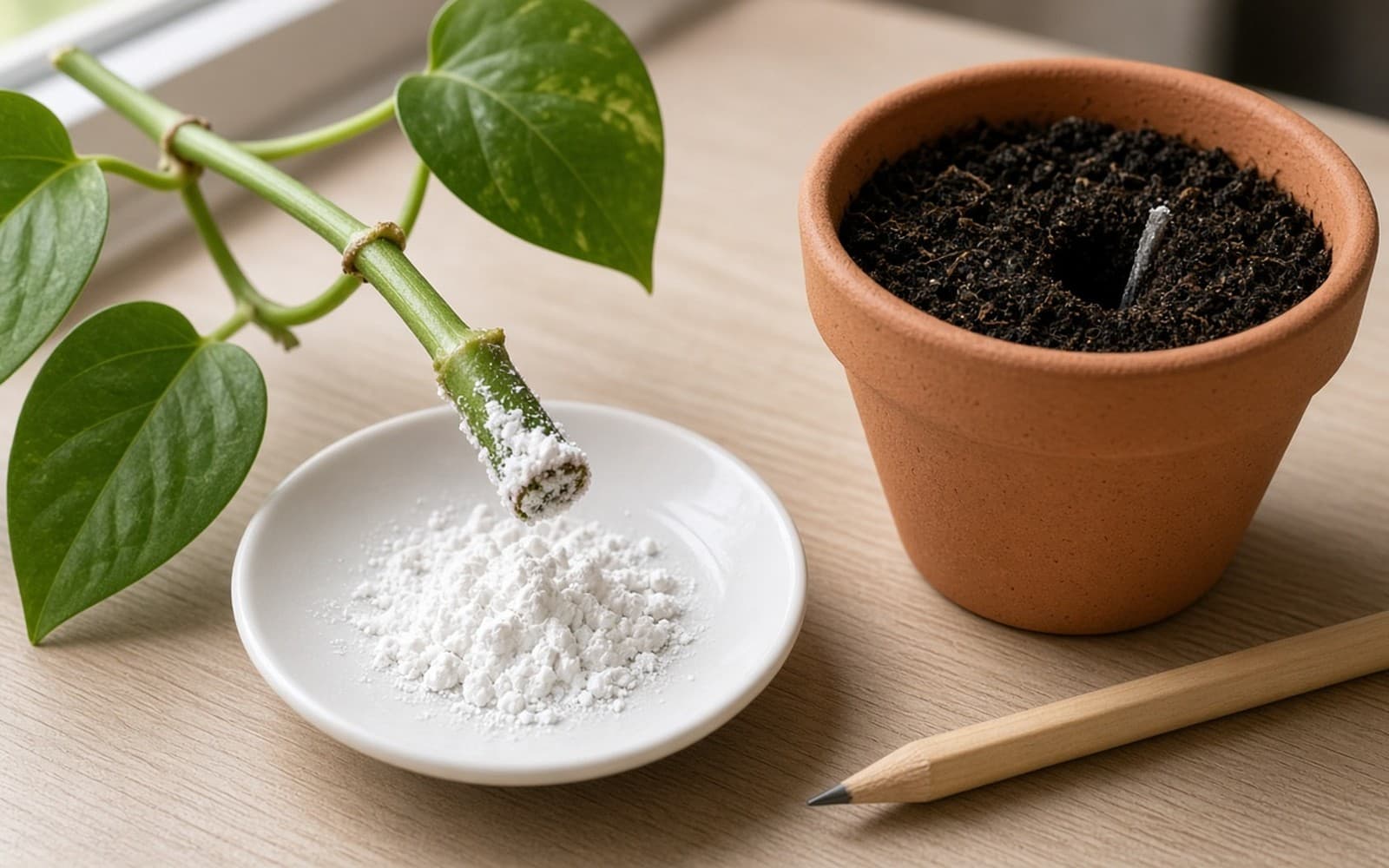
Rooting hormone is a plant growth regulator that goes on the cut end of a cutting so roots form sooner and more evenly. NCSU Extension lists the garden-center forms as IAA, IBA, and NAA, all auxins. Iowa State Extension names IBA and NAA as the two synthetic auxins used most often. Easy houseplants root without it, and it helps most on stubborn, woodier stems. Of the kitchen substitutes, willow and aloe extracts rooted the most cuttings in published trials, and cinnamon rooted the fewest.
The full rooting methods live on soil propagation, water propagation, and air layering. The hormone belongs on the joint where roots start, so it helps to know what a node on a plant looks like before the first cut.
What rooting hormone is
Auxin is a hormone plants already make. NCSU Extension Gardener Handbook (botany chapter): auxins are produced in the stem tips, and they can induce adventitious root formation on cuttings. UMN Extension: although auxin occurs naturally in plants, applying more to a cutting can encourage cell division and help the plant develop longer root cells.
The US EPA regulates IBA as a pesticide in the plant growth regulator group. EPA (IBA fact sheet, 2000): IBA is closely related in structure and function to a natural plant growth regulator, and growers find it more effective because plants cannot break it down as quickly. It works as a dip for cuttings, often at concentrations several orders of magnitude below 1 percent. It was first registered in 1960 for ornamental plant cuttings and transplants.
| Term | What it means on a label | Source |
|---|---|---|
| IBA (indole-3-butyric acid) | Synthetic auxin, the most common active ingredient | Iowa State and EPA |
| NAA (naphthaleneacetic acid) | The other common synthetic auxin | Iowa State and NCSU |
| IAA (indoleacetic acid) | A third auxin sold as rooting hormone | NCSU botany chapter |
| Powder | Hormone diluted with talc, ready to use | Illinois |
| Liquid | Cut ends dip for a few seconds, strength per the label | Iowa State and NCSU |
| Gel | A third format sold at garden centers | UMN |
Do you need rooting hormone?
Often no. Illinois Extension: many houseplants root so easily on their own that rooting hormones are not important, and hormone helps with more difficult species. UNL Extension (G1853): a rooting hormone is useful for encouraging roots on difficult-to-root cuttings. Iowa State (succulents): hormone can sometimes speed roots, but most succulents root quickly and easily without it.
When a cutting does respond, the gain shows up in several ways at once. NCSU Extension Gardener Handbook (propagation chapter): root-promoting compounds, used particularly on difficult-to-root woody stem cuttings, increase the percentage of cuttings that root, speed rooting, make rooting more uniform, and improve root number and quality. Illinois agrees on the first three: hormone raises the rooting percentage of many plants, tends to shorten rooting time, and often improves root quality and quantity.
| Cutting | Hormone? | What the sources say |
|---|---|---|
| Soft vines with nodes (pothos, heartleaf philodendron, tradescantia) | Skip | Illinois: many houseplants root so easily that hormone is not important |
| Monstera stem with a node | Optional | UMN: monstera may root without it, and auxin can give faster, denser roots |
| Semi-woody or woody stems | Worth trying | NCSU: most useful on difficult-to-root woody cuttings. UNL and Illinois: useful for difficult species |
| Air layers on thick stems | Optional | NCSU: not always necessary. UNL: usually hastens rooting, and some plants root just as well untreated |
| Succulent stems and leaves | Usually skip | Iowa State: most succulents root quickly without it |
| Leaf sections (snake plant) | Common | Iowa State leaf section steps include a hormone dip on the bottom end |
| Leaf petioles (African violet, peperomia) | Optional | Iowa State leaf petiole steps: treat the petiole end if desired |
Snowbush (Breynia disticha) shows how much a stubborn shrub can depend on it. In a 2023 trial (El-Banna and colleagues, Horticulturae), cuttings dipped only in distilled water rooted 0 percent of the time and withered, while cuttings dipped in IBA at 2000 ppm rooted 81 to 88 percent.
Powder, liquid, or gel
All three carry auxin. Strength comes from the label, so the choice mostly comes down to how the product goes on.
- Powder. Illinois: the powder is diluted with talc and ready to use. NCSU: moisten the base of the cutting so the powder sticks, then tap off the excess.
- Liquid. Iowa State: submerge the cut ends for a few seconds, as the label directs. NCSU: dip the lower half inch to 2 inches for 1 to 2 seconds, let the cutting air dry 15 to 20 minutes, then stick it without a dibble.
- Gel. UMN lists gel alongside powder and liquid as a format sold at garden centers.
How to use rooting hormone on a cutting
- Take the cutting first. Iowa State: 3 to 6 inches long with at least two nodes, lower leaves removed. Missouri Botanical Garden: cut just below the node, because roots grow most easily from there.
- Pour a small amount into a separate container. Iowa State: never dip a cutting into the original container and never return leftovers to it, since disease spreads that way. NCSU: discard whatever is left in the dish.
- For powder, moisten the cut end first (NCSU), then dip or dust only the base. UMN (monstera): rub the hormone along the node that will go into the mix.
- Tap off the excess. Iowa State: do not over-apply, since too much hormone can sometimes slow root development.
- Open a hole with a pencil or dibble so the powder stays on the stem as it goes in (NCSU).
- Stick at least one node below the surface with no leaves buried (Iowa State). Firm the mix around the stem.
- Hold conditions steady. Iowa State: 4 to 6 hours of bright, indirect light, air at 65 to 75°F, and a heat mat to bring the rooting media to 75 to 80°F. Most houseplant stem cuttings root in 3 to 6 weeks and are ready to pot once roots reach about 1 inch.
A window or lamp can be checked against that light target with the propagation light DLI calculator. Cuttings rooting in a jar can follow a refresh schedule from the water change calculator.
Mistakes that cost roots
- Dipping into the original container. Iowa State: disease spreads through the stock this way. A small dish for each session keeps the rest clean.
- Using too much. Iowa State: excess hormone can slow rooting. A thin, even coat is enough.
- Keeping product too long. Iowa State: rooting hormone loses strength over time, so replace it after about two years.
- Wounding without hormone. NCSU: wounding the base gives no benefit unless a root-promoting compound follows, and most species do not need wounding at all.
- Sticking a stem segment upside down. Iowa State: stem segments will not root upside down. For snake plant leaf sections, Iowa State cuts a notch in the top of each piece so the bottom end is the one that gets dipped and buried.
Homemade and natural rooting hormone: what the research says
Willow, aloe, honey, and cinnamon all have measured rooting data from at least one trial. Aspirin and coconut water appear in one.
| Option | Trial evidence | Verdict |
|---|---|---|
| Willow | Snowbush: willow leaf extract rooted 69 to 75 percent, against 0 percent for a distilled water dip (El-Banna 2023). Fringetree and mung bean: willow stem diffusate plus IBA gave the most roots (Arena 1997) | Best documented natural option, strongest when paired with IBA |
| Aloe vera | Snowbush: 75 to 81 percent rooting with the longest roots (El-Banna 2023). Syzygium: aloe pieces rooted 33 percent, IBA 67 percent (Somarathna 2026) | Promising, still behind IBA |
| Honey | Snowbush: 44 percent rooting (El-Banna 2023). Diluted honey without auxin did not improve rooting in most measures (Bowden 2025) | Weak alone |
| Cinnamon | Snowbush: lowest rooting of any treatment, 19 to 25 percent (El-Banna 2023). Syzygium: callus only (Somarathna 2026) | Not a rooting aid |
| Aspirin, coconut water | Syzygium: callus only (Somarathna 2026) | Skip |
| Apple cider vinegar, hydrogen peroxide | No extension or peer-reviewed rooting trial found | Untested for rooting |
Every trial in that table used woody shrubs, trees, or mung bean seedlings. None tested pothos, philodendron, or other soft houseplant vines, the cuttings Illinois describes as rooting easily with no hormone at all.
Willow water
Willow turns up in two separate trials. Arena, Schwarz, and Witte (1997, HortScience) made a willow diffusate by steeping 680 g of chopped fresh contorted willow stem tips in 4 L of water for 24 hours. Chinese fringetree (Chionanthus retusus) cuttings soaked in it for 24 hours and then treated with 3.0 percent IBA powder produced the most roots after 75 days, more than cuttings given IBA alone or a water soak before IBA. That study had no willow-only group for fringetree. In mung bean tests, willow diffusate plus IBA produced more roots than IBA or willow alone. The willow activity survived 20 minutes at 100°C (212°F).
El-Banna and colleagues (2023) used a willow leaf extract rather than a stem soak. At full strength it rooted 69 to 75 percent of snowbush cuttings across two seasons, against 0 percent for the distilled water dip and 81 to 88 percent for IBA.
The one published preparation is the Arena lab method: 680 g of chopped willow stem tips in 4 L of water for 24 hours, with the cutting bases soaked in the liquid. Neither study tested a home dilution.
Aloe vera
El-Banna (2023): full-strength aloe extract rooted 75 to 81 percent of snowbush cuttings and produced the longest roots of any treatment. IBA and NAA gave more roots, but those roots were short, thick, and brittle. Somarathna, Devasinghe, and Wijayawardhana (2026) tested Syzygium campanulatum softwood cuttings: aloe vera pieces were the best natural treatment at 33 percent rooting and 83 percent survival, still well behind IBA at 67 percent rooting and 92 percent survival.
Honey
Honey appears on nearly every homemade list, and the rooting data behind it is thin. Bowden and colleagues (2025, Agriculture, USDA-ARS with university partners) mixed honey 2 parts water to 1 part honey. Honey alone did not improve rooting in most measures without auxin. On rose, honey type made no difference to rooting percentage, root number, or root quality. On ‘Little Gem’ magnolia, a multiflora honey added to IBA gave more roots than Manuka honey or no honey, though magnolia rooted only 7 to 20 percent overall. The paper’s review of earlier work credits hydrogen peroxide as the main antimicrobial agent in honey, and methylglyoxal in Manuka. El-Banna (2023): honey rooted 44 percent of snowbush cuttings in both seasons, well below aloe, willow, and the synthetic auxins.
Cinnamon
Cinnamon is widely sold as a rooting aid. In El-Banna (2023), it rooted the fewest snowbush cuttings of any treatment, 25 and 19 percent across the two seasons. In Somarathna (2026), cinnamon cuttings formed only callus. Cinnamon is also claimed as a fungicide against damping off. University of Saskatchewan Gardening: no scientific study shows cinnamon works for that, so no amount is recommended, though it would likely do no harm.
Rooting hormone by method
- Soil propagation. The standard use: dip, open a hole, stick a node below the surface, and firm the mix.
- Water propagation. UMN (monstera): auxin may also be added directly to the water. Missouri Botanical Garden: many woody plants such as hibiscus and citrus do not root well in water and usually rot first.
- Air layering. UNL: dust a small amount into the stem incision, if available, before wrapping it in moist sphagnum. NCSU: hormone is not always necessary. UNL: it usually hastens rooting when applied correctly, and some plants root just as well untreated.
- Leaf cuttings. Iowa State: snake plant leaf sections get a hormone dip on the bottom end, and leaf petioles get one only if desired.
- Succulents. Iowa State: most root quickly without it, and most do not root well in a glass of water.
Woody and semi-woody houseplants where hormone is worth weighing: rubber plant, fiddle leaf fig, croton, umbrella plant, dracaena, and geranium.
Storage and safety
Iowa State: keep rooting hormone in its original container somewhere cool and dark, and replace it after about two years. EPA (2000): the only health concern identified for IBA was eye irritation for certain workers, and no environmental risks were expected. Concentration and handling come from each product’s label, since Iowa State and Illinois both defer to it.
People also ask
What can be used instead of rooting hormone?
Willow extract and aloe vera have the strongest trial results among natural options (El-Banna 2023, Arena 1997, Somarathna 2026). Neither matched IBA for rooting percentage in those trials. Many easy houseplants need no hormone at all (Illinois), only a cut just below a node, where roots grow most easily (Missouri Botanical Garden).
Can I use cinnamon instead of rooting hormone?
Not as a rooting aid. Cinnamon rooted the fewest snowbush cuttings of any treatment (19 to 25 percent) in El-Banna (2023), and cuttings treated with it formed only callus in Somarathna (2026). University of Saskatchewan Gardening: no scientific study shows it prevents damping off either.
How do I make homemade rooting hormone?
Willow water is the one option with a published preparation. Arena and colleagues (1997) steeped 680 g of chopped fresh willow stem tips in 4 L of water for 24 hours, then soaked cutting bases in the liquid. Their best fringetree results came from willow followed by IBA powder.
Do you really need rooting hormone?
Not for easy rooters. Illinois: many houseplants root so easily that hormones are not important. UNL: hormone is useful for difficult-to-root cuttings. NCSU: when it works, more cuttings root, they root faster, and root quality improves.
Is apple cider vinegar a rooting hormone?
No extension or peer-reviewed rooting trial of apple cider vinegar on cuttings turned up, so there is no evidence that it helps roots form.
Can I use hydrogen peroxide as a rooting hormone?
No rooting trial for hydrogen peroxide turned up in extension or peer-reviewed sources. Its link to cuttings comes through honey: the review section in Bowden (2025) names hydrogen peroxide as the main antimicrobial agent in honey, which concerns microbes, not root formation.
What helps cuttings root faster?
A node in the mix, warm media, and good light. Iowa State: media at 75 to 80°F, air at 65 to 75°F, and 4 to 6 hours of bright, indirect light. Illinois and NCSU: rooting hormone shortens rooting time on cuttings that respond to it.
How long does rooting hormone last?
Iowa State: about two years in the original container, stored cool and dark. After that its strength drops and it should be replaced.