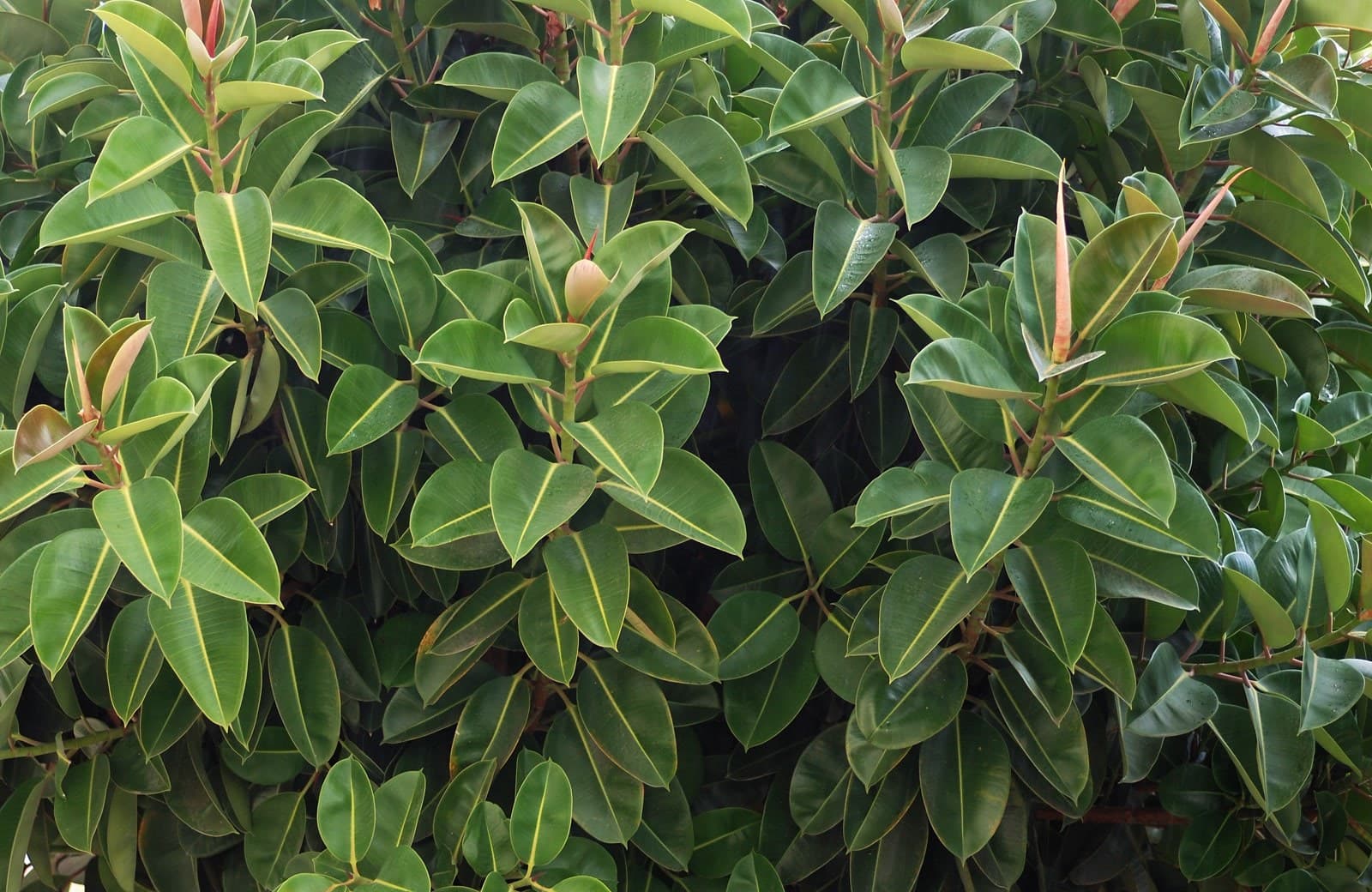
A rubber plant, Ficus elastica, is often started by air layering, so roots form on the stem while it is still attached to the parent. That is the method Iowa State describes in full. Clemson also names stem or tip cuttings. Illinois Extension: do not stick a fresh rubber-plant cut into media; let the cut surface air dry and callus first. UNL lists air layering and seeds. None of these pages describe a water-jar method for Ficus elastica.
Air layering
For the method in general, see air layering. The numbers below are from rubber-plant pages.
Iowa State materials: a sharp knife, sphagnum moss, a sheet of clear plastic, twist ties, and rooting hormone. Hormone is optional. Iowa says the stem will root without it; it takes longer.
Iowa State steps:
- Pick a point on a stem about 12 to 18 inches from a shoot tip. Remove leaves in that area.
- Cut all the way around the stem, down to the woody center. One inch below that, cut around again. Connect the two cuts and remove the ring of bark.
- Scrape the exposed surface so the soft cambial tissue is gone.
- Dust a small amount of rooting hormone on the wound if you use it.
- Pack 1 or 2 handfuls of moist sphagnum around the wound. Wrap it in clear plastic so no moss sticks out the ends. Tie above and below.
- Iowa State: roots should appear in several weeks. When a good root system has formed, cut the stem just below the bottom tie. Remove the wrap and pot in well-drained potting soil.
UNL G1853 uses a different wound from Iowa’s bark ring. UNL: a sharp knife, an upward or downward slanting cut 1 to 1 1/2 inches long, about one-quarter to one-half of the way through the stem. Put a matchstick or toothpick in the cut so it stays open. Hormone optional. Remove leaves or twigs about 3 to 4 inches above the cut. Wrap with two handfuls of moist, not soggy, sphagnum, then plastic film, and seal the edges. UNL: after several weeks, roots should show at the edge of the moss. Cut just below the moss ball and pot. The remaining cane can be saved; new buds will arise on it.
SDSU Extension, rubber tree as the example: this works best on a large stem, often 1/2 inch or larger. Leave 3 to 5 leaves at the tip, then bare about 6 inches of stem. White sticky sap drips when leaves come off; they recommend gloves. Two circular cuts 1 to 2 inches apart, then scrape the green cambium. Moist sphagnum or peat, plastic wrap, twist ties. SDSU: roots usually take about 6 to 10 weeks. If the moss dries, the layer often fails. Cut just below the wrap, then pot. You can cut the old plant back further; buds at the next leaves may grow out.
Rooting wait is a range across these pages. Iowa State and UNL say several weeks. SDSU says about 6 to 10 weeks.
Cuttings
Clemson names stem or tip cuttings and air layering. Clemson does not give cutting length, callus time, or a week count on that page.
Illinois Extension, stem cuttings in general: usually 3 to 6 inches, at least two nodes and not more than six, often the tip, spring or summer preferred. Pre-moisten the media. Named exception: rubber plant (Ficus) should not be stuck into media while the cut is still fresh. Let the cut surface air dry and heal over first. Callus helps prevent disease. Illinois does not say how many days that takes. Then insert 1 to 3 inches into pre-moistened media. Hormone is optional. Press the media, mist, and you may cover with a clear plastic bag. Bright light, not direct sun. Illinois does not give a rubber-specific week count.
Seeds
UNL’s table lists rubber plant as air layering and seeds. It does not give a Ficus seed recipe.
Sap
Clemson: the sticky white sap may irritate skin or the stomach if eaten. Keep the plant away from pets or young children that tend to eat plants. SDSU: wear gloves when you strip leaves, because the sap drips.
Light while propagating
A stem cutting and an air layer sit in different light, because only the cutting has left the parent.
Callused stem cuttings. Illinois Extension gives one light step for stem cuttings in general, not for rubber plant alone. After you stick the cutting, mist it, and cover it with a clear plastic bag, move it to bright light. Do not place it in direct sunlight.
Air layers. The layer stays on the parent stem, so it gets whatever light the parent gets. Iowa State, UNL, and SDSU give no separate light step for the moss ball.
The parent plant. Clemson describes the growing plant, not a rooting setup. Rubber plants prefer bright light but adapt to low light, and they grow best with morning light from an east window. Too little light, dry air, or cold drafts may cause leaf loss. NCSU Extension Gardener Plant Toolbox says to grow the plant indoors under bright indirect light or partial shade, with protection from the afternoon sun. Neither Clemson nor NCSU gives a separate light rule for a rooting start.
If a window looks dim, check daily light with the propagation light DLI calculator. When no window can give bright indirect light, see best grow lights for indoor propagation.
Common mistakes
- Sticking a fresh rubber cutting into wet media. Illinois wants a callus first.
- Treating Iowa’s bark ring and UNL’s slanting cut as one recipe.
- Letting the moss ball dry out (SDSU).
- A water-jar tutorial. These sources do not describe one for Ficus elastica.
People Also Ask
How long until an air layer roots?
Iowa State and UNL: several weeks. SDSU: usually about 6 to 10 weeks. The sources do not settle on one number.
Can I take a stem cutting?
Clemson names stem or tip cuttings. Illinois: callus first, then 1 to 3 inches in pre-moistened media. Clemson does not add more steps.
Can I root a rubber plant in water?
Not in these sources. Keep water propagation for plants those pages actually cover. This guide covers air layering and callused cuttings.
What happens to the old stem?
UNL: save the remaining cane; new buds will arise. SDSU: you can cut further back; older tissue is less likely to resprout.
How long should the cutting be?
Illinois’s general stem cutting is usually 3 to 6 inches, inserted 1 to 3 inches after callus. None of these rubber pages give a separate centimetre length for Ficus.