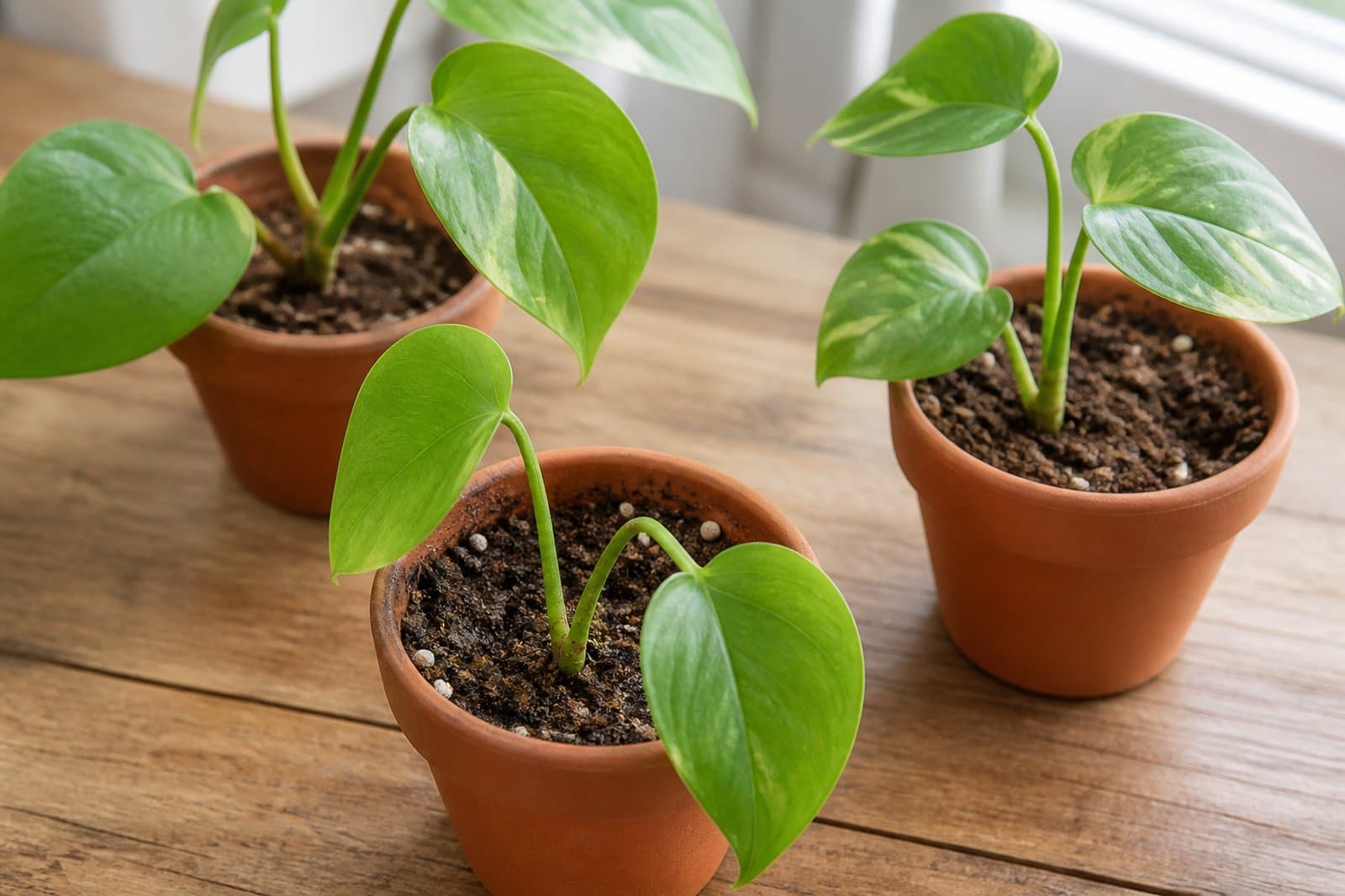
Soil propagation means sticking a healthy stem cutting, with at least one node, directly into moist, well-draining mix instead of rooting it in a jar first. Soft-stem vines such as pothos, heartleaf philodendron, and monstera are the usual examples. If you would rather watch roots form, water propagation roots the same node in a clear jar, and the propagation water change calculator handles the jar schedule. Thick wood is covered in air layering.
Extension sources agree on light, airy rooting media: perlite, vermiculite, coarse sand, or peat moss blended with one of those. Iowa State calls perlite a great rooting medium because it holds a good balance of water and air. UNL and Nebraska Extension Lancaster both suggest equal parts of two ingredients, such as perlite with peat moss. Potting soil alone often lacks enough drainage or aeration for rooting (Iowa State), and UNL rules out field soil. Mix, moisture, and pot size covers each ingredient.
For plant-by-plant steps, see how to propagate pothos, how to propagate philodendron, and how to propagate monstera. Below: when soil is the best fit, materials, stick-in-mix steps, light while cuttings root, mix and pot sizing, the soil-versus-water table, and troubleshooting.
Best way
Soil or soilless mix fits when you want a node to root in moist, drained media and skip the move from a jar. Soft vines such as pothos, heartleaf philodendron, and monstera are the usual examples (Clemson, Iowa State, Illinois, UNL, Wisconsin 4-H). Growers who want to watch the same node root in a clear jar use water propagation. For thick woody stems, Missouri Botanical Garden notes that many woody plants such as hibiscus and citrus usually rot before rooting in water, and UNL lists fiddleleaf fig under air layering. See air layering.
| Method | Best when | Source support |
|---|---|---|
| Soil or soilless mix | Soft indoor stem with a node. You want one less move | Perlite or vermiculite usually beats water (UNL). Water roots are often weak (Illinois). 3 to 6 weeks to root, pot at about 1 inch of roots (Iowa State). Pothos roots in soil or water with a node (Clemson) |
| Water jar | Same soft node when you want to see the roots | Many houseplants root in water, with coarser roots (Iowa State). For the jar method, see water propagation |
| Air layering | Thick woody stems | Hibiscus, citrus, and many woody plants usually rot in water (Mobot). Fiddleleaf fig is listed under air layering (UNL). Thick wood is covered in air layering. For species steps, see fiddle leaf fig |
Pick soil or mix when you want fewer moves or when UNL and Illinois steer toward media. Pick water when you want to see the roots on a soft stem. Pick air layering for thick wood.
Materials
- Clean scissors or pruners
- Stem cutting with at least one node (leaf sections only for plants that root from leaf cuttings)
- Small pot or shallow container with drainage holes (clean, sterile, well drained, and at least 2 inches deep, per Iowa State)
- Light, well-draining rooting mix (perlite, vermiculite, a 50/50 blend such as perlite and peat moss, or a soil-free potting mix)
- Room-temperature water
- Optional: clear bag or dome for humidity, plus rooting hormone for harder-to-root species
- Optional: pencil or chopstick to open a sticking hole so hormone stays on the cut
Stick method for node cuttings
- Take a healthy cutting so at least one node will sit under the mix line. Take a healthy cutting 3 to 6 inches long with at least two nodes (Iowa State). UNL keeps tip cuttings at 3 to 5 inches, cut just below a leaf.
- Strip the leaves that would end up below the mix. Bury at least one node and no leaves (Iowa State). NCSU Wayne County removes the lower one-third of the foliage before sticking.
- Optional: dip the cut end in rooting hormone, using a little powder poured into a separate dish (Iowa State, Illinois Good Growing). Many easy houseplants root without it (Illinois, NCSU Wayne County). For forms, doses, and when it helps, see rooting hormone.
- Fill a small drained pot with mix you moistened beforehand, damp but not soggy. Moisten the media before use, water after sticking, and let it drain for a few minutes (Iowa State). UNL keeps it moist but not soggy and rules out field soil. Illinois Good Growing warns that oversaturation can cause rot.
- Make a hole with a pencil or chopstick, insert the node, and firm the mix so the cutting stands. Push it about 1 inch into the medium (UNL).
- Place in bright, indirect light, out of direct sun while the pot is covered. For hours, temperature, and the DLI tool, see Light while propagating.
- Keep the mix lightly moist. In a dry room, cover the pot loosely with a clear bag or dome held off the leaves with chopsticks, straws, or wire loops, and do not seal it tight (Iowa State). Ventilate enclosed cuttings as needed and keep the media evenly moist, not soggy wet (Illinois). If cuttings rot, humidity or moisture is too high, so reduce both and remove the rotting pieces (Illinois Good Growing).
- Check progress without pulling the cutting up every day. A gentle tug that meets some resistance means roots have formed (NCSU Wayne County). Do not tug hard enough to disturb the cutting. New roots are fragile, so Illinois Good Growing lifts the cutting from the side with a small spoon, butter knife, or plant label, medium and all. New leaf growth is another sign. Most houseplant stem cuttings root in 3 to 6 weeks, and Iowa State pots them up once roots reach about 1 inch or more.
- Once rooted, remove the cover and pot into regular potting soil. Keep the new plant well watered in bright, indirect light (Iowa State). It should establish within a few weeks, and then regular fertilization can start. The drop in humidity can shock new plants, so watch them closely after the move (Illinois Good Growing).
Light while propagating
Mix cuttings need bright, indirect light: not a dark shelf, and not direct sun on a covered pot.
Iowa State recommends 4 to 6 hours of bright indirect light, with air between 65°F and 75°F. A heat mat can raise the rooting media to between 75°F and 80°F. Too little light slows root formation, and cuttings may rot or dry out before roots form. Too much light can burn foliage, especially under plastic bags or domes. Illinois asks for bright, indirect light and rooting media kept at 75 to 80°F. UNL, NCSU Wayne County, and Illinois Good Growing all keep covered pots out of direct sun so heat does not build up under the plastic.
If roots stall for weeks while the stem stays firm and the mix stays evenly moist, adjust light, humidity, or temperature (Iowa State).
If you meter PPFD at the pot, use the propagation light DLI calculator. If the window is not enough, see best grow lights for indoor propagation.
Which cuttings fit soil or mix
Easy soft-stem media examples in the sources:
- Golden pothos (devil’s ivy, Epipremnum aureum) roots in soil or water with at least one node (Clemson) and is on the Iowa State stem-cutting list. Illinois Good Growing names pothos among houseplants commonly grown from stem cuttings and shows golden pothos cuttings rooted in pots of potting mix. See how to propagate pothos.
- Heartleaf philodendron (Philodendron hederaceum and related heartleaf labels) is on the Iowa State list and in the UNL stem-cutting table. Wisconsin 4-H roots a 4 to 6 inch cutting in sand or water. The Illinois table lists Philodendron spp. for stem cuttings and air layering. See how to propagate philodendron.
- Monstera (Swiss cheese plant, Monstera deliciosa) is on the Iowa State list, and the Illinois table lists split-leaf philodendron (Monstera deliciosa) for stem cuttings. See how to propagate monstera.
- Coleus, tradescantia, wax vine (Hoya carnosa), and Chinese money plant (Pilea peperomioides) are also on the Iowa State stem-cutting list.
- Jade is the exception to the bag rule. Illinois Good Growing says jade does not do well under a plastic cover, since too much humidity can cause rot, and roots better in a sand-based medium.
Prefer media over jars when the sources steer that way:
- Perlite or vermiculite is generally more satisfactory than water for many cuttings (UNL).
- Illinois Extension does not recommend water, because water roots are often weak and adapt less easily to potting mix.
- Water-rooted plants often have weak roots that struggle after potting (Illinois Good Growing).
- Water roots are coarser (Iowa State) and, once potted, may show wilting, leaf drop, browning leaves, or tip die-back until they adapt.
Woody stems need a different plan:
- Hibiscus, citrus, and many other woody plants do not root well in water and usually rot first (Missouri Botanical Garden). Iowa State lists citrus among houseplants propagated by stem cuttings.
- UNL lists fiddleleaf fig under air layering. For the steps, see air layering and how to propagate fiddle leaf fig.
Mix, moisture, and pot size
Use a mix that holds moisture but still drains and lets air in. Iowa State says rooting media need a good balance of water and air, and rates the common ingredients this way:
| Ingredient | What Iowa State says it does |
|---|---|
| Perlite | Good drainage and aeration, neutral pH, holds cuttings upright |
| Vermiculite | Holds water well, neutral pH |
| Sand | Good drainage, holds cuttings upright, may need sterilization |
| Peat moss | High moisture retention, acidic, may stay too wet, good to mix with others |
| Coarse sphagnum moss | High moisture retention, good aeration, hard to re-wet if it dries out completely |
| Potting soil | Only as part of a mix. Often lacks drainage or aeration on its own |
UNL says equal parts perlite and peat moss make a quality rooting medium, and warns against field soil, which lacks pore space and can carry disease. Nebraska Extension Lancaster uses sand, perlite, peat moss, or vermiculite, especially as a 50/50 mix (sand-perlite, perlite-peat moss, sand-peat moss, or sand-vermiculite). Illinois lists coarse sand, peat moss, perlite, vermiculite, or a combination, starting with clean, disease-free media. NCSU Wayne County uses sand, vermiculite, perlite, and combinations of these with peat moss, kept sterile and moist. Pothos wants an airy, well-draining mix, and root rot follows overwatering or poorly draining soil (Clemson).
Iowa State wants pots that drain and are at least 2 inches deep so cuttings stay upright. For several cuttings at once, Illinois Good Growing uses a wide, shallow six to eight inch azalea pot. A food storage container with a couple of holes punched in the bottom works the same way. When it is time to pot up, Missouri Botanical Garden says to choose a pot with just enough space for the root system and not to let the plant stand in water.
Humidity helps while roots form. Soggy mix does not. If cuttings start to rot, Illinois Good Growing says the humidity, the mix moisture, or both are too high: vent or remove the bag and ease off the water.
Soil vs water propagation
| Factor | Soil or mix | Water |
|---|---|---|
| Root visibility | Hidden until a gentle tug-test, a careful side check, or new growth | Excellent. Easy to watch progress |
| Watering rhythm | Keep mix lightly moist, not soggy (Iowa State, Illinois, UNL) | Change the jar once or twice a week (Iowa State) |
| Transplant step | Already in the final medium (or move once from pure perlite/vermiculite into potting mix when roots are about 1 inch) | Required when moving to a pot |
| Root texture | Media-formed roots adapt to potting mix more easily (Illinois). Perlite or vermiculite is often more satisfactory (UNL) | Often coarser water roots (Iowa State). Often weak and slower to adapt (Illinois) |
| Best for | Growers who want fewer moves, species UNL and Illinois steer toward media, and soft vines such as pothos, philodendron, and monstera nodes (Clemson, Iowa State, Illinois) | Soft vines and demos when visibility matters. See water propagation. Thick woody starts go to air layering |
Neither method wins for every cutting. Choose soil or soilless mix when you want to skip transplant stress or when the sources prefer media. Choose water when visibility matters on an easy soft stem.
Troubleshooting
Mix stays soggy. Stem soft or rotting. Ease off water, improve drainage and airflow, and vent or remove the bag. Illinois wants media evenly moist, not soggy wet. If cuttings rot, humidity or moisture is too high, so reduce both and remove the rotting cuttings (Illinois Good Growing). Water after sticking and let the pot drain (Iowa State). Clemson ties pothos root rot to overwatering or poorly draining soil. If the stem above the rot is still firm, recut below a healthy node and restick it in fresh, drained mix.
No roots after several weeks. Stem firm. Mix not waterlogged. Check light first. Iowa State says too little bright indirect light slows root formation. Confirm a node is under the mix line and no leaves are buried (Iowa State, UNL, Clemson pothos node rule). Iowa State’s 3 to 6 weeks is the usual range for houseplant stem cuttings, and Illinois Good Growing says rooting time varies greatly from plant to plant. A vine cutting with no node needs replacing.
Cuttings rot under a sealed bag. Iowa State says not to seal the bag tightly, so air can exchange, and to keep the plastic off the leaves. Illinois wants enclosed cuttings ventilated as needed. Open the bag daily or remove it, and discard rotting pieces.
Pot stays wet for weeks. Iowa State wants drained containers at least 2 inches deep. At potting-up time, Missouri Botanical Garden wants a pot with just enough space for the root system, never left standing in water. See Mix, moisture, and pot size.
Gentle tug meets no resistance after the usual window. Digging up damages roots. A gentle tug that meets some resistance means roots have formed (NCSU Wayne County). Do not tug hard enough to disturb the cutting. Illinois Good Growing notes that new roots are fragile. A side scoop with a spoon or label is gentler than repeated tugging. New leaf growth is another signal.
Thick wood only rotted. Missouri Botanical Garden notes many woody plants such as hibiscus and citrus usually rot before rooting in water. For thick stems such as fiddle leaf fig, UNL lists air layering. Use air layering or the species page (fiddle leaf fig for thick Ficus lyrata), not a wetter pot.
Wilting after moving from pure perlite or vermiculite into potting mix. Iowa State says to pot into regular potting soil when roots are about 1 inch long or more, then keep the plant well watered in bright indirect light until established. Illinois Good Growing notes the drop in humidity can shock new plants, so monitor them closely. Cuttings rooted in water can wilt for a while too, because water roots are coarser (Iowa State). See water propagation.
Common mistakes
- Burying leaves under the mix (Iowa State). NCSU Wayne County strips the lower third of the foliage.
- Using a pot with no drainage or keeping the mix soggy (Iowa State, Illinois, UNL, Clemson).
- Potting up into a huge container instead of a pot with just enough space for the root system (Mobot).
- Sealing a plastic bag with no vent until cuttings rot. Iowa State says not to seal it tightly, Illinois ventilates enclosed cuttings, and Illinois Good Growing ties rot to excess humidity.
- Expecting woody fiddle stems to behave like pothos. UNL lists fiddleleaf fig under air layering, so use air layering for thick wood (see fiddle leaf fig for Ficus lyrata).
- Yanking the cutting daily to check. Wait for a gentle tug-test after time has passed (NCSU Wayne County). Illinois Good Growing notes new roots break easily.
- Low light on cuttings. Too little light slows rooting, and cuttings may rot or dry first (Iowa State). Cooking a bagged pot in direct sun is the opposite failure (UNL, NCSU Wayne County, Illinois Good Growing).
- Taking a piece with no node on vines that need one (Clemson pothos, Iowa State, UNL).
People also ask
Can you put cuttings straight into soil?
Yes. Stick a node into lightly moist mix, keep humidity up, and do not let the pot sit waterlogged. Iowa State, UNL, Illinois, and NCSU Wayne County all give steps for rooting cuttings in a medium, and Clemson says pothos roots easily in soil or water. Prefer to see roots first? See water propagation.
How do I know soil cuttings have rooted?
A gentle tug that meets some resistance means roots have formed (NCSU Wayne County). New leaf growth is another signal. Digging the cutting up to look can damage fragile new roots. Illinois Good Growing prefers lifting from the side with the medium attached, and gives one to four healthy roots as one guide for when to pot up. Most houseplant stem cuttings root in 3 to 6 weeks, and Iowa State pots them up once roots reach about 1 inch or more.
What is the best soil or substrate for propagation?
A light, well-draining rooting medium: perlite, vermiculite, coarse sand, or a 50/50 blend such as perlite and peat moss. Soil-free potting mix also works (Illinois Good Growing). Iowa State calls perlite a great rooting medium because it balances water and air. Avoid field or garden soil (UNL), and use potting soil only as part of a mix (Iowa State). Mix, moisture, and pot size covers each ingredient.
How do you make a propagation mix?
Mix two rooting ingredients in equal parts, such as perlite with peat moss, sand with peat moss, or sand with perlite. Nebraska Extension Lancaster calls a 50/50 combination a good rooting medium, and UNL says equal parts perlite and peat moss make a quality one. The pair balances water and air. Peat moss holds a lot of moisture but may stay too wet alone, while perlite drains and aerates (Iowa State). The finished mix should be porous, well drained, and heavy enough to hold cuttings upright (Lancaster). Use potting soil only as part of a mix, since alone it often lacks drainage and air (Iowa State). Moisten the mix before you stick cuttings (Iowa State), and start with clean, disease-free media (Illinois). More in mix, moisture, and pot size.
Do I need rooting hormone for soil propagation?
Easy vines like pothos and philodendron usually root without it. Illinois Extension says hormone helps harder-to-root species and often improves the quality and quantity of roots, and Iowa State warns that too much can slow rooting. For forms, dosing, and homemade options, see rooting hormone.
Is soil better than water for propagation?
Neither is universally better. Use the table above. Soil or soilless mix skips the later transplant and matches UNL and Illinois preference for media on many cuttings. Water lets you see the roots on easy soft stems. For the jar method, see water propagation. Thick wood is covered in air layering.
How much light do soil cuttings need?
Iowa State recommends 4 to 6 hours of bright indirect light. Too little slows roots. Too much can burn, especially under plastic. Illinois wants bright indirect light. UNL and NCSU Wayne County keep covered pots out of direct sun. See Light while propagating. If you meter PPFD, use the DLI tool. For fixture hang-height when windows fail, see best grow lights for indoor propagation.