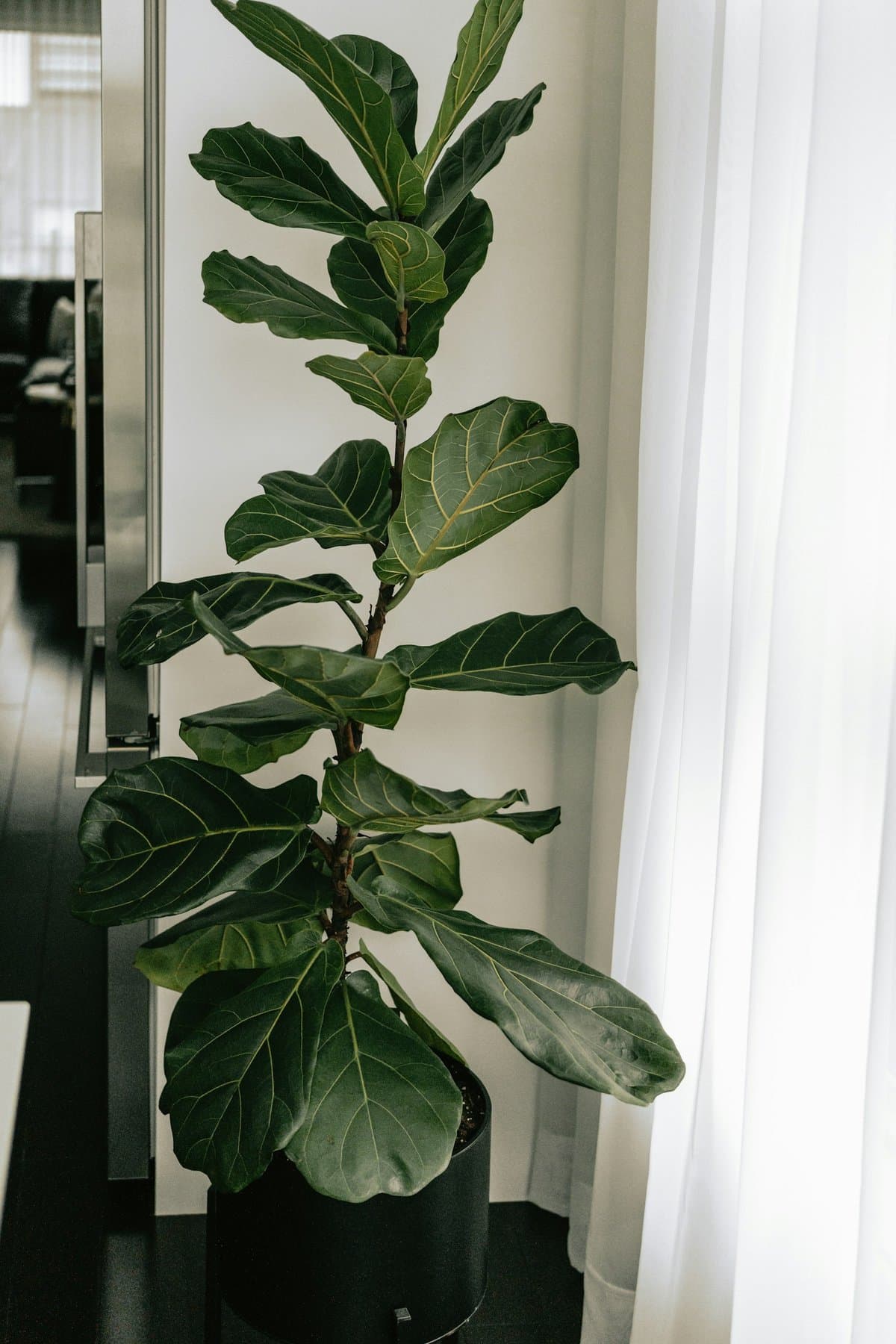
Fiddle leaf fig on this guide means Ficus lyrata (also called banjo fig). Family Moraceae. Native to tropical western and central Africa. NCSU: popular houseplant 2 to 10 feet tall indoors; large lyre-shaped leaves up to 18 inches long; milky stem sap that can irritate skin. UF/IFAS landscape profile: thick fiddle-shaped leaves 8 to 15 inches long; propagation by layering and cuttings. RHS plant profile: evergreen tree with glossy dark green fiddle-shaped leaves; flowers and fruits not seen on container-grown plants; propagate by seed, leaf-bud, or semi-hardwood cuttings.
This is not the rubber plant (Ficus elastica) and not the weeping fig (Ficus benjamina). RHS ornamental figs guide treats lyrata, elastica, and benjamina as separate houseplant types. UF/IFAS PP308: commercial Florida growers traditionally air-layer F. elastica cultivars, F. lyrata, and large F. benjamina trees, while smaller trees, vines, and shrubs often go from cuttings. UCANR Coastal Gardener also warns that the common name "fiddle leaf fig" is sometimes used for Philodendron bipennifolium; here we mean Ficus lyrata only.
Can you propagate a fiddle leaf fig? Yes. Soft tip pieces with a node fit soil or water starts (NCSU stem cutting; UCANR tip in water; RHS semi-ripe / leaf-bud cuttings). Thick woody trunks you do not want to risk as bare sticks fit air layering (UNL, Iowa State, UF/IFAS PP308, Texas A&M). None of those sources describe a leaf alone, with no stem bud or node, as a way to grow a branching plant.
NCSU Recommended Propagation Strategy is stem cutting. Texas A&M Aggie Horticulture names air layering and cuttings. UNL Propagating Houseplants lists fiddleleaf fig under air layering (rubber plant listed as air layering and seeds). Iowa State air-layering table marks Ficus lyrata for air layering and walks dicot girdling steps that name fiddle-leaf fig with weeping fig, rubber tree, and croton. RHS How to grow ornamental figs: semi-ripe cuttings in spring or summer (heated propagator aids rooting); air layering for some figs, including rubber plant. UCANR: a 6-inch stem tip cutting with a leaf in water, or air layering.
Indoor specimen focus. For mix after potting, see soil propagation. Jar technique and water-change cadence: water propagation. Full wrap steps: air layering.
Best way indoors (stem tip, water, or air layer)
Choose by what you can cut safely, not by a blog “best” label.
| Situation | Method the sources support | Why |
|---|---|---|
| Soft tip with a node you can spare | Stem tip in moist media (NCSU; RHS semi-ripe; Penn State / UNL general node cuttings) | Heated propagator helps on RHS; media stays moist, not soggy (Penn State). |
| Soft tip and you want to watch roots | Tip in water (UCANR 6-inch tip with a leaf) | Progress is visible. Prefer general jar cadence (change water ~1–2× weekly; pot near ~1 inch roots on Iowa State’s general stem-tip page) as care habits, not as lyrata week counts. |
| Thick woody trunk you do not want as a bare stick | Air layering (UNL; Iowa State; UF/IFAS PP308; Texas A&M) | Roots form while still attached; sever only after a clear root mass. |
| One leaf plus the bud on a short stem piece | Leaf-bud cutting (RHS lyrata; UNL general leaf-bud recipe) | Still needs the dormant bud at the leaf joint. Not a bare blade. |
Sources don’t give a rooting time for F. lyrata tip cuttings in soil or water. Air-layer timing from Iowa State and UNL: roots often in several weeks, sometimes longer; sever when roots several inches long show in the wrap. Do not paste Iowa State’s 3–6 week stem-tip band (weeping fig is on that list; lyrata is not) or the RHS “about a year” rubber-plant air-layer note onto lyrata.
Stem tip cuttings in soil or media
NCSU names stem cutting as the Recommended Propagation Strategy but does not publish cutting length or days-to-root on the species page.
RHS ornamental figs guide: take semi-ripe cuttings in spring or summer; a heated propagator aids rooting. RHS F. lyrata profile: leaf-bud or semi-hardwood cuttings (and seed). RHS doesn’t give a rooting time for F. lyrata cuttings.
Texas A&M: methods of propagation are air layering and cuttings. No inches or weeks on that foliage card.
Penn State Propagating Houseplants (general houseplant chapter): tip or branch pieces 3 to 6 inches long with at least two nodes; remove leaves on the lower half; optional rooting hormone; stick into water or media; warm, humid, bright indirect light. Stem cuttings: 2 to 3 inches with at least two nodes, with at least one node buried. Media moist but not saturated; rooting-media temperature 75° to 80°F for optimum results. Those lengths and media notes are general Penn State houseplant guidance, not a lyrata-only recipe.
UNL tip and stem cutting care (general): tip cuttings generally 3 to 5 inches, cut just below a leaf; ensure at least one node under the medium surface; push about 1 inch into moist (not soggy) medium; optional plastic bag over stakes for humidity; avoid direct sun under plastic; room at 60° to 70°F; pot when roots are abundant. UNL's species table lists F. lyrata for air layering, not for tip cuttings, so treat those tip inches as general UNL cutting care, not a fiddleleaf-only measurement.
Iowa State stem-tip how-to lists Ficus benjamina (weeping fig) among stem-cutting houseplants but does not list F. lyrata on that species table. Do not copy Iowa State's 3 to 6 inch / 3 to 6 week stem-tip figures onto lyrata as if they were species-specific. Prefer NCSU, UF/IFAS, RHS, Texas A&M, and UCANR for lyrata cutting support, plus Penn State and UNL only as general node-cutting environment notes.
Water
UCANR Coastal Gardener: start with a 6-inch stem tip cutting attached to a leaf and place it in water for roots to develop. That page does not state a week count or root length for F. lyrata.
Penn State names water among propagation media for leaves, stem tips, tips of branches, and stem sections. Iowa State general stem-tip water notes (change water one to two times each week; pot near about 1 inch of roots; water-formed roots coarser than media roots) sit on a page that lists weeping fig, not fiddleleaf fig. Those jar habits are general water-cutting care, not Iowa State data for F. lyrata.
Sources don’t give a rooting time for F. lyrata in water.
When to change the jar: propagation water change calculator. Full jar hygiene: water propagation.
Air layering
Preferred when the stem is thick or woody and a bare cutting would be a large risk. UNL species table: Fiddleleaf Fig (Ficus lyrata), air layering. Iowa State layering table: Ficus lyrata marked for air layering. UF/IFAS PP308: air layers traditionally made on stock plants of F. elastica cultivars, F. lyrata, and large F. benjamina. Texas A&M and UF/IFAS ST254 name layering alongside cuttings. UCANR names air layering as another method.
Iowa State How to Propagate by Air Layering (names fiddle-leaf fig among dicots): select a point about 12 to 18 inches from the shoot tip; remove nearby leaves; for dicots, remove a ring of bark down to the woody center (two cuts about 1 inch apart, then connect and strip the ring); scrape cambium; optional rooting hormone; pack one or two handfuls of moist unmilled sphagnum; wrap clear plastic and seal ends; remoisten if moss dries. Roots should appear in several weeks, although for some species it could take several months. Sever when a good root system is visible with roots several inches long; pot in commercial potting mix; keep well watered in bright indirect light. Iowa State rubber-tree FAQ uses the same girdling wrap for rubber tree, weeping fig, and other woody Ficus species.
UNL air-layering how-to (worked example is rubber plant, Ficus elastica; table also lists F. lyrata): slanting cut 1 to 1½ inches long, about one-quarter to one-half through the stem; keep open with a matchstick or toothpick; optional hormone; wrap moist (not soggy) sphagnum and seal plastic. After several weeks, roots should be visible near the moss edges; when a good root system has formed, sever just below the moss ball and pot. The remaining cane can break new buds.
RHS How to grow ornamental figs: some figs, including the rubber plant (F. elastica), can be air layered in spring or late summer; rooting will take about a year on that guide. That year figure is written for the rubber-plant example, not as a F. lyrata week count. Do not paste it onto fiddleleaf fig as a species clock.
Penn State air layering (general): slice a stem or branch, pack moist moss, cover with plastic wrap, then cut below the new roots once formed and pot immediately. Named easy examples on that page are dumb cane, dwarf schefflera, and Dracaena, not Ficus; use it only as the general woody-houseplant chapter the live page already cites.
Wrap checklist and sever timing live on air layering. Cut free only after a clear root mass shows in the wrap.
Leaf-bud cuttings and seed
RHS F. lyrata profile names leaf-bud and semi-hardwood cuttings plus seed. UNL leaf-bud method (general): a single leaf on a 1- to 1½-inch stem piece so the dormant bud at the leaf joint can make a new shoot; insert with the bud about one-half inch below the medium. That UNL leaf-bud recipe is general houseplant technique supporting the RHS leaf-bud label, not a lyrata-only inch claim.
Sources don’t describe a bare leaf blade (no stem bud or node) as a way to make a branching F. lyrata. Tip and stem methods on Penn State and UNL require nodes.
Light while propagating
A fiddle leaf fig cutting wants bright, indirect light while it roots. Penn State’s general houseplant chapter places tip and stem pieces in warm, humid, bright indirect light, with rooting media at 75°F to 80°F. Penn State does not name a Ficus lyrata-only hour count with that temperature.
UNL’s general cutting care keeps a covered pot out of direct sun under plastic, in a room at 60°F to 70°F. UNL lists F. lyrata for air layering, not tip cuttings. The no-direct-sun rule there covers cuttings in general.
Iowa State’s air-layer steps name fiddle-leaf fig among dicots. After the layer is severed and potted, keep it well watered in bright indirect light. Iowa State prints stem-tip lengths and week counts for plants on that list, including weeping fig. F. lyrata is not on that list.
NCSU ties leaf scorch to too much direct sunlight. RHS ornamental figs lists low light among causes of sudden leaf drop, and dry shriveled leaves from too much direct sun or low humidity. Low light there is a cause of leaf drop, not a preference for dim rooms. UCANR calls the plant finicky about light, along with humidity, wet or dry soil, and drafts.
When the room is dim or days are short, meter the pot with the propagation light DLI calculator. Fixture distance is on best grow lights for indoor propagation. Those conditions change how fast roots form, and whether leaves scorch or drop.
Troubleshooting (won't root, rot, leaf drop)
Work through this checklist before throwing the cutting away.
No node or dormant bud. A petiole or leaf blade with no stem segment will not become a branching plant. Penn State and UNL require nodes in or under the medium. RHS names leaf-bud or stem cuttings, not leaf-only. Start over with a tip that includes a node, or use leaf-bud (leaf + bud on a short stem).
Jar stays cloudy or smells, roots stall. Change water about one to two times each week on Iowa State’s general stem-tip cadence, or sooner when cloudy. Never let roots dry in air. Use the propagation water change calculator for the next-step check, and jar water: cadence and warning signs for hygiene depth.
Soggy mix or sealed stagnant wet air. Penn State: media moist, not saturated. UNL: heat builds under plastic in sun and damages cuttings; Penn State: humidity helps, but not so high that disease thrives. Vent bags; keep bags out of direct sun.
Light too low or too harsh. Penn State wants bright indirect light for cuttings. NCSU: leaf scorch from too much direct sunlight; leaf drop from water extremes. If the window is weak and the jar or pot stays clean while growth stalls, check daily light with the propagation light DLI calculator. Fixture distance and hours: best grow lights for indoor propagation.
Temperature swings and drafts. NCSU: brown spots from heating or cooling swings. RHS ornamental figs: sudden leaf drop from overwatering, low winter temperatures, low light, excess fertilizer, or cold draughts. UCANR: finicky about light, humidity, wet or dry soil, and drafts. Steady bright-indirect warmth beats a cold wet sill.
Waiting for a blog week count that sources do not give. Sources don’t give a rooting time for F. lyrata tip cuttings. Air layers: Iowa State and UNL talk in “several weeks” (sometimes months) and sever when roots several inches long show. Keep going if the tissue stays firm and the environment matches the notes above; restart if the stem turns soft and brown with no node left to salvage.
Common mistakes
- Confusing this plant with rubber plant (F. elastica), weeping fig (F. benjamina), or Philodendron bipennifolium sold under the same common name.
- Taking a piece with no node or dormant bud and expecting a new branching plant. Penn State and UNL cutting chapters require nodes under or in the medium; RHS lyrata names leaf-bud or stem cuttings, not a leaf-only shortcut.
- Following blog week counts for soil or water rooting that NCSU, UF/IFAS, RHS, Texas A&M, and UCANR don’t give for F. lyrata.
- Pasting Iowa State's stem-tip 3 to 6 week figure onto lyrata when that species is not on Iowa State's stem-cutting list (weeping fig is).
- Pasting the RHS ornamental-figs "about a year" air-layer note onto lyrata when that sentence names rubber plant.
- Cutting a thick trunk free before roots exist. UNL, Iowa State, UF/IFAS PP308, and Texas A&M support air layering for this woody indoor Ficus.
- Sealing plastic over cuttings with no airflow, or setting a bagged pot in direct sun. UNL: heat builds under plastic in sun and damages cuttings. Penn State: high humidity helps, but not so high that disease thrives.
- Cold, wet, soggy media. Penn State wants moist, not saturated media; NCSU flags wet-soil intolerance and leaf drop from too much or too little water.
- Harsh direct sun on a jar or bagged cutting. NCSU: leaf scorch from too much direct sunlight; RHS ornamental figs: dry shriveled leaves from too much direct sun or low humidity.
- Handling milky sap without gloves when irritation is a concern. NCSU, RHS, UF/IFAS, and UCANR all flag sap irritation; gloves recommended when pruning or propagating.
People also ask
Can you propagate a fiddle leaf fig?
Yes. Soft tips with a node root in soil or water (NCSU stem cutting; UCANR water tip; RHS semi-ripe / leaf-bud). Thick woody trunks favor air layering (UNL, Iowa State, UF/IFAS, Texas A&M). A bare leaf without a bud or node is not the same method.
Is fiddle leaf fig the same as rubber plant or weeping fig?
No. Here we mean Ficus lyrata. Rubber plant is F. elastica. Weeping fig is F. benjamina. RHS ornamental figs guide and UF/IFAS PP308 keep them as separate ornamental Ficus types. UCANR also separates true F. lyrata from Philodendron bipennifolium, which sometimes shares the common name.
What is the best way to propagate fiddle leaf fig indoors?
Match the method to the wood. Soft tip with a node: soil/media (RHS semi-ripe; Penn State / UNL general node care) or water (UCANR 6-inch tip). Thick trunk: air layer (UNL; Iowa State; UF/IFAS PP308). Prefer media when you want to skip a jar transplant; prefer water when you want visible roots; prefer air layer when a bare stick would be a large risk. See the table under Best way indoors.
Can I propagate from a leaf alone?
Usually no, if “leaf alone” means a bare blade or petiole with no stem bud or node. Sources don’t describe that as a way to make a branching F. lyrata.
What people often mean and what the sources support:
- Leaf-bud cutting (yes, with the bud): RHS F. lyrata names leaf-bud cuttings. UNL’s general leaf-bud method keeps a single leaf on a 1- to 1½-inch stem piece so the dormant bud at the leaf joint can make a new shoot; insert with the bud about one-half inch below the medium.
- Stem tip with a node (yes): Penn State and UNL tip/stem chapters require nodes in or under the medium. UCANR’s water tip is a stem tip attached to a leaf, not a floating leaf.
- Bare leaf blade, no bud: Tip and stem methods require nodes. A leaf that yellows in a jar with no stem segment is expected to fail as a branching plant. Stop waiting and take a proper tip or leaf-bud piece instead.
Should I use water or soil?
Both work for tip cuttings. UCANR supports a 6-inch tip in water. RHS supports semi-ripe cuttings with a heated propagator (soil/media context). Penn State allows water or media for tip cuttings in its general chapter. Iowa State notes water-grown roots are coarser than media-grown roots on its general stem-tip page. Thick woody trunks favor air layering. See water propagation and soil propagation.
How long until roots show?
NCSU, UF/IFAS ST254, Texas A&M, and UCANR don’t give a rooting time for F. lyrata tip cuttings. Iowa State air-layering page (names fiddle-leaf fig): roots should appear in several weeks, though some species take several months; sever when roots several inches long are visible in the moss. UNL air layering: after several weeks roots should be visible; sever when a good root system has formed. RHS ornamental figs: rubber-plant air layers about a year on that guide. Skip tighter blog timelines.
When do I remove an air layer?
Iowa State: when a good root system is readily visible with roots several inches long, then cut below the wrap and pot. UNL: when a good root system has formed under the plastic. Full numbered wrap steps: air layering.
Why won't my cutting root, or why is it rotting?
Check node first, then jar or mix moisture, then light and temperature. See Troubleshooting. Cloudy jars: water change calculator. Dim rooms: DLI calculator.
Why are leaves dropping on a cutting or new plant?
Stress and environment. NCSU: leaf drop from too much or too little water; brown spots from heating or cooling swings; leaf scorch from harsh direct sun. RHS ornamental figs: sudden leaf drop often from overwatering, also low winter temperatures, low light, excess fertilizer, or cold draughts. UCANR: finicky about light, humidity, wet or dry soil, and drafts. Improve bright indirect light, warmth, and moisture balance; skip sealed stagnant wet air.
Is fiddle leaf fig toxic?
Yes for chewing and sap contact. NCSU: low-severity poison; insoluble calcium oxalates; oral irritation, drooling, vomiting; sap that can irritate the skin; problem for cats, dogs, and horses; gloves when pruning or propagating. ASPCA Animal Poison Control news: fiddle leaf fig mildly toxic to dogs and cats; mild gastrointestinal irritation (vomiting, diarrhea); sap may irritate skin. RHS: skin allergen; wear gloves and protective equipment when handling. UCANR: toxic; keep away from children and pets.
Do I need grow lights?
Often when days are short or the room is dim. Penn State wants bright indirect light for cuttings. Iowa State and Virginia Tech DLI bands for vegetative cuttings live on the propagation light calculator; fixture distance and hours live on best grow lights for indoor propagation. Harsh direct sun on a sealed bag is still a failure mode (UNL; NCSU leaf scorch).