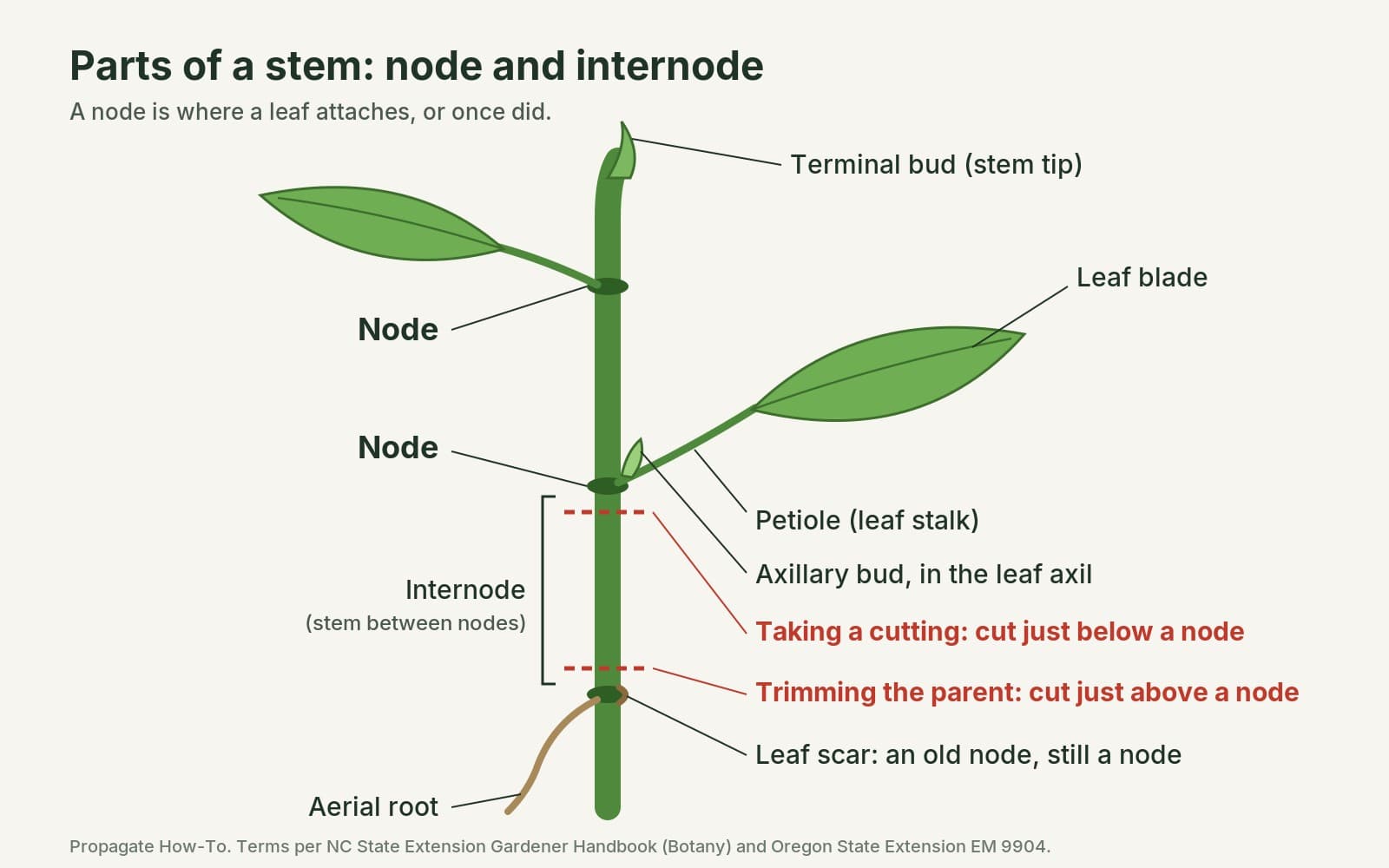
A node is the part of a stem where a leaf is attached, or where one used to be. NCSU Extension Gardener Handbook: within the node is a bud, an area of great cellular activity and growth, and the stretch of stem between two nodes is the internode. New roots and shoots on a cutting come from nodes, so a stem cutting without one has nothing to grow from.
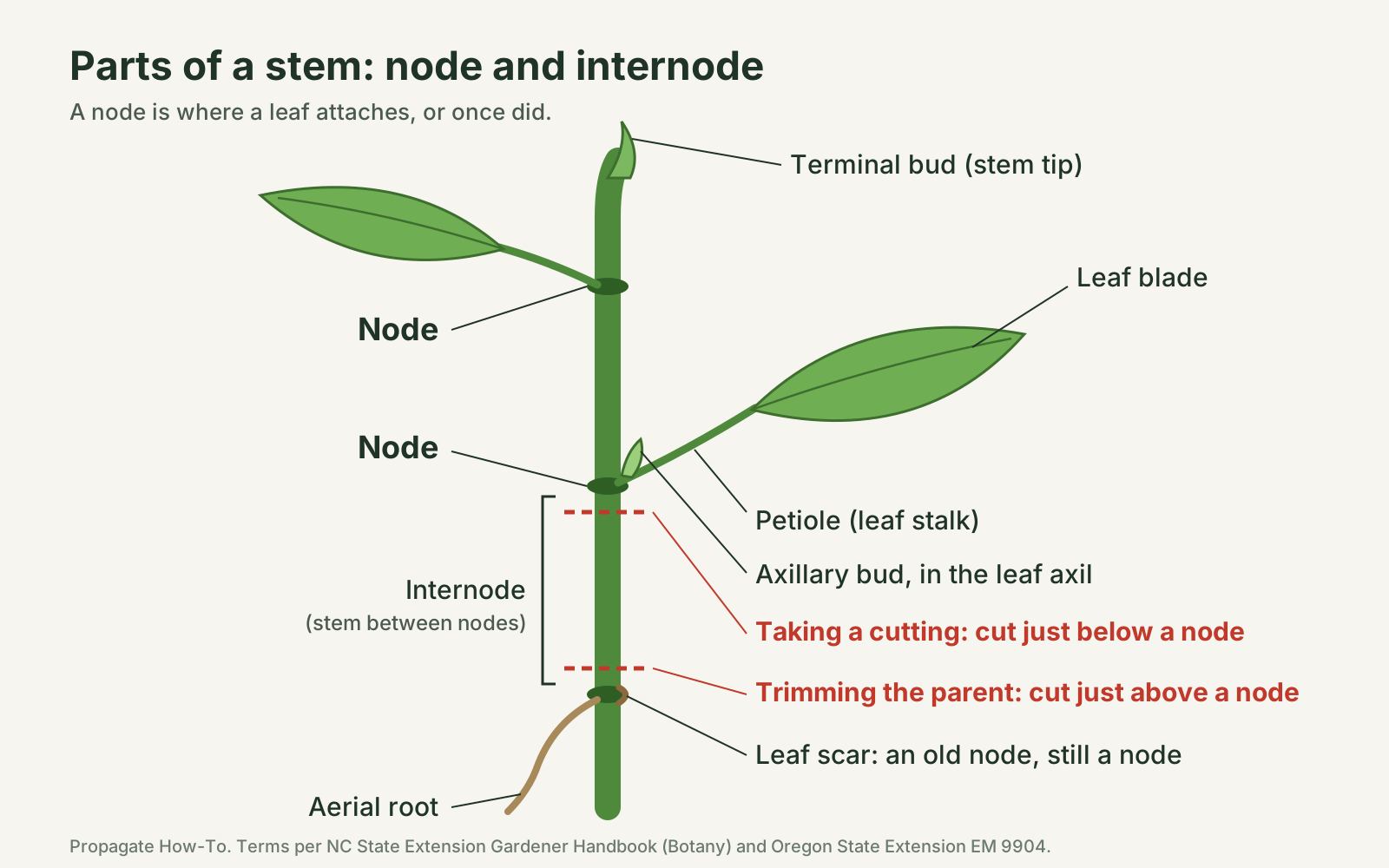
The labeled diagram at the top marks each part, and the full-size diagram opens on its own. Rooting methods in depth live on water propagation and soil propagation.
What a node is
Two extension definitions describe the same spot from slightly different angles:
- NCSU Extension Gardener Handbook (botany): a node is the stem area where leaves are attached, or were once attached. Within the node is a bud.
- Oregon State Extension EM 9904: a node is an area on a stem where buds are located, a site of great cellular activity and growth. Small buds there develop into leaves, stems, or flowers.
| Part | What it is | Source |
|---|---|---|
| Node | Stem area where a leaf attaches or once attached, with a bud inside | NCSU and Oregon State |
| Internode | The stem between two nodes | NCSU and Oregon State |
| Petiole | The leaf stalk, with its base attached to the stem at a node | Oregon State |
| Leaf axil | The small angle between the stem and the leaf attachment | NCSU and Oregon State |
| Axillary (lateral) bud | Bud in the leaf axil, either active or dormant | NCSU and Oregon State |
| Terminal bud | Bud at the tip of a stem | NCSU and Oregon State |
| Leaf scar | Mark left where a leaf was once attached, still a node | NCSU |
| Adventitious bud | Bud that forms away from the tip or axil, such as on an internode, a leaf edge, or callus at a cut end | NCSU and Oregon State |
NCSU also lists meristems, the tissue that keeps growing throughout a plant’s life, in the bud tissue at nodes. That is why a node can restart growth after the stem above it is gone.
How to find a node on a plant
- Follow a leaf back to the stem. Oregon State: the base of the petiole attaches to the stem at a node. Where a leaf has no petiole (a sessile leaf), the blade itself meets the stem there.
- Look in the angle above the leaf stalk. That angle is the leaf axil. Oregon State: the axil holds single buds or bud clusters, which may be active or dormant. A small bump there is the axillary bud.
- On bare stems, look for leaf scars. NCSU counts places where leaves were once attached as nodes. Old, leafless canes still carry usable nodes, which is what NCSU cane cuttings rely on.
- Count leaves per node. NCSU: alternate leaves have one leaf at each node, opposite leaves have two, and a whorled arrangement has three or more. On an alternate-leaved vine, every leaf marks its own node. On an opposite-leaved plant, a pair of leaves shares one.
- Check for stipules. NCSU: stipules are small leaflike structures, often paired, usually found at the base of the petiole or on the node, as on geranium.
- On compound leaves, find the bud, not the leaflet. NCSU: leaflets have no axillary bud at their base, and the axillary bud marks the true base of the whole leaf. A single leaflet pulled off a compound leaf carries no node.
- On rosettes and crowns, expect nodes packed tight. Oregon State: rosulate leaves are arranged in a rosette around a stem with extremely short nodes, and crowns such as African violet are compressed stems with leaves on short internodes.
- Underground, nodes mean stem. Oregon State: stems have nodes and roots do not, and the eyes of a potato are the stem’s nodes, each holding a cluster of buds. NCSU: an underground part with buds, leaf scars, or nodes is a stem, not a root.
Why nodes matter for propagation
Roots and new shoots start at the node. Iowa State (stem tip cuttings): new roots form from buds on the lower portion of the stem. Missouri Botanical Garden: roots grow most easily from the node, just below where a leaf attaches. UMN Extension (monstera): new growth comes from axillary buds and nodes on the stem, so cuttings that lack a node and axillary bud, such as leaves, will not produce new growth and eventually rot.
The same principle shows up on stems that root themselves. Oregon State: strawberry runners are stolons with small leaves at the nodes, and roots develop from those nodes to form a daughter plant. Spider plants also produce stolons that can become entirely new plants.
The node matters for the parent plant too. Oregon State: a pruning cut just above, but not too close to, a node encourages the buds at that node to develop into new stems or leaves.
Where to cut: below or above a node
The answer depends on which piece is meant to grow.
| Piece | Cut where | Why | Source |
|---|---|---|---|
| A cutting to root | Just below a node | Roots grow most easily at the node, and a section of stem left below the node often rots | Missouri Botanical Garden |
| The parent plant, after taking a cutting | Just above a node, not too close | The buds at that node develop into new stems or leaves | Oregon State |
| Monstera stem cutting | 1 to 2 inches below the node, along the internode | The species method from UMN, with the node going into the rooting medium | UMN |
In the diagram, both red dashed lines sit in the same internode, the stretch between the upper node and the leaf scar below it. The upper line frees the cutting just below its node. The lower line trims the leftover stub on the parent back to just above the leaf scar node, so that node can push new growth.
How many nodes does a cutting need?
- Stem tip cuttings: at least two. Iowa State: 3 to 6 inches long with at least two nodes, with lower leaves removed so one or two nodes go into the media and no leaves are buried.
- At least one node under the surface. UNL G1853: make each cut clean and at an angle, with at least one node (joint) under the surface of the medium.
- Leaf-bud cuttings: one node plus its leaf. NCSU: each node on a stem can be treated as a cutting, made of a leaf blade, petiole, and a short piece of stem with an attached axillary bud. The bud goes into the medium, covered to 1 inch, with the leaf exposed. UNL describes a single leaf on 1 to 1½ inches of stem, with the bud about one-half inch below the surface, and names English ivy as an easy example.
- Single-node cuttings. NCSU: cut the stem below and above a petiole that has a well-developed axillary bud. Plants propagated this way include devil’s ivy (pothos), heartleaf philodendron, dracaena, jade plant, and rubber plant.
- Cane cuttings: leafless nodes count. NCSU: leafless sections 2 to 3 inches long from older stems of plants such as dumbcane, corn plant, and Chinese evergreen, each with one or two nodes. The cane lies flat on the medium or goes in upright about halfway, with a bud facing up. UNL: the bud sprouts a new stem once the cane has rooted.
- Hoya: one or two. Iowa State: a hoya cutting should include at least one or two nodes, with the lowest leaves removed and the node placed in water, moist sphagnum, or a light propagation mix. Roots often form within weeks, depending on warmth and light.
Direction matters on segments cut from the middle of a stem. Iowa State: stem segments will not root upside down, and an angled bottom cut helps mark which end goes down. Missouri Botanical Garden adds two leaf rules for jar cuttings: keep the top two or three leaves, and strip any leaf that would sit below the waterline.
New leaves can be slow. UMN: monstera nodes can take up to 2 to 3 months before forming new leaves.
Can you propagate without a node?
Only for a short list of plants. NCSU: leaf cuttings do not include an axillary bud, so they work only on plants capable of forming adventitious buds, and most plants produce only a few roots or simply decay. University of Florida IFAS (PropG): only a limited number of specialized species form new plants from leaf cuttings, including peperomia, African violet, snake plant (Sansevieria), and begonia. A leaf cutting must regenerate both shoots and roots, which a stem cutting with a node does not.
Leaf-grown plants can also differ from the parent. UF IFAS: leaf cuttings of variegated chimeral peperomia and snake plant produce all-green new shoots.
Everything else needs a node:
- Hoya. Iowa State: a leaf without a stem node attached may root but will not develop into a vining plant. Sweetheart hoya (Hoya kerrii) is often sold as a single rooted leaf with no node, and it stays a single, almost unchanging leaf with no new growth.
- Monstera. UMN: leaves and petioles will not grow on their own, because new growth comes from axillary buds and nodes on the stem.
- Pothos and philodendron. NCSU lists both among the single-node cuttings. The node sections on pothos and philodendron show where the joint sits on each.
Plants that do regrow from a leaf have their own method on leaf cuttings.
Long internodes, leggy cuttings
Internode length is not fixed. NCSU: too little light causes long internodes and a spindly stem, known as stretching or etiolation, while low fertility shortens internodes. Oregon State: etiolation often occurs in houseplants that do not get enough sunlight. High-nitrogen fertilizer can greatly increase internode length, early-season growth has long internodes, and late-season growth has much shorter ones. Plant growth regulators and herbicides can change internode length too.
A stretched stem carries fewer nodes per inch, so the same length of vine yields fewer cuttings. The propagation light DLI calculator can check whether a window or grow light is enough for the parent plant before the next round of cuttings.
Node sections on species guides
Each guide below shows where the node sits on that plant:
People also ask
How do you find the node on a plant?
Follow a leaf stalk back to the stem. The node is where it attaches (Oregon State). Look for a small bud in the angle above the stalk, or for a leaf scar where a leaf has dropped (NCSU). On compound leaves, the bud marks the base of the whole leaf, not each leaflet (NCSU).
Do you cut above or below a node?
Below, for the cutting that will root. Missouri Botanical Garden: cut just below the node, because roots grow most easily there and a section of stem left below the node often rots. Above, when trimming the parent plant. Oregon State: prune just above, but not too close to, a node.
Can I propagate without a node?
Usually not. NCSU: leaf cuttings lack an axillary bud and work only on plants that can form adventitious buds. Peperomia, African violet, snake plant, and begonia are among the exceptions (UF IFAS). A hoya leaf without a node may root but never vines (Iowa State). The plants that can are covered on leaf cuttings.
Do you prune before or after the node?
Leave the node on the plant. Oregon State: cut just above a node, not too close to it, so the buds at that node can develop into new stems or leaves.
How do I properly cut a plant node for planting?
Take 3 to 6 inches with at least two nodes, cut just below the lowest node, strip the leaves that would be buried, and stick at least one node in moist rooting mix (Iowa State, Missouri Botanical Garden). For water, the node sits below the waterline with no leaves under it (Missouri Botanical Garden). On monstera, UMN rubs rooting hormone along the node when it is used.
What is the difference between a node and an internode?
The node is where a leaf and bud attach. The internode is the stem between two nodes (NCSU). Roots and shoots on a cutting normally start at a node, though NCSU notes that adventitious buds can sometimes form on an internode.
Does a node need a leaf to grow?
No. NCSU counts spots where leaves were once attached as nodes, and its cane-cutting method uses leafless sections with one or two nodes each. A leaf on the cutting does help: UMN notes that multiple leaves on a monstera cutting promote rooting through photosynthesis.