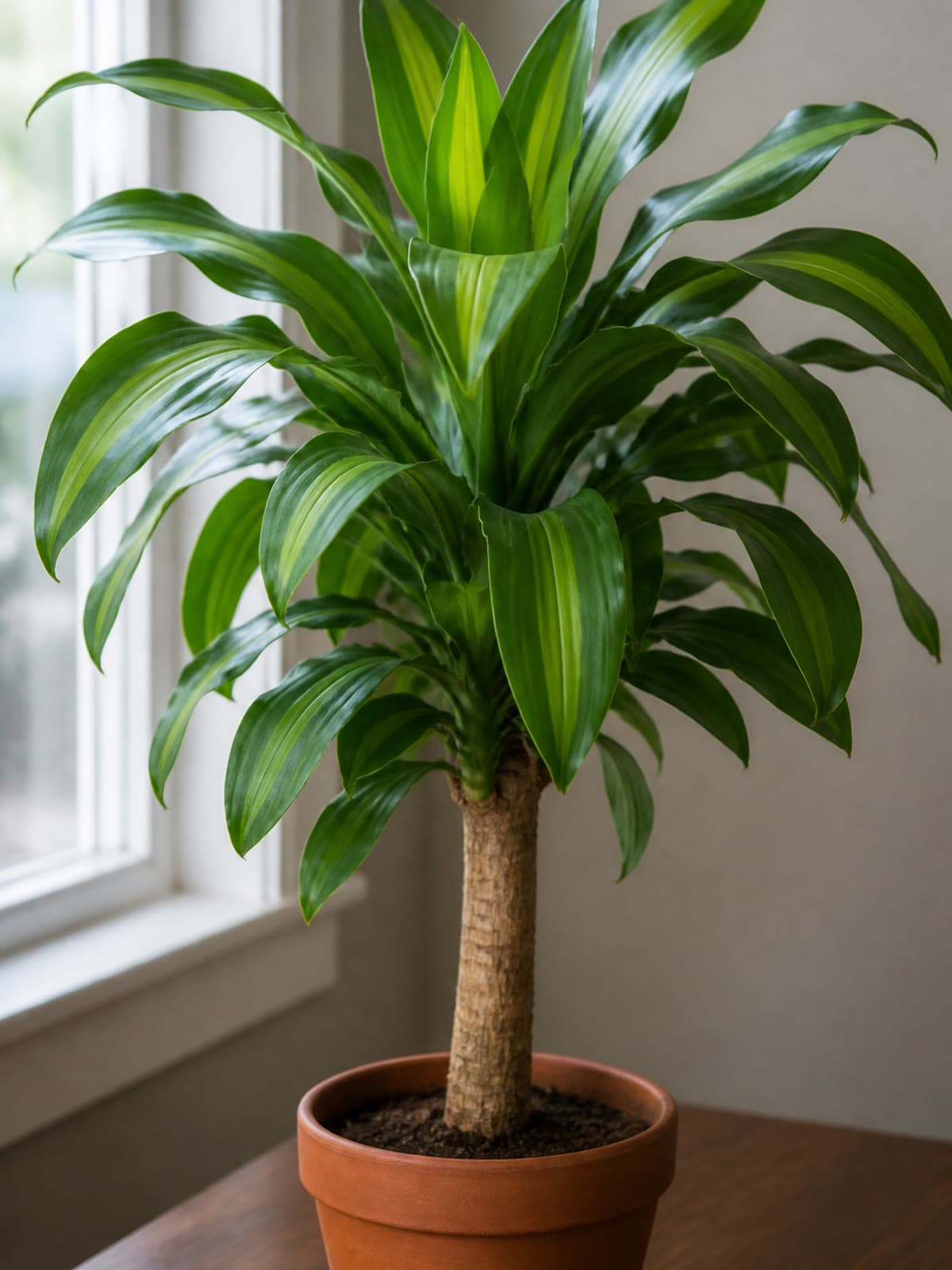
Dracaena fragrans, the corn plant, is the houseplant this guide covers. Cultivars sold as Janet Craig, Warneckii, and Massangeana sit here with the species. NCSU names Corn Plant and those cultivar labels on the same D. fragrans toolbox page, and notes that corn plant is often confused with Dracaena sanderiana (lucky bamboo). Lucky bamboo is a different plant with its own cane habit and retail packaging. Snake plant is Dracaena trifasciata (formerly Sansevieria); that species has its own leaf and division playbook at how to propagate a snake plant. Do not treat corn-plant cane recipes as snake-plant leaf cuttings.
Can you propagate a dracaena? Yes. NCSU’s Recommended Propagation Strategy for D. fragrans is stem cutting; the same toolbox line says propagate by stem cuttings. Iowa State lists Dracaena fragrans (corn plant) on its cane-cutting page and on its air-layering page. Illinois marks Dracaena for stem cuttings and air layering. Missouri lists herbaceous/softwood stem cutting, stem sections (relatively slow), and air layering. Arkansas Extension covers cane pieces and a monocot air-layer cut for dracaena. Those five extension families give you leafy tip/stem work, leafless cane sections in media, and air layering while the top stays attached.
Indoors, match the tissue you have to the method the sources name. A leafy tip is a stem cutting. A bald trunk piece is a cane cutting in perlite, coarse sand, vermiculite, or a similar drained media. A tall plant you do not want to chop free yet is an air layer. For mix after potting, see soil propagation. Wrap steps for the monocot cut live on air layering. Overview of cuttings vs layering: plant propagation. Bright indirect light matters for cane starts (Iowa cane page) and for general stem-tip work; when a room stays dim, check the propagation light DLI calculator and best grow lights for indoor propagation.
Best way indoors
| Situation | Method the sources support | Why |
|---|---|---|
| Leafy tip or soft stem piece with nodes | Stem cutting in drained media (NCSU strategy; Iowa stem-tip list names corn plant; Illinois stem recipe; Missouri herbaceous cutting) | NCSU’s named strategy. Iowa’s stem-tip list puts D. fragrans on a page whose general houseplant clock is 3 to 6 weeks for most cuttings on that page. |
| Leafless woody cane / bald trunk | Cane sections in media, horizontal or vertical (Iowa cane; NCSU cane; Illinois cane; Arkansas cane) | Sources emphasize media for cane. Iowa: new roots and shoots in 8 to 10 weeks on that cane page; pot when about 1 inch long. |
| Tall plant you want to keep upright while roots form | Air layering, monocot slanting cut (Iowa; NCSU Massangeana note; Arkansas; Illinois; Missouri) | Parent stays intact until roots are ready. Iowa: several weeks, some species several months. Arkansas: usually two to four months. Not one averaged number. |
| Water jar | Not the primary cane path. Leafy tip only as Iowa’s general stem-tip option on a page that lists corn plant | Iowa stem-tip how-to lists D. fragrans and notes many houseplants can root in a jar of water as part of that page’s general stem-tip guidance. That is not a cane-in-water recipe. Prefer media for leafless cane. Jar cadence, if you use the tip option: water propagation and the propagation water change calculator. |
Iowa gives 8 to 10 weeks for cane and 3 to 6 weeks for stem tips, and Arkansas gives two to four months for air layers.
Stem cuttings
NCSU: propagate D. fragrans by stem cuttings; Recommended Propagation Strategy is Stem Cutting.
Iowa’s stem-tip houseplant page lists Dracaena fragrans (corn plant) with that list’s general recipe: 3 to 6 inches, at least two nodes, lower leaves off, hormone optional, at least one node in the media. Most houseplant stem cuttings on that page form roots in 3 to 6 weeks. Those numbers are the list page’s general stem-tip protocol for species on the list, not a separate corn-plant-only timer printed elsewhere.
Illinois lists Dracaena under stem cuttings. Their general stem recipe is 3 to 6 inches, two to six nodes.
Missouri lists a herbaceous/softwood cutting for dracaena, and separately notes stem sections as relatively slow. Use the leafy tip path when you still have leaves and soft or semi-firm stem; use the cane section below when the piece is leafless trunk.
Media stick. Iowa and Illinois both use a 3 to 6 inch band for general stem work. Stick so at least one node sits in a drained mix. Keep leaves out of the media. Bright, indirect light and steady humidity help general stem-tip starts on Iowa’s page. Pot when roots are ready under that page’s guidance (Iowa stem-tip: about 1 inch long as the general transplant cue on that how-to). After potting, soil propagation covers drained mix habits.
Water as a leafy-tip option only. Iowa’s stem-tip how-to (the same page that lists D. fragrans) says many houseplants root in a jar of water as part of that page’s general stem-tip guidance: change water one to two times each week, never let developing roots dry in air, and transplant when roots are about 1 inch long; water-formed roots are coarser and may show transplant stress until they adapt. That jar path is general stem-tip guidance from a page that names corn plant among leafy tips. It is not a recipe for leafless cane in a jar, and it is not a leaf-only method. If you use the jar for a leafy tip, see water propagation for shared jar technique and the propagation water change calculator for change timing. Prefer media when the cutting is a bald cane.
Cane cuttings
Iowa: cane cuttings work well for Dracaena. Corn plant is on that list. Cut the leafless cane into 2- to 3-inch segments, each with at least two nodes. Hormone optional. Lay them horizontally in perlite, coarse sand, or vermiculite, just at the surface. Bright, indirect light and high humidity. On that page, new roots and shoots in 8 to 10 weeks. Pot when they are about 1 inch long.
NCSU: cane cuttings for overgrown corn plant and similar thick stems; leafless sections 2 to 3 inches, one or two nodes. Horizontal, or vertical with about half in the mix and a bud facing up. Corn plant is the named example. Pot when roots and new shoots appear. The same cane facts appear in NCSU’s Extension Gardener Handbook chapter on propagation.
Illinois: two- or three-inch cane, at least two nodes. Vertical (new leaves at exposed nodes, roots at buried ones) or horizontal (half buried).
Arkansas Extension: cane from 2 inches to many feet. For the most plants, 2-inch pieces with at least one node, on their side, half buried. Longer dracaena pieces can go in vertically, base in the mix; a shoot grows from the top bud.
Node counts differ by source. Iowa wants at least two nodes. NCSU allows one or two. Arkansas names one.
Orientation. Horizontal surface or half-buried lays are the common small-piece path (Iowa, Illinois, Arkansas for short pieces). Vertical works when a bud faces up and roughly half the piece sits in media (NCSU), or when a longer piece has its base buried (Arkansas). Mark the top end if you cut a tall cane into several pieces so you do not bury the wrong end.
Media, not a water jar, for cane. Iowa, NCSU, Illinois, and Arkansas describe cane in perlite, sand, vermiculite, or mix. They don’t describe rooting cane in water. Treat water as the leafy-tip general option above, not as a bald-trunk shortcut.
Clock. Iowa’s cane page alone owns 8 to 10 weeks for new roots and shoots, then pot at about 1 inch. NCSU and Illinois say pot when roots and new shoots appear, without that week band. Do not merge those lines.
Dim rooms slow cane starts that want bright indirect light. If the parent sat in a dark corner, move the tray nearer a bright window or use the propagation light DLI calculator before you assume the cane is “dead.”
Air layering
Iowa lists Dracaena fragrans for air layering, not simple layering. For monocots such as dracaena: a point 12 to 18 inches from the tip, an upward-slanting cut about one-third of the way through the stem, a toothpick to hold it open, hormone, moist unmilled sphagnum, plastic. Roots in several weeks; some species several months. Cut below the wrap when roots are several inches long.
NCSU names Dracaena fragrans ‘Massangeana’ (corn plant) for the same monocot cut, about 1 foot from the tip, one-third of the way through.
Arkansas: on dracaena, a diagonal slice halfway through, held open with a stick. Roots usually after two to four months.
Illinois marks air layering for Dracaena. Missouri does too.
Cut depth is not one number. One-third of the way through (Iowa, NCSU) and halfway (Arkansas) are different instructions. Follow the source you are using; do not blend them into a vague “partial cut.”
Timing varies. Iowa gives several weeks to several months, and Arkansas two to four months. Full wrap technique, sphagnum, and aftercare live on air layering.
Use air layering when the plant is tall and you want a rooted top before you sever the cane. After you cut below the root ball, pot the top in drained mix (soil propagation) and keep the stump if you want new shoots from lower buds.
Troubleshooting
Won’t root (stem tip). Confirm at least two nodes on Iowa’s stem-tip recipe and that one node sits in media with lower leaves removed. Restart with a fresher tip if the old piece dried out. Iowa’s general stem-tip band for most houseplants on that page is 3 to 6 weeks; waiting only a few days is too early. Low light slows root formation on the same general protocol; brighten the spot or check propagation light DLI.
Won’t root (cane). Confirm nodes (Iowa two; NCSU one or two; Arkansas one) and that the piece is in media, not left dry on a shelf. Iowa’s cane clock is 8 to 10 weeks. Horizontal pieces should sit just at the surface in perlite, coarse sand, or vermiculite; vertical pieces need a bud up and enough bury depth. Soft, brown cane with no firm tissue will not recover; take a new section from healthy wood.
Rot or mushy stem tip in a jar. If you tried Iowa’s general stem-tip water option on a leafy tip, cloudy water and submerged leaves invite rot. Empty the jar, clean it, and restart with a fresh tip, leaves above the water line, and a change cadence from the propagation water change calculator. Shared warning signs: water propagation. Many growers skip the jar entirely and stick tips in drained mix instead.
Soft or rotting cane in media. Overwet mix without drainage, or burying leaves with the cane, leads to collapse. Use a drained medium (Iowa’s perlite / coarse sand / vermiculite examples), keep humidity high without leaving the cane swimming, and discard pieces that are soft through. Take a new firm section with nodes.
Low light / pale, stalled starts. Iowa’s cane page wants bright, indirect light. Stem-tip work also assumes enough light for rooting on the general houseplant protocol. A north-facing interior shelf may stall both tip and cane. Raise light before you change methods. Use the propagation light DLI calculator and, if windows cannot deliver, best grow lights for indoor propagation.
Air layer stays dry or cut closes. Keep sphagnum moist inside the wrap (Iowa). Hold the monocot cut open with a toothpick or stick as Iowa, NCSU, and Arkansas describe. Do not swap in a full bark girdle meant for dicots such as rubber tree; Iowa and NCSU want the slanting monocot cut for dracaena.
Confused plant ID. Lucky bamboo (D. sanderiana) and snake plant (D. trifasciata) are not corn plant. Wrong ID sends you to the wrong cutting type. Snake plant details: how to propagate a snake plant.
Common mistakes
- Confusing this plant with lucky bamboo. NCSU: corn plant is often confused with Dracaena sanderiana.
- Treating corn plant like snake plant. Snake plant is Dracaena trifasciata, leaf and division focused, at how to propagate a snake plant.
- A cane with no node. Iowa: at least two. NCSU: one or two. Arkansas: at least one on short pieces.
- Expecting one rooting time. Iowa gives 8 to 10 weeks on cane and 3 to 6 weeks on stem tips, and Arkansas air layers take months.
- A dicot bark ring on a corn plant. Iowa and NCSU: dracaena is the slanting monocot cut, not the rubber-tree girdle.
- Putting leafless cane in a water jar because tips sometimes go in water. Cane sources here use media. Water appears only as Iowa’s general stem-tip jar option on a page that lists leafy corn-plant tips.
- Leaving cane in a dark corner and calling 8 to 10 weeks a failure. Brighten first; see the DLI tool above.
- Expecting one universal “weeks to root” for tip, cane, and air layer.
People also ask
Can you propagate a dracaena?
Yes. NCSU recommends stem cuttings for D. fragrans. Iowa lists corn plant for cane cuttings and for air layering. Illinois and Missouri also mark stem work and air layering. Arkansas covers cane and air layering on dracaena.
Tip, cane, or air layer?
NCSU’s strategy is stem cutting. Iowa also lists cane and air layering for corn plant. A leafy tip is a stem cutting (Iowa stem-tip list; Illinois stem recipe; Missouri herbaceous cutting). A bald trunk is a cane section in media (Iowa, NCSU, Illinois, Arkansas). A tall plant you do not want to cut free yet is an air layer (Iowa monocot wrap; NCSU Massangeana note; Arkansas; Illinois; Missouri).
How long does it take?
Iowa stem-tip list: 3 to 6 weeks for most houseplants on that page. Iowa cane page: 8 to 10 weeks for new roots and shoots; pot when about 1 inch long. Iowa air layering: several weeks, some species several months. Arkansas air layer: usually two to four months. Those are not one number.
Can you propagate dracaena in water?
Only with care, and only for a leafy tip under Iowa’s general stem-tip guidance on the page that lists Dracaena fragrans: many houseplants on that how-to can root in a jar, with water changes and transplant when roots are about 1 inch long. That is general stem-tip guidance, not a cane-in-water method. Leafless cane belongs in media on Iowa, NCSU, Illinois, and Arkansas cane pages. Jar technique: water propagation. Change timing: propagation water change calculator.
Tip vs cane vs air layer: which is best indoors?
For most indoor corn plants with a leafy top you can spare, a stem tip in drained media matches NCSU’s recommended strategy and Iowa’s stem-tip listing. For a bare trunk you already cut, cane sections in media are the named path, with Iowa’s 8 to 10 week cane clock. For a tall specimen you want to keep intact until rooted, air layer. Water is secondary and tip-only under the attribution above.
Is corn plant a snake plant?
No. Snake plant is Dracaena trifasciata, at how to propagate a snake plant. Corn plant is Dracaena fragrans. Lucky bamboo (D. sanderiana) is a third plant NCSU says is often confused with corn plant.