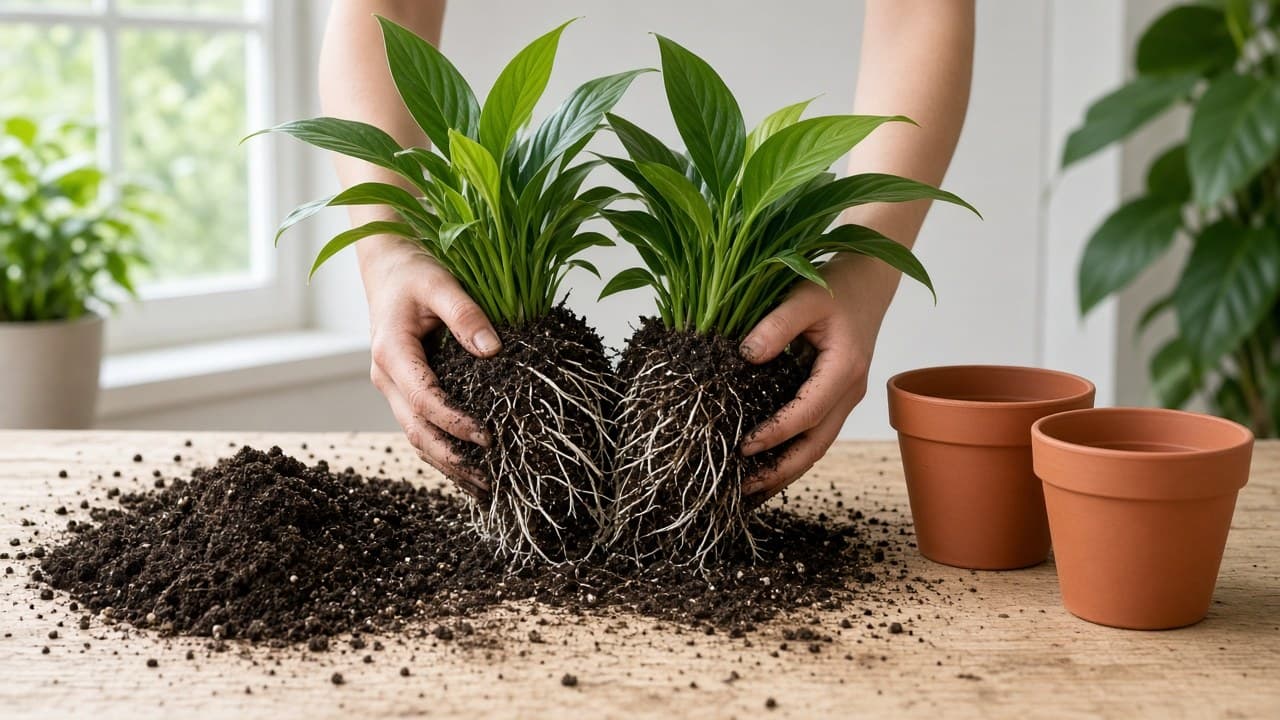
Division is how you turn one crowded houseplant into two or more plants that already have leaves and roots attached. You tip the plant out, tease or cut the root ball into pieces, and pot each piece in fresh mix. It is the usual path for clumping foliage plants such as peace lily, snake plant, and ZZ plant. Soft vines that root from a node go on water propagation or soil propagation instead. Woody trunks that should stay attached while roots form stay on air layering.
Iowa State Extension How to Propagate Houseplants by Division and Offsets (lists peace lily, snake plant / former Sansevieria, Aspidistra, Strelitzia, Asparagus densiflorus, and others): early spring is ideal, though most houseplants can be divided any time of year; remove from the container; loosen the root ball by hand; use a knife, sharp spade, or saw if the ball will not separate; each piece needs healthy leaves, stems, and roots; larger pieces recover faster; replant in fresh potting soil in a pot sized to the piece (often smaller); water to settle soil; bright indirect light; wait a few weeks before fertilizing. UNL G1853: division is the quickest way for plants that make stems at the base; fingers or a knife; each division should have some roots; plants can be divided at any time, with the dormant or rest period best. NCSU Wayne County includes prayer plant among houseplants you split at the roots: unpot, gently pry the roots apart, pot each clump.
Outdoor perennial borders and lawn division calendars are out of scope. This guide is indoor houseplants only. Beginner plant chooser: easiest indoor plants to propagate.
When to divide
Iowa State: early spring is ideal for most houseplants on that page; any time of year can work if the parent is healthy. UNL: any time, with the dormant or rest period preferred. UF/IFAS often names spring for peace lily and similar clumps. Species pages may add plant-specific windows (for example Clemson spring / early summer for cast iron plant while actively growing; Mississippi State spring or fall for Aspidistra).
Common signals that a clump is ready:
- Crowded offsets or pups filling the pot (Iowa State division-and-offsets framing). Roots circling hard against the pot wall or pushing through drainage holes
- Water that runs straight through a root-bound ball, or a plant that dries out within a day of watering
Do not invent a fixed “every N years” clock. Iowa State notes some plants (including Aspidistra / cast iron on its easy-houseplants notes) are harmed by frequent repotting, so divide infrequently when the clump truly needs it.
Materials
- Sharp clean knife, spade, or saw (Iowa State: use a blade if the ball will not pull apart). Fresh potting mix and drained pots sized to each new piece (often smaller than the mother pot). Optional stakes for floppy divisions (NCSU Wayne County notes staking until roots take hold on prayer plant)
Rooting hormone is usually unnecessary for division pieces that already have roots. Hormone notes for stick-in-mix cuttings live on the soil propagation FAQ, not here.
Step sequence
- Water the parent lightly the day before if the mix is bone-dry, so the ball holds together when you tip it out (general handling; preferred sources do not print a soak recipe for every species).
- Tip the plant out of its pot (Iowa State; NCSU Wayne County).
- Lay the root ball on its side and loosen it by hand into smaller pieces (Iowa State).
- If the rhizomes or roots will not pull apart, cut with a knife, sharp spade, or saw (Iowa State; UNL).
- Check each piece: healthy leaves, stems (or petioles), and roots. Prefer larger pieces when recovery matters (Iowa State). Species pages add leaf counts where sources name them (for example Clemson ≥2 leaves and Mississippi State 2-3 leaves with healthy roots on cast iron plant).
- Pot into fresh potting soil in a container sized to the piece. Water once to settle soil (Iowa State). Mix and drainage habits: soil propagation.
- Bright indirect light. Wait a few weeks before fertilizing (Iowa State).
Skip invented “days until the division roots” clocks. These pieces already have roots; they need recovery, not a jar week count.
Aftercare
Keep the new pots drained. Overwatering a freshly cut rhizome in a huge wet pot is a common failure mode on species pages that warn about soggy mix (for example RHS / Clemson on cast iron plant). Match light to the species guide: most want bright indirect light after the split; harsh direct sun can scorch soft foliage.
If the recovery spot is dim and growth stalls while the mix stays appropriately moist, check daily light with the propagation light DLI calculator. Fixture distance and hours: best grow lights for indoor propagation.
Which houseplants on this site use division
Open the species guide for plant-specific leaf counts, timing, and caveats. This list is the indoor division grid, not a second copy of each recipe.
Clump and rhizome splits
- Peace lily (Spathiphyllum). Iowa State, UNL, NCSU, UF/IFAS, and Illinois point at division (Illinois: division only, not stem or leaf cuttings).
- Snake plant (Dracaena trifasciata / former Sansevieria). Division gives a finished plant with roots; leaf sections are a slower alternate.
- ZZ plant (Zamioculcas zamiifolia). NCSU: division and leaf cutting; prefer division for a first win.
- Cast iron plant (Aspidistra elatior). Rhizome or clump division only on preferred sources.
- Bird of paradise (Strelitzia). NCSU, Clemson, UF/IFAS, and Iowa State lean division of rhizomes or suckers.
- Alocasia (indoor elephant ear). NCSU offsets; RHS rhizome division in late spring or early summer.
- Prayer plant (Maranta leuconeura). NCSU rhizomatous division; UNL lists division.
- Oxalis / false shamrock (Oxalis triangularis). NCSU rhizome or scale-leaf division; UAEX: division best.
- Asparagus fern (Asparagus spp.). Iowa State marks A. densiflorus for division; Wisconsin, UF, and RHS also name division (not a true fern).
Ferns that divide or runner
- Boston fern (Nephrolepis exaltata 'Bostoniensis'). Wisconsin: easier to divide than to grow named cultivars from spores; division and/or stolons on several extension pages.
Pups and offsets (related, not the same cut)
- Spider plant (Chlorophytum comosum). Iowa State marks layering, division, and offsets/plantlets. Runner plantlets (spiderettes) are often rooted while attached or detached into water or mix. That is offset or layering work next to mother-plant crown division. A pup on a stolon is not the same cut as splitting a peace-lily rhizome clump, even though both end in a new pot.
Beginners choosing which plant to try first: easiest indoor plants to propagate.
When division is the wrong tool
| What you have | Better method |
|---|---|
| Soft stem with a node (pothos, heartleaf philodendron, tradescantia, coleus) | Water or soil cuttings |
| Thick woody trunk you do not want as a bare stick (many Ficus) | Air layering |
| Single leaf on a plant that leaf-cuts (many peperomias, many succulents) | Species guide + soil propagation |
| Crowded clump with several crowns or rhizomes | Division (this page + species guide) |
Common mistakes
- Cutting a soft vine into “divisions” when the plant wants a node cutting (Iowa State / Illinois method tables).
- Tiny pieces with no roots (Iowa State: each piece needs roots; larger pieces recover faster).
- Inventing blog week counts for “rooted divisions” when the piece already had roots and sources only describe recovery.
- Overwatering in a pot far too large for the new piece (settle once, then ease toward the species’ moisture habit).
- Dividing cast iron and similar plants too often (Iowa State: frequent repotting can harm Aspidistra).
- Harsh direct sun on soft new divisions, or a cold drafty sill while the cut surface settles.
- Treating spiderette potting as identical to rhizome division without reading the spider plant guide.
People also ask
How do you divide a houseplant?
Unpot, loosen or cut the root ball into pieces with healthy leaves and roots, pot each piece in fresh mix, water to settle, and give bright indirect light (Iowa State; UNL; NCSU Wayne County). Species pages add leaf counts and timing where sources name them.
When should I divide houseplants?
Iowa State: early spring is ideal; most houseplants any time of year. UNL: any time, rest period preferred. UF/IFAS often names spring. Follow the species guide when it cites a tighter window.
Do divisions need rooting hormone?
Usually no. The pieces already have roots. Hormone for stick-in-mix cuttings is covered on soil propagation.
Is dividing the same as taking cuttings?
No. Division keeps leaves and roots on each piece. Cuttings start without a finished root system and belong on water, soil, or air-layering guides.
Which houseplants are easiest to divide?
Peace lily, snake plant (division path), ZZ by division, Boston fern, and spider plant (pups or crown) are common indoor starts. See easiest indoor plants to propagate and the species links above.
Can I divide in winter?
Iowa State allows any time of year for most houseplants on that page if the parent is healthy. UNL prefers the rest period. Growth may be slower in short days; keep light and moisture honest, and use the DLI calculator if the room is dim.