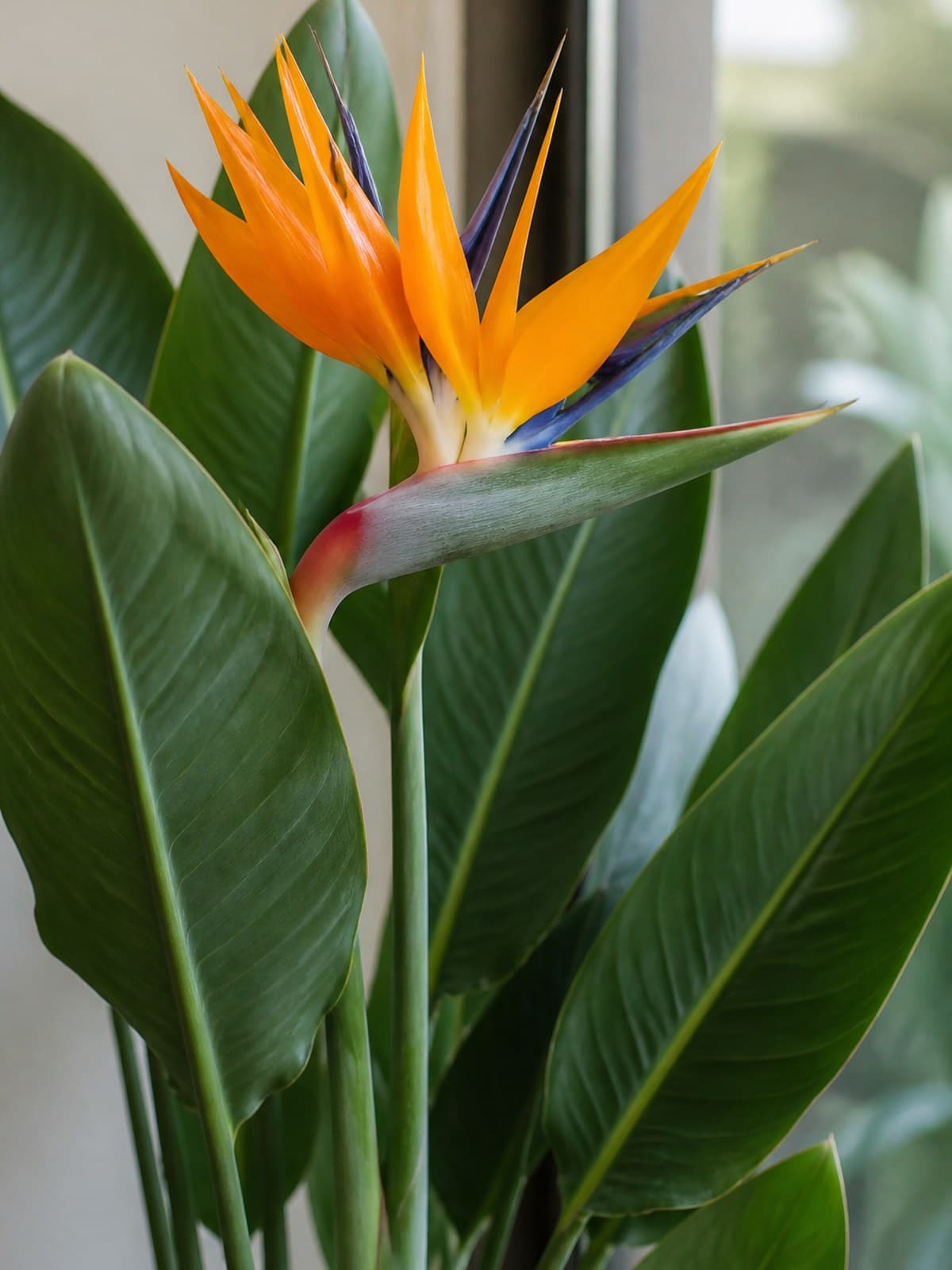
Bird of paradise is Strelitzia. The usual houseplant is Strelitzia reginae. Clemson also describes the white and giant plants (Strelitzia alba and Strelitzia nicolai) and the juncea form. Those names belong in this guide. UF/IFAS Gardening Solutions calls white bird of paradise Strelitzia nicolai and says propagation is easiest by division. Clemson’s naming (white = S. alba, giant = S. nicolai) and UF’s white-nicolai label are different source labels for related plants. Do not fuse them into one Latin for “white.”
Can you propagate bird of paradise? Yes. NCSU’s recommended strategy for S. reginae is division. The leaves rise from underground rhizomes. Clemson: the easiest way is to divide those rhizomes. UF/IFAS MG106: easily propagated by division. Iowa State puts Strelitzia reginae on its division-and-offsets list, with cuttings and layering left blank for this species. Wisconsin: seed or division. NCSU lists division or seed for S. nicolai. Hawaii CTAHR OF-27 also describes division and seed for bird-of-paradise under its own clocks.
That rhizome habit is why method choice stays narrow. Extension sources name division, seed, or both. They do not give a leaf-cutting recipe, a stem-cutting recipe, or a water-jar protocol for this plant. A paddle leaf in a jar is not a supported start on these sources.
For drained mix after a division settles, see soil propagation. Overview of cuttings vs division vs seed for houseplants in general: plant propagation. Shared pot-splitting habits that are not species-specific: how to divide houseplants.
Best way indoors
| Situation | Method the sources support | Why |
|---|---|---|
| Crowded S. reginae clump, early spring before new growth | Rhizome division (Clemson HGIC 1562) | Each piece a fan with roots; small pot; warm bright indirect eight weeks, then bright sunlight; flower two to three years. |
| Old clump with four to five shoots, late spring or early summer | Single-stem divisions (UF/IFAS MG106; Hawaii OF-27 similar timing) | Same depth as before; moist until established at least three months, then fertilize; flower one to two years (MG106 / OF-27). |
| Houseplant out of the pot any season (early spring ideal) | Division with healthy leaves, stems, roots (Iowa) | Larger piece recovers faster; fresh mix; settle with water; bright indirect; wait a few weeks before fertilizer. Cuttings and layering blank for this species on that page. |
| Blooming plant you still want to split | Division or young suckers (Wisconsin); keep FPS-563 caveat in view | Wisconsin: may not bloom again for a few years after dividing a long-blooming plant; or lift young suckers. FPS-563: flower more freely crowded, best left undisturbed. |
| Fresh seed, willing to wait years | Seed (Clemson / UF MG106 / Wisconsin / Hawaii OF-27) | Separate pretreatments and year windows per source. Not the fast indoor default. FPS-563: many nursery operators report seeds are difficult to germinate. |
| Leaf tip, stem piece, or water jar | Not supported on cited sources | NCSU, Clemson, UF, Iowa, Wisconsin, and Hawaii name division and/or seed only for this plant. |
Clemson divides in early spring and UF in late spring or early summer. Clemson gives eight weeks in bright indirect light, UF at least three months moist before fertilizer, and Iowa a few weeks before fertilizer. UF expects flowers in one to two years and Clemson in two to three. Wisconsin’s seed step is to remove the orange tuft, while Clemson and UF scarify with a file.
What bird of paradise can be propagated
Strelitzia is the genus. Strelitzia reginae is the orange-and-blue crane flower most people mean indoors. Clemson also covers white (S. alba), giant (S. nicolai), and a juncea form on the same fact sheet. NCSU separates strategies by species: division for S. reginae; division or seed for S. nicolai. UF Gardening Solutions calls S. nicolai the white bird of paradise and says it is easiest by division, while Clemson calls S. alba white and S. nicolai giant.
Leaves rise from underground rhizomes (NCSU). That architecture is why division of fans or clumps is the home path, and why a detached leaf or stem without a rooted rhizome piece is not the method these pages teach. Seed is a second named path with long waits to flower and pretreatments that differ by source.
Indoor only on this page. Outdoor landscape notes on the extension sheets stay on those sheets; the how-to below follows the houseplant division and seed lines.
Division
Division is the primary home path. Clemson, UF/IFAS MG106, Iowa, Wisconsin, NCSU, UF Gardening Solutions (white), and Hawaii OF-27 all support it in their own words. Read each block as its own protocol. Shared habits for crowded pots live on how to divide houseplants; the species clocks below stay on the bird-of-paradise sources.
Clemson (early spring, fan with roots, eight weeks)
Clemson HGIC 1562. Easiest propagation by dividing rhizomes in early spring before new growth. Lift the plant. Cut the rhizome so each piece is a fan with roots attached. Pot in a small container, water, and keep it warm in bright, indirect light for eight weeks while it makes new roots. Then move it into bright sunlight. Flowering in two to three years.
Piece rule on Clemson. A fan with roots. A rhizome chunk with no roots, or a leaf fan stripped of rhizome and roots, is not the piece that page describes.
Season on Clemson. Early spring, before new growth. That is not UF’s late spring or early summer window.
Clock on Clemson. Eight weeks of warm bright indirect light while new roots form, then bright sunlight. That eight-week band is Clemson’s. It is not UF’s moist-for-at-least-three-months line, and it is not Iowa’s few weeks before fertilizer.
UF/IFAS MG106 (late spring or early summer, single-stem, three months)
UF/IFAS MG106. Easily propagated by division. Dig and separate old clumps. Divide those with four to five shoots into single-stem divisions. Late spring or early summer. Replant at the same depth they grew before. Keep the soil moist until roots are established, at least three months, then start fertilizer. Flowering in one to two years.
Piece rule on MG106. Old clumps of four to five shoots become single-stem divisions. That clump count and single-stem target belong on MG106. Do not paste them onto Clemson’s fan-with-roots wording as if they were one sentence.
Season on MG106. Late spring or early summer. Hawaii CTAHR OF-27 uses the same season band for division and similar piece language (single-stem divisions from clumps with four to five young shoots; same soil depth; moist until roots establish, usually at least three months; divisions flower in one to two years). OF-27 also notes that in their conditions the success rate of division was lower than seed. Keep that Hawaii outcome on OF-27; do not rewrite Clemson or Iowa with it.
Depth on MG106 / OF-27. Same soil depth as before. Planting deeper than the plant grew is a named risk path on these pages (flowering can lag when depth changes).
Iowa (healthy leaves + stems + roots; few weeks before fertilizer)
Iowa State Extension (division and offsets, Jan 2025). Strelitzia reginae (Bird of Paradise) is on the list. Out of the pot, loosen the ball; use a knife if it will not pull apart. Each piece needs healthy leaves, stems, and roots. A larger piece recovers faster. Fresh mix, water to settle, bright indirect light. Wait a few weeks before fertilizing. Early spring is ideal; most houseplants on that page can be divided any time of year. Cuttings and layering are left blank for this species on that page.
Piece rule on Iowa. Healthy leaves, stems, and roots on each piece. Larger recovers faster. That sizing note is Iowa’s, not a substitute for Clemson’s fan-with-roots or MG106’s four-to-five-shoot clump math.
Season on Iowa. Early spring ideal; any time of year is allowed for most houseplants on that page. Do not erase Clemson’s “before new growth” or UF’s late spring / early summer by averaging all three into one calendar tip.
Fertilizer clock on Iowa. A few weeks before fertilizing. That is not Clemson’s eight weeks of rooting light, and it is not UF’s fertilize-after-at-least-three-months line.
White and giant names on division
UF Gardening Solutions: white bird of paradise (Strelitzia nicolai), propagation easiest by division. NCSU: division or seed for S. nicolai. Clemson describes white (S. alba) and giant (S. nicolai) on the same sheet as S. reginae. Those names stay in this guide. Confirm the tag before you apply a species-specific NCSU strategy line.
After division
Recovery is not one averaged calendar.
Clemson aftercare. Small pot, water, warm bright indirect light for eight weeks while new roots form, then bright sunlight. Flower expectation on that sheet: two to three years.
UF/IFAS MG106 aftercare. Same depth. Soil moist until roots are established, at least three months, then fertilize. Flower expectation on that sheet: one to two years. Hawaii OF-27 tracks the same moist-until-established / usually at least three months / flower in one to two years pattern for divisions.
Iowa aftercare. Fresh mix, water to settle, bright indirect. Wait a few weeks before fertilizer. Iowa does not give a separate eight-week or three-month rooting band for Strelitzia on that page; keep “a few weeks before fertilizing” as Iowa’s named wait.
Light while roots re-establish. Clemson and Iowa both call for bright indirect light in the early window. Dim corners stall new roots and invite soft tissue in a wet pot. Measure or estimate available light with the propagation light DLI calculator. When windows cannot deliver bright indirect conditions, see best grow lights for indoor propagation.
Mix and pot size. Clemson uses a small container for the new piece. A oversized pot that stays wet is a waterlogging risk, not a faster recovery path. Shared drained-mix habits after the piece is potted: soil propagation. Iowa calls for fresh mix, UF and Hawaii keep the division moist until established, and Clemson uses a small pot.
The waits differ. Eight weeks (Clemson) ≠ at least three months moist before fertilizer (UF) ≠ a few weeks before fertilizer (Iowa). One to two years to flower (UF / Hawaii) ≠ two to three years (Clemson). Follow the page you used for the cut.
When division can delay flowers
Division multiplies plants. It can also push flowering out. Keep the caveats next to the how-to.
Wisconsin. Plants that have been blooming for a few years can be divided, but that may keep them from blooming again for a few years. Or lift young suckers off the parent. Wisconsin also notes plants bloom more when pot-bound.
UF/IFAS FPS-563. Propagation by seed or division. Plants seem to flower more freely under crowded conditions and are best left undisturbed. Many nursery operators report the seeds are difficult to germinate. That “best left undisturbed” line sits beside UF’s own MG106 division how-to. Both apply: MG106 teaches how to divide; FPS-563 warns that crowding favors bloom and disturbance is not free.
Flower windows after a successful split. UF MG106 and Hawaii OF-27: divisions flower in one to two years. Clemson: flowering in two to three years. Those are source windows after division, not a promise that every piece will bloom on schedule. Wisconsin’s multi-year bloom pause after dividing a long-blooming plant is a separate named outcome.
If the goal is flower continuity on the parent, Wisconsin’s sucker option and FPS-563’s leave-crowded note matter as much as the knife cut.
Seed
Seed is supported. It is slow to flower compared with a rooted division, and pretreatments differ by source. FPS-563: many nursery operators report the seeds are difficult to germinate. Follow one sheet. Do not merge Wisconsin’s tuft removal with Clemson or UF file scarification into a single kitchen recipe.
Clemson seed
Clemson HGIC 1562. Seed is possible. Offspring vary. Flowering in four to 10 years or more. Seed needs to be fresh, less than six months old, and scarified with a file. Press into moist seed mix, cover, indirect light. Bottom heat of 75 to 90 °F. Seedlings in six to 12 weeks.
UF/IFAS MG106 seed
UF/IFAS MG106. Three to five years to bloom. Black seeds with orange fuzz. Soak in lukewarm water one or two days, then nick the coat. Scarified seeds usually germinate in one to two months. Some gardeners chill un-scarified seed at 40 to 45 °F for two weeks, then scarify. Sow ½ to 1 inch deep. Soil stays damp. Germination can take one month to a year depending on pre-treatment. Pot on when there are two true leaves.
Wisconsin seed
Wisconsin Horticulture (Mahr). Four to seven years to bloom. Germination may take up to eight weeks or more. Sow fresh seed in spring. Soak 24 hours and remove the bright orange tuft, then place 1 inch deep in moist mix and keep warm (85 °F). Transplant when seedlings have two to three leaves.
Hawaii CTAHR OF-27 seed
Hawaii CTAHR OF-27. Seed: three to five years; germinate in two to three months if kept moist; scratch hard coat with a file. OF-27’s division-vs-seed success note (division success rate lower than seed in their conditions) stays on that sheet and does not rewrite Clemson’s “easiest by dividing rhizomes” line for other climates.
Why seed is not the fast indoor default
Year-to-flower bands run from UF / Hawaii’s three to five years through Wisconsin’s four to seven to Clemson’s four to 10 or more. Germination clocks run from Clemson’s six to 12 weeks for seedlings, through Wisconsin’s up to eight weeks or more, through UF’s one month to a year by pretreatment, through Hawaii’s two to three months if kept moist. Offspring can vary (Clemson). Nursery operators report difficulty (FPS-563). A rooted fan from division is the shorter path to a plant that already matches the parent on these pages.
Light for seedlings. Indirect light (Clemson) and warm moist conditions appear across the seed sheets. Dim shelves stall germination trays the same way they stall new divisions. Check the propagation light DLI calculator when a tray sits far from a window.
Light while propagating
A new bird of paradise division and a seed tray do not share one light setting.
Clemson keeps a divided fan warm in bright, indirect light for eight weeks while new roots form, then moves it into bright sunlight. Those eight weeks are a phase length. They are not a count of hours in a day. Iowa keeps a division in bright indirect light only. Iowa does not add a sunlight step. Iowa’s few weeks are a wait before fertilizer, not a light duration.
A Clemson seed tray is a different job. Seed goes into moist mix, under a cover, in indirect light. That is indirect light, not bright indirect light, and not bright sunlight. Do not put a new division under that seed cover. Do not move a seed tray into bright sunlight because a rooted division later wants it.
Wisconsin’s bright orange tuft is the color of the seed coat. It is not a light setting.
UF, Hawaii, Wisconsin culture notes, NCSU, FPS-563, and Gardening Solutions do not name brightness for this plant. Do not borrow Clemson or Iowa light onto those protocols.
A dim corner stalls new roots in a wet pot. When windows cannot deliver bright indirect conditions for a new division, meter the spot with the propagation light DLI calculator. Fixture distance for a lamp that fills a weak window is on best grow lights for indoor propagation. A division follows the light its source named. A seedling stays on Clemson’s indirect light.
Troubleshooting
No roots / damaged rhizome. Clemson wants a fan with roots. Iowa wants healthy leaves, stems, and roots on each piece. A rhizome piece with crushed or missing roots, or a leaf fan with no rhizome attached, is not the starting piece those pages describe. Take a fresh piece that still meets the source’s piece rule, or leave the plant undivided (FPS-563: best left undisturbed when bloom is the goal).
Floppy leaves after potting. New divisions often look tired while roots re-form. These sources don’t give a watering amount, a misting schedule, or a humidity level for that stage. Confirm the piece still has roots (Clemson / Iowa), the pot is not sitting in standing water, light is bright indirect in the early window (Clemson / Iowa), and you have not planted deeper than before (UF). Raise light with the propagation light DLI calculator before blaming the cultivar.
Waterlogging or a pot that is too big. Clemson starts divisions in a small container. A large pot that stays wet holds water around a cut rhizome. Prefer drained mix and a pot sized to the piece. Shared drained-mix habits: soil propagation.
Planted deeper than before. UF MG106 and Hawaii OF-27: replant at the same soil depth. Deeper planting is a named way to slow flowering. Match the old soil line on the stem when you pot up.
Fertilizer too soon. Iowa: wait a few weeks before fertilizing. UF MG106: keep moist until roots establish, at least three months, then fertilize. Those are different waits.
Flower expectations after division. UF / Hawaii: one to two years. Clemson: two to three years. Wisconsin: dividing a plant that has bloomed for a few years may keep it from blooming again for a few years. FPS-563: crowded plants flower more freely and are best left undisturbed. Name the window you are using. Do not promise bloom next season.
Leaf, stem, or water-jar attempt. NCSU, Clemson, UF, Iowa, Wisconsin, and Hawaii list division and/or seed for this plant. They do not give a stem-cutting recipe, a leaf-cutting recipe, or a water-jar protocol. None of these sources describe rooting a paddle leaf in water.
Species confusion (reginae / nicolai / white). S. reginae is the usual orange-and-blue houseplant; NCSU strategy is division. S. nicolai is giant on Clemson; NCSU allows division or seed. Clemson’s white is S. alba; UF Gardening Solutions’s white bird of paradise line uses S. nicolai and easiest-by-division. Confirm the label before you apply a species strategy or expect flower color from a seedling (Clemson: offspring vary).
Common mistakes
- Treating a leaf tip or stem piece in a jar as the method. Sources list division and/or seed, not cuttings or water rooting for this species.
- Expecting one “spring” date. Clemson divides in early spring and UF in late spring or early summer.
- Expecting one recovery wait. Clemson gives eight weeks, UF at least three months, and Iowa a few weeks before fertilizer.
- Expecting one flowering time after division. UF gives one to two years and Clemson two to three.
- Expecting one flowering time from seed. Clemson gives four to 10 years, UF and Hawaii three to five, and Wisconsin four to seven.
- Blending Wisconsin’s “remove the orange tuft” with Clemson / UF / Hawaii file scarify or nick into one pretreatment.
- Planting deeper than the plant grew (UF / Hawaii: same depth).
- Fertilizing on Iowa’s day-three instinct while following UF’s three-month moist establishment.
- Ignoring FPS-563’s crowded-and-undisturbed bloom note when the goal is flowers, not more pots.
- Using UF Gardening Solutions’s white-nicolai label and Clemson’s white-alba / giant-nicolai pair as if they were one Latin assignment.
- Expecting a water-jar timeline or a leaf-cutting length. None of the cited sheets provide those for bird of paradise.
- Judging a Clemson division at day ten against an eight-week rooting window, or a UF division at week four against a three-month moist establishment window.
People also ask
Can you propagate bird of paradise?
Yes. Division of rhizomes or clumps is the primary home path (Clemson, UF MG106, Iowa, Wisconsin, NCSU for S. reginae, UF white note, Hawaii OF-27). Seed is also named (Clemson, UF MG106, Wisconsin, NCSU for S. nicolai, Hawaii OF-27), with long waits to flower and pretreatments that differ by source. Cuttings and layering are blank for this species on Iowa’s division page. No cited sheet here gives a leaf or stem cutting recipe or a water-jar protocol.
Can I root a cutting or a leaf in water?
Not on the extension pages used here. Those pages list division and/or seed. They do not give a stem-cutting recipe, a leaf-cutting recipe, or a water-jar protocol for bird of paradise. Use rhizome division or seed instead.
When do I divide?
Clemson: early spring, before new growth. Iowa: early spring is ideal; most houseplants on that page can be divided any time of year. UF MG106 and Hawaii OF-27: late spring or early summer. Those are not one date. Pick the source you are following.
How long until flowers after division?
UF MG106 and Hawaii OF-27: one to two years. Clemson: two to three years. Wisconsin: dividing a long-blooming plant may keep it from blooming again for a few years. FPS-563: plants flower more freely when crowded and are best left undisturbed.
How long for seed to germinate and bloom?
Clemson: seedlings in six to 12 weeks; flower in four to 10 years or more; fresh seed under six months; file scarify; bottom heat 75 to 90 °F. UF MG106: scarified usually one to two months; overall germination one month to a year by pretreatment; flower in three to five years. Wisconsin: up to eight weeks or more to germinate; flower in four to seven years; soak 24 hours and remove the orange tuft; 85 °F. Hawaii OF-27: two to three months if kept moist; flower in three to five years; scratch with a file. FPS-563: many nursery operators report seeds are difficult.
White or giant bird of paradise?
Those names belong here. Clemson describes white (S. alba), giant (S. nicolai), and juncea on the same sheet as S. reginae. UF Gardening Solutions: white bird of paradise (S. nicolai), easiest by division. NCSU: division for S. reginae; division or seed for S. nicolai.
Seed or division for a houseplant?
Division is the shorter path to a plant that already matches the parent on these pages (Clemson calls dividing rhizomes the easiest way; UF MG106 easily by division; Iowa lists the species for division with cuttings blank). Seed works with patience and separate pretreatments; year-to-flower counts run three to five (UF / Hawaii), four to seven (Wisconsin), or four to 10 or more (Clemson), and FPS-563 notes nursery difficulty. Hawaii OF-27 reported higher seed than division success in their conditions; that outcome stays on OF-27 and does not erase Clemson’s easiest-by-division line elsewhere.
Do I need grow lights?
The cited sheets ask for bright indirect light while new roots form (Clemson, Iowa) and indirect light for seed trays (Clemson). They do not prescribe a branded fixture. If the room is dim, measure with the propagation light DLI calculator and, when windows cannot deliver, use best grow lights for indoor propagation.
Keep reading
- Plant propagation for cuttings vs division vs seed in general
- Soil propagation for drained mix after a division settles
- How to divide houseplants for shared pot-splitting habits
- Best grow lights for indoor propagation when bright indirect light is short
- Propagation light DLI calculator to check light while roots re-establish