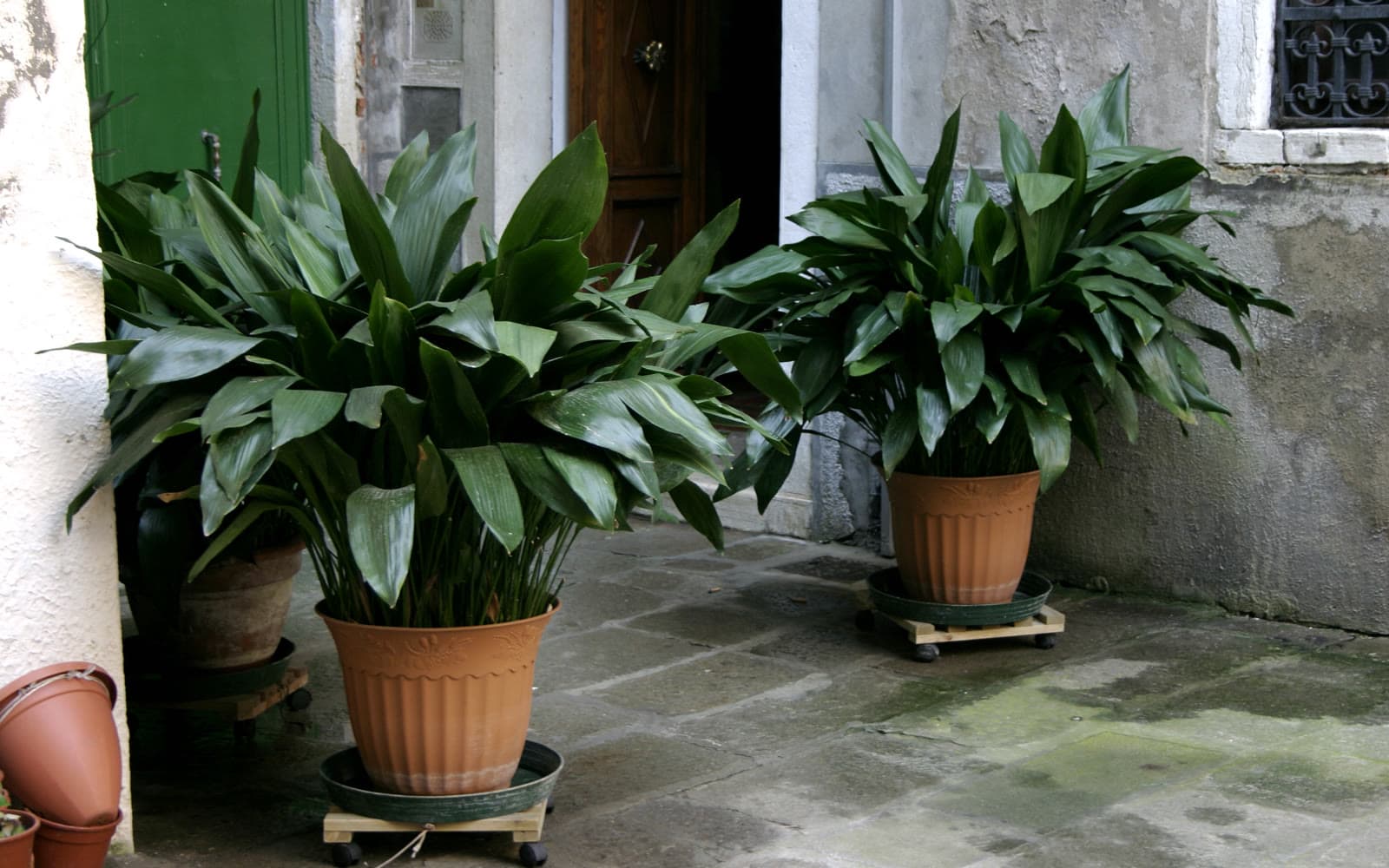
Cast iron plant is Aspidistra elatior. Labels may say bar room plant, barroom plant, iron plant, or common aspidistra. Same plant. Family Asparagaceae. NCSU species page lists Japan as country of origin; Clemson and Mississippi State describe it as native to Asia / East Asian forest understory. Evergreen rhizomatous perennial. Glossy dark green lance-shaped leaves on long petioles, rising from underground rhizomes rather than upright stems. NCSU: height and width about 1 to 3 feet; entire leaf often 20 to 24 inches; petioles 7 to 12 inches. RHS profile: evergreen rhizomatous perennial to about 60 cm with inconspicuous dull brownish-cream flowers at soil level in early summer.
Distinct from hosta (NCSU notes cast iron as a shade “hosta substitute”) and from other Aspidistra species and cultivars UF/IFAS lists beside A. elatior. This page is for A. elatior, the usual cast iron / bar room houseplant.
NCSU genus Aspidistra Recommended Propagation Strategy is Division. RHS How to grow aspidistras: divide a large clump in spring by cutting thick fleshy rhizomes so each section has several leaves. Clemson: divide when actively growing, spring and early summer; divisions need two or more leaves. UF/IFAS: propagation by division of the matted clumps. Mississippi State: rhizome division in spring or fall; each division at least 2 to 3 leaves with healthy roots. Iowa State marks Aspidistra elatior for division only in its houseplant method table (not leaf, stem, layering, or offsets).
Indoor foliage focus. For mix after division, see soil propagation. Water lives on water propagation; opened primaries do not name water rooting for this species.
Division (rhizome)
This is the method named across opened extension and RHS pages for cast iron plant.
RHS How to grow aspidistras: make new plants by dividing a large clump in spring. Cut through the thick fleshy rhizomes. Each new section needs several leaves.
Clemson HGIC (A. elatior): divide plants when they are actively growing, in spring and early summer. Be sure the divisions have two or more leaves.
Mississippi State Extension (A. elatior for cut foliage): propagate through rhizome division during spring or fall. Each division should have a minimum of 2 to 3 leaves and healthy roots attached.
UF/IFAS FPS53 (Aspidistra spp., naming A. elatior as the most common landscaping species): Propagation is by division of the matted clumps. No cutting lengths or days-to-root on that factsheet.
NCSU genus Aspidistra: Recommended Propagation Strategy Division; plants spread by rhizomes. NCSU species A. elatior page describes rhizomatous clumping habit and acaulescent growth (apparent “stems” are petioles) but does not print a separate Recommended Propagation Strategy field on the opened species page.
Iowa State division-and-offsets how-to (lists Aspidistra elatior among houseplants best propagated by division): early spring is ideal, though most houseplants can be divided any time of year. Remove from the container; loosen the root ball by hand into smaller pieces; use a knife, sharp spade, or saw if the ball will not separate; each piece needs healthy leaves, stems, and roots; larger pieces recover faster; replant in fresh potting soil in a suitably sized (often smaller) pot; water to settle soil; bright indirect light; wait a few weeks before fertilizing. Those steps are Iowa State’s general division protocol applied to a species it names for division, not a cast-iron-only timing claim beyond the early-spring preference stated on that page.
RHS Perennials: dividing advice (general clump-forming perennials, not Aspidistra-specific): lift gently; shake off excess soil; fibrous or fleshy crowns may need a sharp knife or spade; plant divisions promptly and water well. Use only as genus-level technique support for how to cut a tough clump; prefer the aspidistra-named RHS grow guide for species wording.
Iowa State easy houseplants note for A. elatior: plants are harmed by frequent repotting, so divide and repot infrequently.
Seed, cuttings, and water
Opened NCSU, Clemson, RHS aspidistra grow guide, UF/IFAS, Mississippi State, and Iowa State pages do not give a home seed protocol, leaf-cutting recipe, stem-cutting recipe, or water-rooting protocol for Aspidistra elatior. Iowa State’s method table marks division only for this species. Do not invent leaf or water steps from blogs.
Common mistakes
- Treating cast iron as a stem- or leaf-cutting plant like pothos or peperomia when Iowa State and the opened Aspidistra pages point to division.
- Inventing blog week counts for “rooted rhizomes” that opened extension/RHS pages do not state for this species.
- Copying Clemson’s two-or-more-leaves rule or Mississippi State’s 2 to 3 leaves as if every source used the same number without attributing.
- Dividing too often; Iowa State says frequent repotting harms this plant.
- Overwatering divisions; RHS aspidistra grow guide warns soggy compost can rot roots; Clemson says the plant does not like wet soil and, indoors, not to leave water in the saucer.
- Setting divisions in direct sun; Clemson, NCSU, RHS, and UF/IFAS all flag scorch or bleaching from strong sun.
People also ask
Is cast iron plant Aspidistra elatior?
Yes. NCSU, RHS, Clemson, UF/IFAS, Mississippi State, and Iowa State use Aspidistra elatior for cast iron / bar room plant. Family Asparagaceae.
How do you propagate cast iron plant?
By division of the rhizome clump. NCSU genus: Division. RHS: divide in spring through thick fleshy rhizomes with several leaves per section. Clemson: spring and early summer, two or more leaves. Mississippi State: spring or fall, 2 to 3 leaves and healthy roots. UF/IFAS: division of matted clumps. Iowa State: division listed for this species.
Can you propagate cast iron plant from a leaf or in water?
Opened preferred primaries do not name leaf cuttings or water rooting for A. elatior. Iowa State’s foliage table marks division only.
When should you divide?
RHS aspidistra grow guide: spring. Clemson: spring and early summer while actively growing. Mississippi State: spring or fall. Iowa State general division page: early spring ideal; most houseplants any time of year.