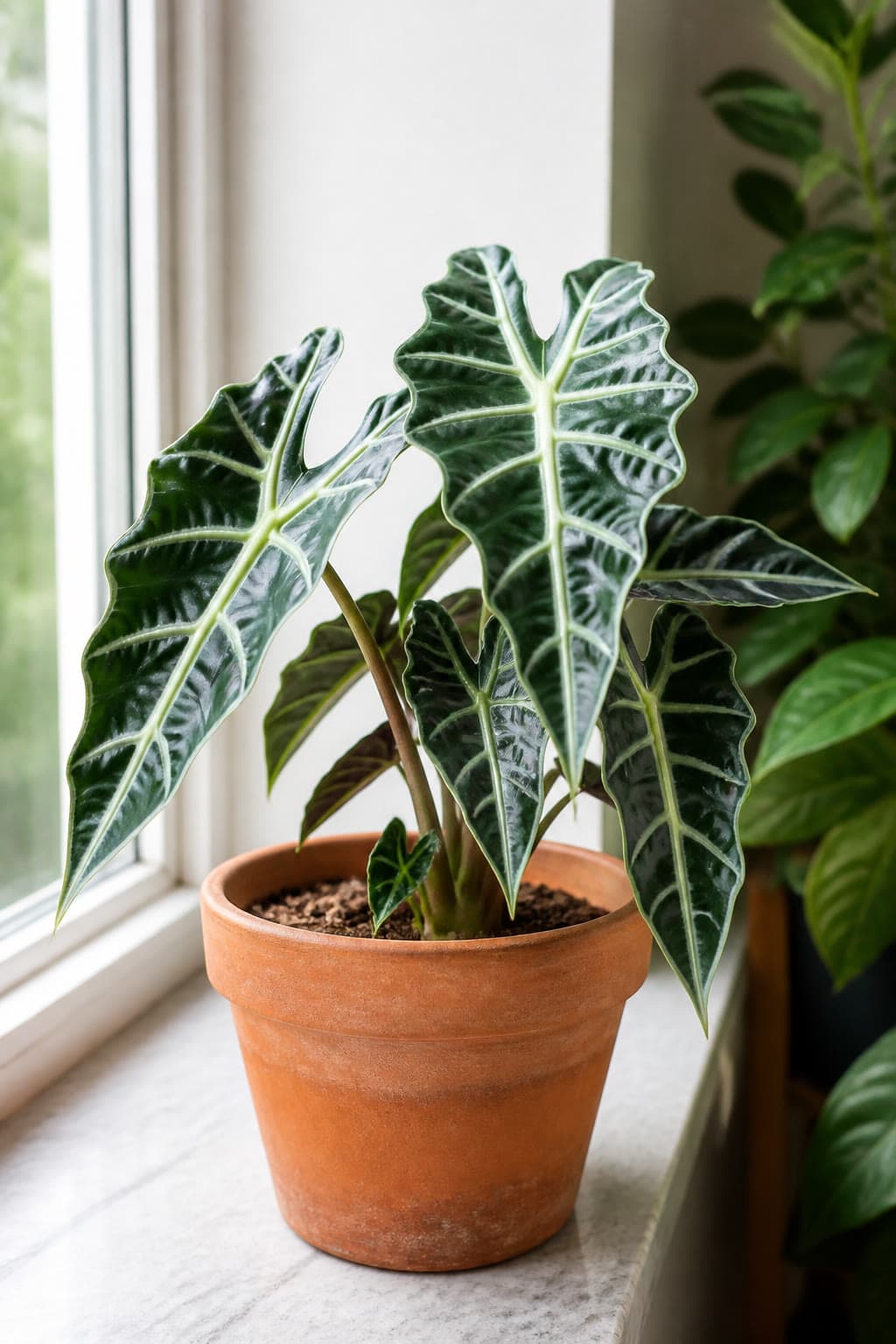
Alocasia is the indoor plant sold as elephant ear or African mask. NCSU and UF/IFAS place it in the arum family, Araceae. A popular hybrid is Alocasia × mortfontanensis, formerly Alocasia × amazonica and still sold as Amazonica. RHS calls its cultivar 'Polly' one of the most widely available alocasias.
Elephant ear is a shared name. Wisconsin Horticulture uses it for Colocasia, Alocasia, and Xanthosoma together. In the Wisconsin description, most elephant ear leaves attach to the stalk near the center of the blade (peltate) and face upward or outward. Alocasia leaves are usually not peltate and are held more upright. UF/IFAS notes that Alocasia is often confused with Colocasia, which can be invasive in the landscape.
NCSU gives division as the Recommended Propagation Strategy for Alocasia and says the plant can be propagated by division of offsets. The RHS growing guide names two routes. Offsets are separated and potted in spring, and the fleshy rhizome is divided in late spring or early summer. Wisconsin says elephant ears can be grown from seed but doesn't describe how to sow them at home. Stem cuttings appear only on the RHS profile for Alocasia cucullata, with no steps. The main RHS guide and NCSU name division only.
Offsets and rhizome pieces go into gritty compost that drains. General technique for that is on soil propagation. Jar rooting for other houseplants is on water propagation. NCSU and the main RHS guide do not name a water jar as a way to propagate Alocasia.
Best way indoors
NCSU and RHS both put division first. The right method depends on what the parent plant has to offer.
| Situation | Method with source support | Why |
|---|---|---|
| A mature plant with small plants sprouting around the base in spring | Separate offsets | RHS calls this the easiest way. NCSU lists division of offsets for the genus and for A. × mortfontanensis. |
| A fleshy rhizome that can be cut into pieces | Rhizome division | RHS gives late spring or early summer. The RHS profile for A. scabriuscula also describes potting rhizome sections individually. |
| A dormant corm or tuber coming out of winter storage | Corm restart | Wisconsin says elephant ears grow from corms, with side offsets called cormels. NCSU says corms may be started indoors in pots. |
| A stem in a jar of water | Not named for Alocasia by NCSU or the main RHS guide | Jar care for other plants is on water propagation and the propagation water change calculator. |
| A stem cutting as the default method | Named on one species profile only | RHS lists stem cuttings in spring for A. cucullata, with no steps. The main RHS guide and NCSU stay with division. |
| Outdoor Colocasia clumps | A different plant | Wisconsin separates the two by how the leaf attaches. UF/IFAS flags Colocasia as potentially invasive in the landscape. |
For most shop alocasias, including Polly, spring offsets or a late spring rhizome split are the practical ways to get a new plant. Corm restart applies to a plant that spent the winter dormant in storage, and it follows its own spring timing.
Materials
- A parent Alocasia with offsets at the base, or a rhizome large enough to divide
- A knife for slicing offsets free (RHS)
- Small individual pots with drainage holes
- Gritty, peat-free compost. RHS suggests about three parts peat-free houseplant or multi-purpose compost to one part horticultural grit.
- Gloves. RHS warns that the sap can irritate skin, and NCSU lists contact dermatitis.
- A warm spot with bright, indirect light
- Optional: the propagation light DLI calculator if the window is dim
Offsets
RHS calls offsets the easiest way to propagate an alocasia. Offsets are new small plants that sprout around the base of a mature plant in spring. Slice down carefully with a knife to separate each one from the mother plant, and take as much root as possible. Pot each offset on its own in gritty, peat-free compost.
NCSU lists division of offsets for the genus and for A. × mortfontanensis, with Division as the Recommended Propagation Strategy for both.
Iowa State's general how-to on division does not name Alocasia, and its steps are written for houseplants in general. Early spring is the ideal time, though most houseplants can be divided at any time of year. Each piece needs healthy leaves, stems, and roots. Larger pieces recover faster. Water the new pots to settle the soil, place them in bright indirect light, and wait a few weeks before fertilizing.
NCSU, RHS, and the other extension sources give no minimum offset size and no number of weeks for an Alocasia offset to root. A new offset settles best warm, in good light, and in moist compost that drains.
Rhizome division
RHS gives a second route. Divide the fleshy rhizome in late spring or early summer and pot up the pieces. Kept in warmth and good light, the pieces soon produce new shoots, according to RHS.
The RHS profile for Alocasia scabriuscula describes the same approach. Divide the plant once clumps form, or divide the rhizome and pot the sections individually to root and grow on.
NCSU notes for Alocasia sarawakensis 'Yucatan Princess' that divided roots may be started indoors in pots or containers and set outside after the last frost date. NCSU doesn't give further steps.
RHS keeps its two timings apart. Offsets come away in spring. Rhizome pieces are cut in late spring or early summer.
Corms and storage restart
Wisconsin says elephant ears generally grow from corms, which are often wrongly called bulbs. Some types form smaller offsets called cormels on the sides of the main corm. Wisconsin also notes that many newer cultivars are sold only as tissue cultured plants that have not yet formed corms. A young shop plant may have no corm to store.
To restart a corm, Wisconsin suggests potting it indoors in March with the top close to the soil surface and keeping it in a warm spot. The first leaves take a few weeks to emerge. NCSU also says corms may be started indoors in pots.
Storage advice differs by source. NCSU says tubers can be lifted and kept in a cool, dry location over winter. Illinois says to dig the tuber in fall and store it cool and dry until spring. Penn State covers Colocasia, Alocasia, and Xanthosoma together. It says most tuberous tropicals store best at 45 to 55 °F, but elephant ears prefer warmer storage into the 70 °F range. Penn State's steps are to cut off all but 4 to 6 inches of foliage, dry the plant in a warm place for a few days, and pot the tubers up about 4 to 6 weeks before the last frost.
Wisconsin's few weeks applies to first leaves from a potted corm. Wisconsin does not give it as a rooting time for offsets.
Mix and drainage
NCSU describes the genus in slightly acidic, moist, well-drained, humus-rich, fertile loam, though it tolerates a wide range of soil types. For A. × mortfontanensis, NCSU gives moist, well-drained, fertile, loamy soil. RHS suggests peat-free houseplant or multi-purpose compost with horticultural grit for drainage, about three parts compost to one part grit.
Too much water is the main rot risk that NCSU and RHS name. NCSU links overwatering to root rot and leaf spots. For A. × mortfontanensis, it adds bacterial stem rot. RHS says overwatering, especially while the plant is dormant, can cause the roots to rot. The RHS profile for A. scabriuscula warns that plants left sitting in water for long periods can rot at the root.
A fresh offset or rhizome piece in a wet saucer faces the same rot risk as the parent. More drained-mix technique is on soil propagation.
What you are looking at
NCSU describes Alocasia as a genus of 80 species of tuberous, herbaceous perennials in Araceae. UF/IFAS counts over 91 species. The leaves are heart-shaped or arrowhead-shaped and 12 to 36 inches long. Each leaf sits on a long, sturdy stem, and the veins are often prominent. In tropical areas the plants can reach up to 10 feet tall, while indoor plants stay much smaller.
NCSU describes A. × mortfontanensis with large, smooth, thick, arrowhead-shaped leaves in medium to dark green, with prominent silver to lime-white veins. The plant grows 1 to 4 feet tall and 1 to 2 feet wide. Houseplants rarely flower.
NCSU lists calcium oxalate crystals as the toxic principle and says the plant causes contact dermatitis. It advises caution around small children and pets. RHS says alocasias contain toxic compounds and recommends gloves when handling them.
Light while propagating
Fresh offsets and rhizome pieces need the same light as the parent plant. That means bright light without strong sun on the leaves.
NCSU genus. The Cultural Conditions list Dappled Sunlight (shade through an upper canopy all day) and Partial Shade (direct sunlight only part of the day, 2 to 6 hours). NCSU says the plant prefers a shaded site and grows best where daytime temperatures range from 68 to 77 °F. Yellowing leaves can come from overwatering, too little water, or inadequate light.
NCSU, A. × mortfontanensis. The hybrid prefers bright, indirect sunlight, warm temperatures, and high humidity. Air temperatures should not drop below 60 °F. Direct sunlight can scorch its leaves.
RHS. Alocasias grow best in bright but indirect light. Strong sunlight can scorch the foliage. In lower light they survive, but growth is much slower. Keep them above 16 °C (60 °F) from spring to autumn and out of cold drafts. In winter, cooler and drier conditions, still above 10 °C (50 °F), let them go dormant. Humidity should be medium to high through the growing season.
UF/IFAS says an Alocasia grown as a houseplant belongs in bright indirect light. Iowa State gives the same placement for any new division.
These conditions describe how to grow the parent and how to hold a fresh start. They do not add up to a rooting schedule.
If an offset or rhizome piece stalls in a dim window while the compost stays clean, check the daily light with the propagation light DLI calculator. When the window cannot supply enough light, fixture choice and hanging distance are covered in best grow lights for indoor propagation.
Mix and watering while a start roots
Iowa State says to water new divisions to settle the soil. RHS pots offsets in gritty, peat-free compost and waters from April to October once the top 5 cm (2 in) of compost has dried. Let each pot drain fully, and empty any standing water the same day.
In winter, RHS cuts watering to a minimum while the plant is dormant. A piece potted late in the season needs less water as its growth slows.
Full drained-mix steps are on soil propagation. The propagation water change calculator goes with jar-rooted plants on water propagation. NCSU and the main RHS guide do not name a water jar for Alocasia.
Troubleshooting
Offset or rhizome piece is slow to push new shoots. RHS says rhizome pieces kept in warmth and good light soon produce new shoots. It doesn't give a week count. Check that the pot sits above the RHS growing-season minimum of 16 °C (60 °F), in bright indirect light, in compost that drains. If the spot is dim, measure it with the propagation light DLI calculator.
Soft or rotting base. NCSU links root rot to overwatering, and adds bacterial stem rot on A. × mortfontanensis. Empty the saucer and let the top of the compost dry before the next watering. If the mix stays wet, repot into gritty compost that drains.
Yellow leaves on a start or the parent. NCSU links yellowing to overwatering, too little water, or inadequate light. Check the compost moisture and the light before anything else. Extra water will not fix a dim corner.
Scorched patches on the leaves. NCSU and RHS both say direct or strong sunlight can scorch the foliage. Move the plant to bright, indirect light.
Brown leaf edges or spider mites. RHS says low humidity can brown the leaf edges and may attract red spider mites, which thrive in dry air. NCSU says Alocasia is prone to spider mites and advises monitoring for aphids and mealybugs. RHS raises humidity with a tray of gravel and water kept just below the gravel surface, a spot in the bathroom, misting, grouping plants together, or a humidifier.
Damage after a cold trip home or a draft. RHS says to keep alocasias warm in transport, because low temperatures can damage or even kill them. Cold drafts, particularly in winter, can also do harm. RHS keeps alocasias above 10 °C (50 °F) at all times, and NCSU says air around A. × mortfontanensis should not drop below 60 °F.
Leaves drop in winter. RHS says alocasias may lose some foliage during winter dormancy and produce fresh leaves once growth resumes in spring. Keep watering to a minimum through this rest, because overwatering while dormant can rot the roots.
Restarted corm shows no leaves yet. Wisconsin says first leaves take a few weeks to emerge from a corm potted with its top near the soil surface and kept warm. Check that the corm is firm. Penn State advises discarding stored tubers that are rotting.
Leaves face outward on stalks attached near the middle of the blade. Wisconsin describes that peltate leaf for elephant ears in general and says Alocasia leaves are usually not peltate and are held more upright. The plant may be Colocasia, which UF/IFAS says is often confused with Alocasia.
Common mistakes
- Starting with a stem in a jar of water. NCSU and the main RHS guide name division only for Alocasia.
- Treating stem cuttings as the default method. RHS lists them only for A. cucullata, with no steps.
- Merging the two RHS timings into one date. Offsets come away in spring. Rhizome division waits for late spring or early summer.
- Pulling an offset free with little or no root. RHS says to take as much root as possible, and Iowa State wants healthy roots on every piece.
- Feeding a new division straight away. Iowa State says to wait a few weeks before fertilizing.
- Handling cut rhizomes and offsets bare-handed. RHS warns that the sap can irritate skin, and NCSU lists contact dermatitis.
People also ask
Alocasia or Colocasia?
Wisconsin describes most elephant ears with the leaf stalk attached near the center of the blade and the leaves facing upward or outward. Alocasia leaves are usually not peltate and are held more upright. UF/IFAS says Alocasia is often confused with Colocasia, which can be invasive in the landscape.
Can I take stem cuttings?
RHS lists stem cuttings in spring for Alocasia cucullata, with no steps. The main RHS growing guide and NCSU name division only.
When should I divide Alocasia?
RHS separates offsets in spring and divides the rhizome in late spring or early summer. Iowa State's general advice for houseplants calls early spring the ideal time.
How long until an offset roots?
NCSU and RHS give no number of weeks for an Alocasia offset. RHS says rhizome pieces kept in warmth and good light soon produce new shoots. Wisconsin's few weeks refers to first leaves from a potted corm.
Can I root Alocasia in water?
NCSU and the main RHS guide do not name water propagation for Alocasia. Both describe division, with RHS potting the pieces in gritty compost. Jar steps for other plants are on water propagation.