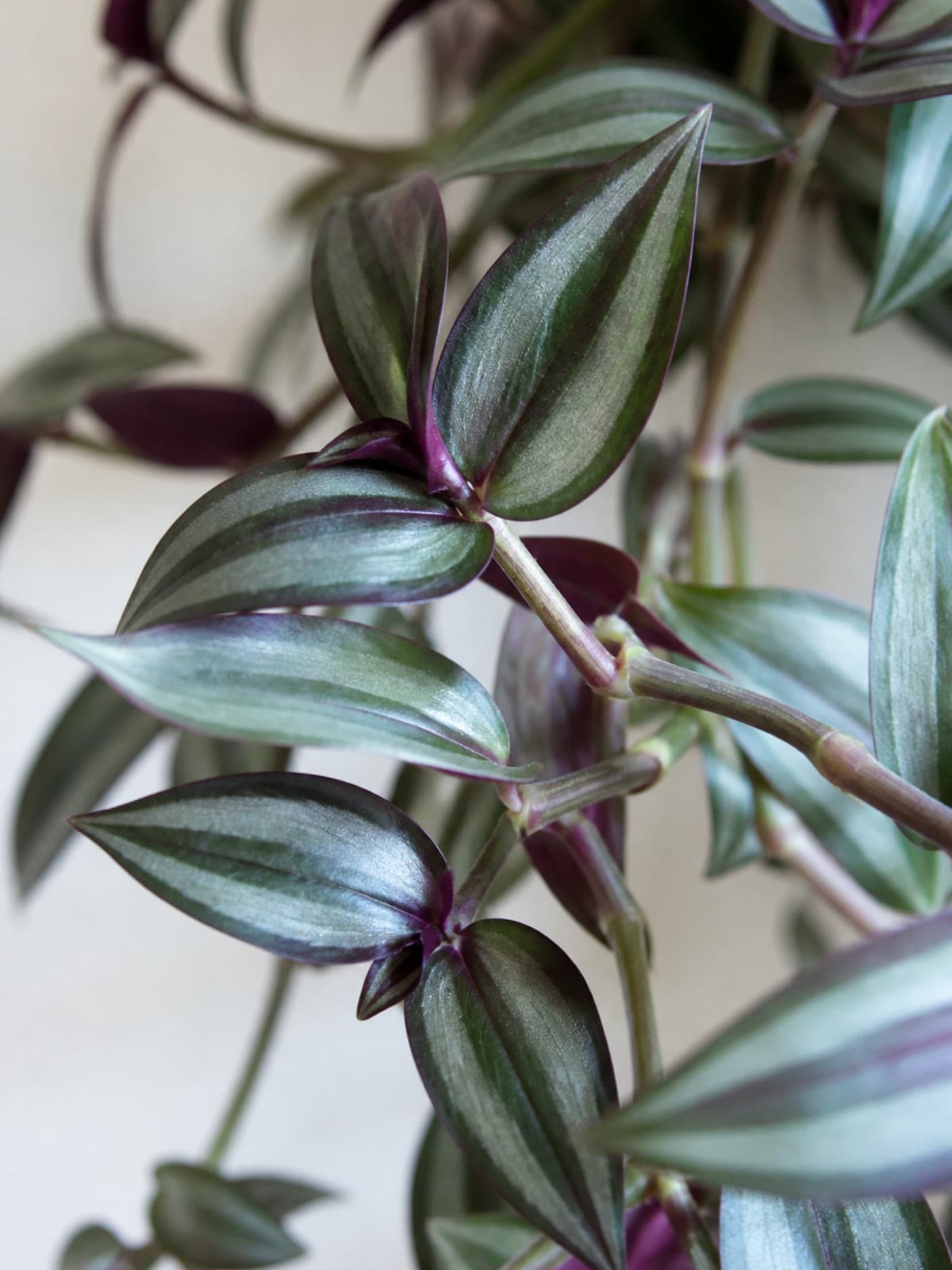
Tradescantia is the genus behind several trailing houseplants sold as inch plant, wandering jew, and wandering dude. NCSU Extension uses Inch Plant, Silver Inch Plant, and Wandering Dude for Tradescantia zebrina, and Inch Plant, White Inch Plant, and White-Flowered Spiderwort among the names for Tradescantia fluminensis. University of Florida IFAS Extension files the plant as Zebrina pendula, wandering Jew or inchplant, with the scientific name Tradescantia pendula. All of them propagate the same way.
Stem cuttings are the recommended method for both species in the NCSU Extension Gardener Plant Toolbox. UF: propagation is by stem cuttings, which root easily. Illinois Extension marks Wandering Jew and Inch Plant, under both Tradescantia and Zebrina, as stem propagation. Missouri Extension lists wandering jew as a herbaceous cutting, very easy, that may be rooted in water.
The stems explain why. On T. zebrina, the leaf nodes sit about an inch apart, which NCSU gives as the reason for the name inch plant. The stems are succulent and branching, and they root at the nodes. UF adds that the stems root wherever they touch soil. A cutting works because it carries nodes.
Drained-mix technique for any houseplant is on soil propagation, jar care is on water propagation, and the main methods across houseplants are compared on plant propagation.
Best way indoors
A stem cutting is the default. Iowa State Extension puts Tradescantia species and Zebrina species (inch plant, wandering dude) on its list of houseplants best propagated by stem cuttings. Missouri allows water for wandering jew. Iowa State also lists Tradescantia for simple layering, where a stem stays on the parent while a buried node roots in a second pot.
| Situation | Method | Source support |
|---|---|---|
| A healthy trailing tip you can cut | Stem tip in drained media | Iowa State lists Tradescantia and Zebrina for stem cuttings: 3 to 6 inches, at least two nodes, lower leaves off, at least one node in the media. |
| Roots you want to watch form | Stem tip in water | Missouri: wandering jew may be rooted in water. UVM Extension names inch plant (Tradescantia zebrina) among the vining plants that are easy to root in water. |
| A long stem that can reach a second pot | Simple layering | Iowa State marks Tradescantia and Zebrina for simple layering, not air layering. At least one node is buried while the stem stays attached. |
| A single leaf with no stem | Not a tradescantia method | Illinois, NCSU, UF, and Iowa State all name stem cuttings. |
| A fleshy stem that looks like a succulent | Stem cutting, not a succulent leaf tray | NCSU calls the stems succulent, but Iowa State, Illinois, Missouri, and UF all put it under stem cuttings. Leaf-rooting succulents are covered on how to propagate succulents. |
Timing depends on the method. Most houseplant stem cuttings root in 3 to 6 weeks, according to Iowa State, and a layered stem forms new roots in 6 to 12 weeks, maybe longer depending on the species. Early spring is the ideal time for cuttings, though most houseplants can be propagated any time of year.
Water roots come with a tradeoff. Illinois Extension does not recommend rooting houseplants in water, because roots that develop in water are often weak and do not adapt as easily to potting mix as roots formed in rooting media. Iowa State describes water-formed roots as more coarse in texture. Missouri and UVM still name water for this plant, so a jar works, with extra care at potting time.
Outdoors, the same rooting habit becomes a problem. UF rates T. pendula invasive and not recommended, and NCSU notes that T. fluminensis roots at each node when grown outdoors, with Australia, New Zealand, and the southeastern United States among the seriously affected areas.
Materials
- A healthy parent plant with trailing stems long enough to cut, or one stem long enough to reach a second pot
- Sharp, clean scissors, pruners, or a knife
- A small pot with a drainage hole for media, or a clean jar for water
- Rooting media: perlite, sand, coarse sphagnum moss, vermiculite, or peat moss, alone or mixed, with potting soil used only as part of a mix (Iowa State)
- Room-temperature water for the jar method (UVM)
- Rooting hormone, optional
- A clear plastic bag or dome for media cuttings
- A spot with bright indirect light
Hydrated stems root more reliably. Iowa State: water the parent plant the day before so leaves and stems are fully hydrated, then stick the cuttings as quickly as possible. If cuttings have to wait, store them with the cut ends wrapped in a moist paper towel in a cool spot with low light.
Stem cuttings
Spring pruning supplies the material. NCSU: T. zebrina can be pruned back hard every spring, trimming promotes denser foliage, and removing leggy growth also gives stem cuttings for propagation. On T. fluminensis, NCSU recommends pinching to make the plant denser and prevent leggy stems.
Stem tips in media
Iowa State’s steps for houseplant stem cuttings, which include Tradescantia and Zebrina:
- Cut stems 3 to 6 inches long with at least two nodes. Stem tips or segments from lower on a stem both work, as long as each segment stays right side up. Stem segments will not root upside down, and an angled bottom cut marks which end goes down.
- Remove the lower leaves and any flowers.
- Treat the cut end with rooting hormone if desired.
- Make a hole with a pencil or chopstick, then stick the cutting with at least one node and no leaves buried in the media.
- Water the media and let it drain for a few minutes.
- Set the pot in a warm location with bright indirect light and high humidity. A plastic bag or dome raises humidity. Keep the bag off the leaves with supports such as chopsticks or straws, and do not seal it tightly, so air can exchange.
- Check the cuttings often, moisten the media if it is dry, and adjust light, humidity, or temperature as needed.
- When roots are about 1 inch long or more, pot the new plant in regular potting soil. Keep it well watered in bright indirect light until it establishes, usually within a few weeks.
Illinois Extension’s tips fit the same setup: keep the rooting media evenly moist but not soggy, ventilate enclosed cuttings as needed, keep leaves from touching each other, and keep the media warm, around 75 to 80°F.
Missouri’s version for herbaceous cuttings runs close. Take cuttings from vigorous, healthy shoots, most 4 to 6 inches long. Cut just below a node with a sharp, clean knife and remove leaves from the lower half of the cutting. Missouri calls for rooting hormone on all plants except easy rooters, and wandering jew is on its very easy list.
Stem tips in water
UVM Extension’s jar method, written for houseplants in general and naming inch plant among the easy ones:
- Take a 3 to 6 inch cutting from the tip of a healthy stem, with several leaf nodes.
- Remove the leaves from the bottom 1 to 2 nodes.
- Set the cutting in room-temperature water in indirect light, with no leaves below the surface.
- Replace the water with fresh room-temperature water when it turns cloudy.
- Pot the cutting when roots are more than 2 to 3 inches long.
Rooting in a jar can take days or weeks, sometimes months, according to UVM. Iowa State adds three jar rules for houseplants: change the water one to two times each week, never let the water level drop and expose the developing roots to air, and transplant when roots are about 1 inch long. A reminder for water changes is easy to set with the propagation water change calculator.
After potting, a jar-rooted start may wilt, drop leaves, brown, or die back at the tips while its coarse roots adjust to soil, according to Iowa State. Good, consistent care helps it recover. More jar routines are on water propagation.
Soil without a jar
UVM also describes rooting straight in potting mix, which skips the transplant. Rooting hormone is not necessary for this method. Fill a pot that has drainage holes with moistened potting mix, make a hole with a pencil, insert the cutting, and firm the mix around it. Water lightly, then cover the pot with a jar, a plastic bag, or a dome. If moisture drips from the cover, open it to let air circulate. Keep the mix moist, not wet. New growth, or resistance to a gentle tug, means roots have formed.
Layering
Long, flexible stems suit simple layering, and Iowa State lists Tradescantia and Zebrina for it. Simple layering skips special rooting media and high humidity, which makes it a good alternative to cuttings for plants with long flexible stems.
- Bend a stem down to the soil, or over to a second pot of potting soil or rooting media such as perlite or sphagnum moss.
- Bury the stem 2 to 4 inches deep, with the tip bent up out of the soil and at least one node buried.
- Remove any leaves that would be buried.
- Pin the stem in place with a floral pin, a hairpin, or a bent paper clip.
- For faster rooting, make a partial cut in the stem and dust it with rooting hormone powder before burying it.
- New roots form in 6 to 12 weeks, maybe longer depending on the species. When the stem is firmly rooted, cut it from the parent.
- If perlite or another rooting media was used, pot the new plant in regular potting soil.
The habit is already there. UF describes the stems rooting as they touch the ground, and NCSU notes that T. fluminensis roots at each node outdoors. A pinned node in a second pot uses the same trait indoors.
Light while propagating
Cuttings need light for root and shoot growth, and too much under a cover causes trouble. Iowa State: 4 to 6 hours of bright indirect light supports rooting. Too much light can burn foliage, especially under plastic bags or domes, and too little slows root formation, so cuttings may rot or dry out before new roots form. Air between 65 and 75°F is ideal, and a heat mat that raises the media to 75 to 80°F helps.
The parent plant has its own preferences. NCSU: T. zebrina does best in filtered sun. Full sun gives the greatest color intensity, but in more southern locations the sun can wash out the color. In low light, the stems lose their lower leaves and the remaining leaves lose some of their color. T. fluminensis prefers bright, indirect sun, and full sun calls for afternoon protection to prevent leaf scorch.
A dim window is easier to judge with numbers. The propagation light DLI calculator estimates daily light at the cutting, and fixture options are compared in best grow lights for indoor propagation.
Once a new plant is established, T. zebrina takes regular watering with the soil drying between waterings, less water in winter, and temperatures between 65 and 75 degrees, per NCSU.
Troubleshooting
The cutting turns soft and dark at the base. Soggy media or stale water is the usual cause. NCSU notes that root rot and stem rot can occur in soggy soil, and Illinois keeps rooting media evenly moist but not soggy. In a jar, UVM replaces cloudy water with fresh room-temperature water. Start again with a fresh cutting.
No roots after two weeks. Most houseplant stem cuttings take 3 to 6 weeks in media, per Iowa State, and UVM allows days to months in water. A cutting that stays firm is still inside that range. Iowa State’s fix is to adjust light, humidity, or temperature as needed.
A jar-rooted start wilts after potting. Water-formed roots are more coarse, and Iowa State lists wilting, leaf drop, browning, and tip die-back as signs of stress once they are potted. Keep the new plant well watered in bright indirect light until it settles.
Stripes fade and lower leaves drop. NCSU links low light to lost lower leaves and faded color on T. zebrina. Move the plant to brighter, filtered light. Color that washes out in strong southern sun points the other way, toward less direct light.
Skin itches after handling cuttings. NCSU: the stems have a watery sap that can cause skin irritation. NCSU rates the poison severity as low, lists contact causing skin irritation and redness and ingestion causing mouth and stomach irritation, and flags the plant as a problem for cats, dogs, and children.
Common mistakes
- Pulling a single leaf instead of cutting a stem with at least two nodes.
- Sticking a lower stem segment upside down. Mark the bottom with an angled cut.
- Leaving leaves below the media surface or under the waterline.
- Sealing the bag tight over media cuttings instead of leaving it loose and ventilating as needed.
- Letting the jar water drop until developing roots sit in air.
- Leaving rooted cuttings too long before moving them into their own pots.
- Cutting a layered stem free before it is firmly rooted.
People also ask
Is wandering jew the same plant as inch plant?
Both names cover the same trailing Tradescantia houseplants. NCSU uses Inch Plant and Wandering Dude for T. zebrina, and White Inch Plant among the names for T. fluminensis. UF uses wandering Jew and inchplant for T. pendula. Each one roots from stem cuttings.
Should tradescantia root in water or soil?
Both work. Missouri and UVM name water for this plant, and Iowa State lists it for stem cuttings in rooting media. Media avoids the jar-to-pot transition that Illinois warns about. Water shows the roots as they form.
How long do tradescantia cuttings take to root?
Most houseplant stem cuttings root in 3 to 6 weeks in media, per Iowa State. A layered stem takes 6 to 12 weeks, maybe longer. Water rooting can take days or weeks, sometimes months, per UVM.
Can tradescantia grow from a single leaf?
Stem cuttings with nodes are the method on every extension list for this plant. Roots form at the nodes.
When is the best time to take cuttings?
Early spring is ideal for houseplant cuttings, per Iowa State, and most houseplants root any time of year. NCSU notes that T. zebrina can be pruned back hard every spring, and the leggy growth removed then makes good cuttings.