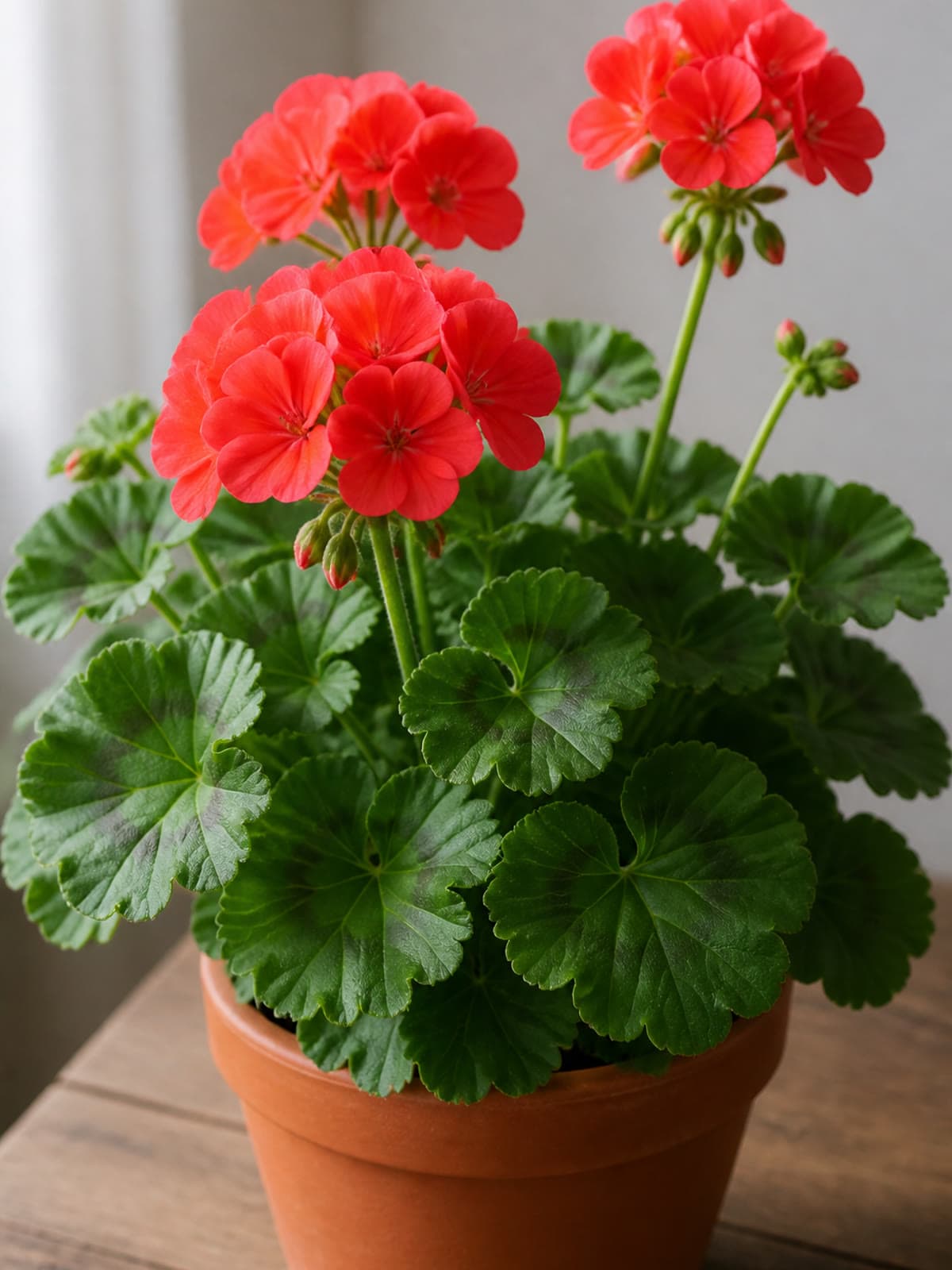
The plants sold as geraniums in garden centers are Pelargonium, not genus Geranium. Zonal (P. × hortorum), ivy-leaved (P. peltatum), Martha Washington or Lady Washington (P. × domesticum), and scented types sit in this guide. True geranium, wild geranium, and cranesbill are hardy perennials in genus Geranium. That is a different plant with a different playbook. Confusing the two names sends you to the wrong cutting length, winter hardiness, and seed habits.
Can you propagate a geranium? Yes. Stem cuttings are the primary path named across Iowa State, Illinois, Wisconsin Hort, UMN, UGA, UNL Lancaster, and Missouri. UGA and UMN also name seed for bedding types. Illinois, Wisconsin, UMN, and UGA overwinter the same plant as a houseplant, bare-root, or (UMN) a dormant pot. You do not need a fancy setup: a drained mix, bright light without harsh direct sun on soft cuttings, and patience with each source’s own clock.
Scented Pelargonium stays here. This guide is not an herb garden page.
For mix in a drained pot after roots form, see soil propagation. Overview of cuttings vs seed vs keeping the mother plant: plant propagation.
Best way indoors
| Situation | Method the sources support | Why |
|---|---|---|
| Healthy tip from a zonal, ivy, Martha Washington, or scented plant | Stem cutting in drained media (Iowa, Illinois, Wisconsin, UMN, UGA, UNL, Missouri) | Primary method across the cited pages. Lengths and weeks differ by source. |
| Bedding types for many plants next season | Seed (UMN, UGA) | UGA: many shop bedding plants are seed-grown. Cuttings keep flower color, scent, and zonal pattern. |
| Same plant through winter before frost | Houseplant prune, bare-root store, or dormant pot (Illinois, Wisconsin, UMN, UGA) | Overwintering keeps the mother. Sources also treat cuttings as backup when bare-root fails. |
| Water jar | Not described for Pelargonium | Jar technique for other plants lives on water propagation and the propagation water change calculator. |
Iowa gives 3 to 4 inches and 6 to 8 weeks, UNL about 6 inches and 3 to 4 weeks, and UMN 2 to 3 inches and 3 to 4 weeks.
Stem cuttings
Stem cuttings are how most home growers multiply Pelargonium. The pages agree on terminal or tip wood, lower leaves off, a drained rooting medium, and bright light without harsh direct sun on soft tissue. They do not agree on one cutting length or one rooting week band. Read each line as its own recipe.
Iowa State FAQ (how do I take geranium cuttings?). Take 3- to 4-inch cuttings from the ends of the shoots. Pinch off the lower leaves. Dip the base in rooting hormone. Root in vermiculite, or in perlite mixed with sphagnum peat moss. Insert just far enough that the cutting stands. Water, drain, then a clear plastic bag or a dome. Bright light, not direct sun. Roots in 6 to 8 weeks. Pot each rooted cutting, then a sunny window or artificial lights until spring.
Illinois Extension. Use 3- to 4-inch terminal shoots, hormone, and perlite, vermiculite, or a sand-peat mix. A bag is optional; watch for mold. Bright lights. Roots in 4 to 8 weeks, then move into 3- to 4-inch pots indoors.
Wisconsin Hort. Cuttings 3 to 4 inches in peat moss, sand, or perlite. Bright light, not direct sun. Well-rooted after about 6 weeks.
UMN Extension. Cuttings any time of year. Take 2 to 3 inches of terminal stem. Set a node in the mix. Use peat moss, sand, or perlite. A north or east window, or lights. Generally 3 to 4 weeks. A partly open bag is optional; they also flag mildew.
UGA CAES. Cuttings 3 to 4 inches, lower leaves off, about 1 inch deep in coarse sand or another aerated mix. Usually 3 to 4 weeks under indirect light. Do not let the cuttings dry out.
UNL Lancaster. About 6 inches from healthy tips, late summer before frost (September on that page). Strip leaves from the lower half. Pinch flowers and buds. Use hormone. Roots ½ to 1 inch long in 3 to 4 weeks, then individual pots for winter. Do not allow leaves to lie on the soil surface; they rot.
Missouri Extension (G6560). Geranium is marked for a herbaceous cutting. Keep the foliage dry while it roots.
Lengths are not one number. Iowa, Illinois, Wisconsin, and UGA sit in a 3 to 4 inch band. UMN names 2 to 3 inches. UNL names about 6 inches. Follow the source you are using.
Weeks are not one number. Iowa: 6 to 8 weeks. Illinois: 4 to 8 weeks. Wisconsin: about 6 weeks. UMN, UGA, and UNL: 3 to 4 weeks.
Media and cover. Vermiculite; perlite with peat; sand-peat; coarse sand; peat, sand, or perlite alone appear across the pages. Stick so the cutting stands (Iowa) or about 1 inch deep (UGA), with a node in the mix where UMN requires it. Bags and domes raise humidity but raise mold risk (Illinois optional bag with mold watch; UMN partly open bag and mildew flag). Missouri’s dry-foliage rule and UNL’s “leaves on the medium rot” line both push you to keep leaves off wet mix.
Light while rooting. Bright, not direct sun (Iowa, Wisconsin). Bright lights (Illinois). North or east window or lights (UMN). Indirect light (UGA). Dim rooms stall rooting and invite soft, stretched tissue. If the tray sits in a dark corner, raise light before you blame the cultivar. Check the propagation light DLI calculator and, when windows cannot deliver, best grow lights for indoor propagation.
After roots form, pot into drained mix and grow on. Shared potting habits live on soil propagation.
Seed
UMN and UGA name seed for bedding geraniums. Seed is slower to a garden-ready plant than a rooted cutting, but it is how many commercial bedding packs start.
UMN. Geraniums can be started from seed. Sow mid-January indoors. Barely cover the seed. Use a clear cover, bright indirect light, and about 75 °F. Germination takes 1 to 3 weeks depending on variety. Then lights, days in the 70s °F, nights no lower than 60 °F, 16 to 20 hours of light with fixtures 3 to 4 inches above the plants. Use half-strength liquid fertilizer. Move into 4-inch pots at three sets of leaves. About 3 to 4 months from sowing to outdoor planting.
UGA. Seed germinates best at about 75 °F in a porous sterile mix. Germination in 7 to 10 days. Transplant as soon as seedlings can be handled, then light fertilizer. Many bedding geraniums in shops are seed-grown. Cutting-grown types keep flower color, scent, and zonal pattern.
Germination times differ. UGA gives 7 to 10 days and UMN 1 to 3 weeks.
Wisconsin Hort mentions plants started from seed the previous winter. That is a mention of seed-grown stock, not a sowing recipe. Do not treat it as a third germination protocol.
If winter light is weak for seedlings that want long photoperiods (UMN’s 16 to 20 hours), use the propagation light DLI calculator and best grow lights for indoor propagation rather than stretching plants on a dim sill.
Overwintering the plant
Illinois, Wisconsin, UMN, and UGA also keep the same plant through winter, before frost. Overwintering is not the same as taking a cutting, but it is how many gardeners “propagate” next year’s display from this year’s plant. Sources still recommend cuttings as backup when bare-root storage fails.
As a houseplant. Illinois digs or moves the pot, prunes by one-third to one-half, then a bright window or lights at about 65 °F by day. Wisconsin: same prune band, 60 to 65 °F, away from heat vents. UMN: prune to about two-thirds, 60 to 65 °F, south window or lights. UGA: cut the top to not more than 6 inches, sunny window, soil kept moist. Those prune fractions, height caps, and temperatures are not one recipe. Follow one page at a time.
Bare-root. Illinois shakes the soil, stores in a paper bag at 45 to 50 °F dry, then in March cuts back to firm green tissue and pots. Wisconsin: hang upside down or use an open paper bag at 45 to 55 °F; some gardeners soak roots a few times (Wisconsin treats that as an experiment). Cut back in March to about one-third or to live green. UGA: hang in a cool, moist basement that does not freeze; soak roots now and then; in spring remove one-half to three-quarters of the top. UMN: hang, soak several times, about 45 to 50 °F; pot in early spring. UMN and Wisconsin both say bare-root can fail, and to take cuttings as backup.
Dormant pot (UMN). Store a dormant pot in the dark at about 45 to 50 °F, water about once a month, then move to a sunny window in early spring.
Overwintering keeps one plant alive. Stem cuttings multiply it. Many growers do both: pot the mother and stick tips as insurance before frost.
Troubleshooting
No roots yet. Check which clock you are on. Iowa’s FAQ is 6 to 8 weeks. Illinois is 4 to 8. Wisconsin is about 6. UMN, UGA, and UNL sit at 3 to 4 weeks. Pulling the cutting at day ten because “nothing happened” is too early for every page here. Confirm tip length matches the source you followed (2 to 3 inches UMN; 3 to 4 Iowa/Illinois/Wisconsin/UGA; about 6 UNL), lower leaves off, and a node in the mix where required. Soft, brown tissue will not recover; take a fresh tip.
Mold under a bag or dome. Illinois treats the bag as optional and warns to watch for mold. UMN allows a partly open bag and flags mildew. Crack or remove the cover, improve air flow, and keep leaves off wet media. Bright light without cooking the plastic helps; a closed, dim bag is a mold chamber. If the room is dark, raise light with the propagation light DLI calculator or grow lights for indoor propagation rather than sealing the tray tighter.
Soft cutting / wet leaves on the mix. Missouri wants dry foliage during rooting. UNL: leaves that lie on the soil surface rot. Lift leaves clear of the medium, reduce surface wetness, and restart from firm green tissue if the stem has collapsed. Overwet mix without drainage collapses soft herbaceous cuttings the same way.
Cuttings dry out. UGA is explicit: do not let the cuttings dry. Aerated mix still needs moisture at the stem base. Check more often under lights or near a heat vent. Dry, shriveled tips will not root; take new ones and keep the medium evenly moist without swimming.
Low light / pale, stalled starts. Iowa and Wisconsin want bright light without direct sun on soft cuttings. Illinois wants bright lights. UMN names a north or east window or lights. A dim interior shelf stalls roots and stretches tissue. Measure or estimate light with the propagation light DLI calculator. When windows cannot deliver, use best grow lights for indoor propagation.
Water jar honesty. These sources describe Pelargonium in drained media (vermiculite, perlite-peat, sand, coarse sand, and similar), not in a jar. Shared jar technique for plants that do root in water lives on water propagation and the propagation water change calculator. Prefer the media path here.
Wrong plant. True Geranium (wild geranium, cranesbill) is not Pelargonium. Hardy cranesbill division and seed habits are outside this annual-bedding cutting guide. Confirm the nursery label before you apply Iowa’s FAQ lengths.
Common mistakes
- Expecting one length and rooting time. Iowa gives 3 to 4 inches and 6 to 8 weeks, UNL about 6 inches and 3 to 4 weeks, and UMN 2 to 3 inches and 3 to 4 weeks.
- Expecting one rooting time. Illinois gives 4 to 8 weeks, Wisconsin about 6, and UMN, UGA, and UNL 3 to 4 weeks.
- Expecting one germination time. UGA gives 7 to 10 days and UMN 1 to 3 weeks.
- Confusing this plant with wild geranium or cranesbill (genus Geranium).
- Leaving a wet leaf on the mix. Missouri wants dry foliage. UNL: leaves on the medium rot.
- Sealing a bag tight in low light until mold forms (Illinois mold watch; UMN mildew flag).
- Letting cuttings dry out after sticking (UGA: do not let them dry).
- Rooting Pelargonium in a jar of water when these sources describe media.
- Turning scented Pelargonium into an herb page. It stays here.
- Treating overwinter bare-root as guaranteed. UMN and Wisconsin both say it can fail; take cuttings as backup.
People also ask
Can you propagate a geranium?
Yes. Stem cuttings are the primary method on Iowa, Illinois, Wisconsin, UMN, UGA, UNL, and Missouri. UMN and UGA also name seed. Illinois, Wisconsin, UMN, and UGA overwinter the whole plant. Cuttings remain the backup when bare-root storage fails.
Geranium or Pelargonium?
The plants sold as geraniums belong here. Genus Pelargonium: zonal, ivy-leaved, Martha Washington / Lady Washington, and scented types. True Geranium (wild geranium, cranesbill) is a different hardy perennial. That naming mix-up is the most common ID mistake on this topic.
Cuttings or seed?
Iowa’s FAQ is a stem. UGA: many bedding plants in shops are seed-grown; cuttings keep color, scent, and zonal marks. UMN names both. Use cuttings to clone a favorite flower color or scent. Use seed when you want many bedding plants and accept seedling variation and a longer indoor start (UMN: about 3 to 4 months to outdoor planting).
How long until roots?
Iowa: 6 to 8 weeks. Illinois: 4 to 8 weeks. Wisconsin: about 6 weeks. UMN, UGA, and UNL: 3 to 4 weeks. Those are not one number. Match your expectation to the page you followed.
Can you propagate geranium in water?
Not in these sources. Those pages describe stem cuttings in vermiculite, perlite-peat, sand, coarse sand, and similar drained media. Jar technique for other plants lives on water propagation and the propagation water change calculator.
How do you overwinter a geranium?
Before frost, keep it as a pruned houseplant (Illinois, Wisconsin, UMN, UGA with different prune fractions and temperatures), store bare-root cool and mostly dry or with occasional soaks per each page, or (UMN) hold a dormant pot in the dark at about 45 to 50 °F with monthly water. Bare-root can fail; take cuttings as backup (UMN, Wisconsin).