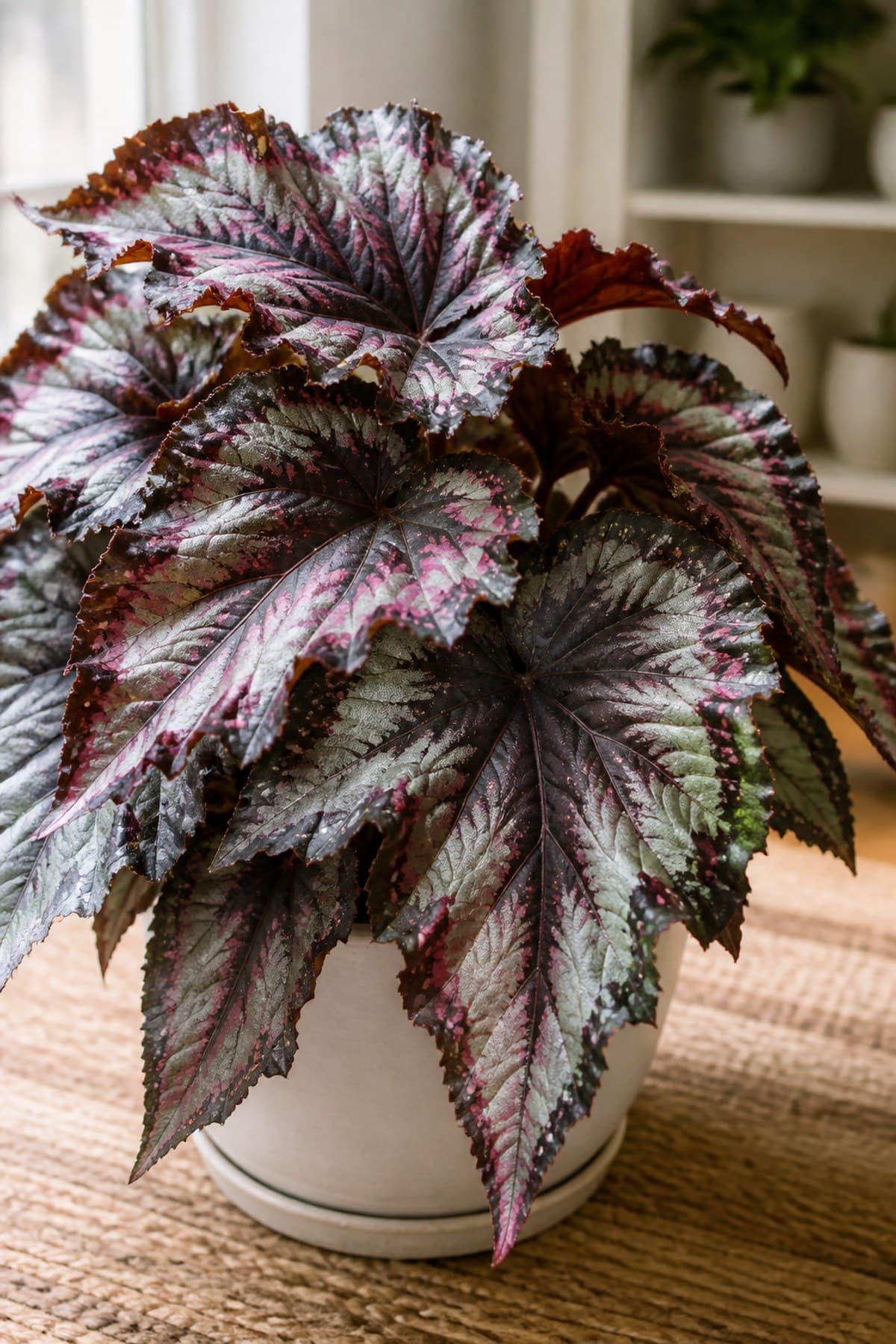
Begonias root from stem cuttings and from leaves. Iowa State Extension roots stems in water or in perlite under mist, and many houseplant types also start from pie-shaped leaf wedges on moist media. Illinois Extension cuts through the major veins on a rex or other fibrous leaf, lays the whole leaf on the media, and pins it flat. University of Nebraska Lincoln Extension cuts a rex leaf into sections and inserts the edge that sat closest to the parent. NCSU Extension lists seeds, stem cuttings, leaf cuttings, and division for the genus, and for rex types names division, leaf cutting, and stem cutting as the recommended strategies.
NCSU wants a moist, well-drained mix and high humidity. Drained-mix technique for any houseplant is on soil propagation. Iowa names water for stems, and jar care in general is on water propagation.
Sap can irritate skin, according to NCSU, and the roots contain soluble calcium oxalates.
Best way indoors
| Method | Best when | Source support |
|---|---|---|
| Stem in water or perlite under mist | You have a healthy stem tip | Iowa State: stem cuttings are relatively easy to root either way |
| Pie-shaped leaf wedges on moist media | Houseplant types on a leaf-vein path | Iowa State: plantlets emerge from the cut edges |
| Whole leaf, major veins cut, pinned flat | Rex and other fibrous begonias | Illinois Extension: new plants form at the wounds |
| Leaf sections, base edge into media | Rex begonia sections | UNL Extension: insert the edge closest to the parent base |
| Division of a rhizome clump | Rex types with a crowded crown | NCSU rex recommended strategies include division |
| Seed | You accept slower maturity | NCSU genus list includes seed |
Stem work usually reaches a finished plant sooner than leaf work. Illinois notes that a leaf cutting must make both roots and shoots, and that it usually takes longer than a stem cutting. None of these pages give a begonia week count for leaf plantlets.
Materials
- Clean blade or snips
- A healthy parent stem or leaf that is free of insects and disease (Illinois)
- A jar of clean water, or a drained pot of moist rooting media
- Perlite for Iowa mist stems, or a moist soilless mix for leaf work
- A clear plastic bag if you follow Illinois humidity cover on stem cuttings
- Pins if you follow the Illinois whole-leaf path
- Optional rooting hormone for Illinois stem cuttings
- A spot with bright light that is not direct sun (Illinois, NCSU)
Leaf cuttings
Three leaf recipes sit on three different extension pages. Follow one recipe end to end.
Iowa State, houseplant types. Cut pie-shaped wedges of leaf. Set them on moist media. Plantlets emerge from the cut edges. Iowa groups this under leaf vein cuttings. Other leaf-cutting styles side by side are on leaf cuttings.
Illinois Extension, Rex begonia and other fibrous begonias. Cut through the major veins. Lay the whole leaf on the rooting media. Pin it so the leaf stays in contact. New plants form at those wounds.
UNL Extension, Rex begonia. Use leaf section cuttings. Cut the leaf into pieces. Insert the edge that was closest to the base of the parent plant into the rooting medium. On that same UNL page, whole-leaf cuttings are named for peperomia and African violet, not for begonia.
A leaf cutting has to make both roots and shoots, according to Illinois, and it usually takes longer to a finished plant than a stem cutting. Illinois does not give a begonia week count.
Stem cuttings
Iowa State. Stem cuttings are relatively easy to root in water or in perlite under mist.
If you follow the water path, jar routines for houseplants in general are on water propagation. A reminder for water changes is easy to set with the propagation water change calculator.
Illinois Extension, stem cuttings in general. These lengths and times are Illinois houseplant guidance, not a begonia-only measurement. Stem cuttings are usually 3 to 6 inches long, with at least two nodes and not more than six. The tip is often selected. Spring or summer is preferred, though other months can work. Pre-moisten the media. Strip leaves that would sit below the mix. Insert the cutting 1 to 3 inches deep. Hormone is optional. Press the mix, mist, and you may cover with a clear plastic bag. Move to bright light, not direct sun. When roots are one inch long, pot each cutting on. Tender stems with water-filled tissue often root within a week. Tougher stems may take 10 to 14 days. Those figures are Illinois general, not measured on begonia.
NCSU, rex types. To prevent disease, avoid misting and overwatering. Iowa’s stem method uses mist over perlite. The two advice lines sit side by side. Rex also wants high humidity without soaking the leaf. Bathrooms, kitchens, or a tray of wet pebbles are NCSU humidity cues for rex care.
Light while propagating
Illinois wants bright light, not direct sun, on bagged stem cuttings. NCSU rex types want bright but indirect sunlight.
A leaf flat on media still needs bright, indirect light so new shoots can form at the wounds.
A dim window is easier to judge with numbers. The propagation light DLI calculator estimates daily light at the cutting.
Care after potting
When Illinois stems show about one inch of roots, move each cutting into its own pot with a moist, well-drained mix. NCSU wants that same moist, well-drained habit for begonias in general, and says to water at the base and avoid the leaves.
Keep humidity up for rex types without a constant leaf mist if you are following the NCSU disease note. Overwatering can cause root rot on rex types as well.
Troubleshooting
The stem base turns soft, or the mix stays wet and foul. Begonias are highly susceptible to root rot when overwatered, according to NCSU.
A rex cutting declines after frequent misting. NCSU says to avoid misting and overwatering on rex types to prevent disease.
A pinned whole leaf lifts off the media. Illinois needs the leaf held flat so the wounds stay in contact with the media.
No plantlets form after steps from more than one leaf recipe. Iowa wedges, Illinois pinned leaves, and UNL sections are three different methods.
Skin itches after sap contact. Sap can cause skin irritation, according to NCSU, and the roots contain soluble calcium oxalates.
Common mistakes
- Blending Iowa wedges, Illinois pinned whole leaf, and UNL leaf sections into one set of steps.
- Setting a bagged cutting in direct sun. Illinois and NCSU want bright, indirect light.
- Leaving the mix wet enough to invite root rot (NCSU).
- Treating Illinois’s one-week and 10 to 14 day stem figures as a begonia measurement.
- Misting rex leaves while also following NCSU’s disease note, instead of keeping high humidity with a pebble tray or a humid room.
- Treating UNL whole-leaf cuttings as a begonia method. On G1853, whole-leaf is named for peperomia and African violet.
People also ask
Water or mix for a stem?
Iowa State roots stems in water or in perlite under mist. UNL says cuttings can root in water, sand, perlite, or vermiculite, and that perlite or vermiculite generally gives more satisfactory results than water.
Which leaf method should I use?
Iowa uses pie-shaped wedges on moist media. Illinois uses a whole leaf with the major veins cut and pinned. UNL uses sections with the base edge down. Follow one source through to the end.
Can I divide a begonia?
NCSU lists division for the genus. For rex types, division sits on the recommended strategy list with leaf cutting and stem cutting.
How long until a leaf makes a plant?
Illinois says a leaf cutting usually takes longer than a stem cutting. None of these pages give a begonia week count.
Is rex different from other fibrous begonias?
Illinois names rex and other fibrous begonias together for the pinned whole-leaf vein method. NCSU gives rex its own care notes on humidity and misting. Stem and leaf still apply across both, with the mist tension called out above.