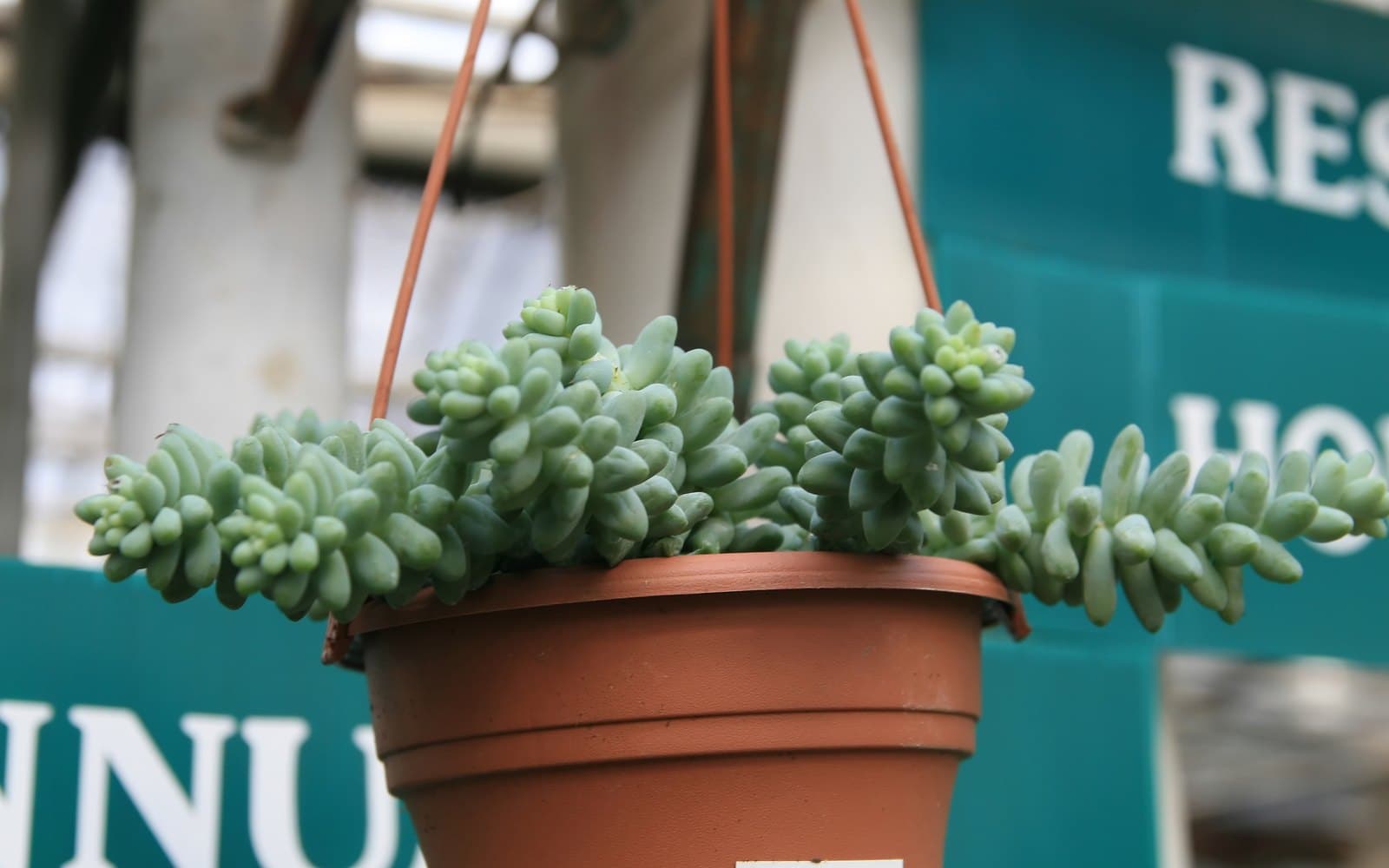
Burro’s tail is Sedum morganianum. Labels may say donkey’s tail, horse’s tail, or lamb’s tail. Same URL. Family Crassulaceae. Wisconsin Hort, NCSU, and RHS all use Sedum morganianum. Native to southern Mexico (Wisconsin also Honduras; NCSU notes Mexico states and Dominican Republic distribution).
Wisconsin warns that donkey’s tail is also a common name for the hardy perennial Euphorbia myrsinites. That is a different plant. ‘Burrito’ / baby burro tail forms appear on Wisconsin and NCSU cultivar notes; status as species, cultivar, or hybrid is unclear on Wisconsin’s page.
This is the named Sedum morganianum houseplant page. It is not a substitute for how to propagate succulents. Use the Wisconsin Hort burro’s tail steps and the NCSU/RHS species facts below rather than generic succulent hub wording.
NCSU Recommended Propagation Strategy: division, leaf cutting, stem cutting. Wisconsin: stem or leaf cuttings easily; also seed or divisions. RHS plant profile lists seed and division; RHS Leaf cuttings advice separately names Sedum morganianum among tender sedums suited to leaf cuttings. Report both RHS pages; do not erase stem and leaf because the profile omits them.
For mix, see soil propagation.
Stem cuttings
Wisconsin Horticulture (Susan Mahr): strip the leaves from the lower end of a cut stem, allow it to dry for a day or two, then push the stem ends into a well-drained medium. Long or heavy cuttings may need pins or stakes until roots can anchor the plant. It may take several months before plants root well.
NCSU: cuttings and dropped leaves root easily; Recommended Propagation Strategy includes stem cutting. No cutting length or dry-down days on that page.
Opened Wisconsin and NCSU pages do not give a stem inch length or water-jar timelines.
Leaf cuttings
Wisconsin: roots develop from individual leaves removed from the stem, but it takes longer to regenerate a plant from leaf cuttings than from stem cuttings.
NCSU: leaf cutting is a recommended strategy; dropped leaves root easily.
RHS Leaf cuttings advice: tender sedums including Sedum morganianum can be propagated from leaf cuttings. Timing on that guide: spring to early summer for best results. For succulent whole-leaf cuttings in the same guide, leave a day or two to callus before potting; use free-draining cactus-type mix with grit; do not cover; warm position and good light; keep compost just slightly moist. Attribute that callus and mix detail as RHS general leaf-cutting advice that names this species.
Division and seed
NCSU lists division. Wisconsin: the species can also be grown from seed or divisions. RHS plant profile: propagate by seed sown at 15–18°C in early spring, or by division. No detailed home division protocol on the opened Wisconsin or NCSU body text.
Common mistakes
- Replacing this named page with an unsourced generic succulents how-to.
- Inventing stem lengths or water-propagation week counts not on Wisconsin/NCSU/RHS.
- Ignoring Wisconsin’s “several months” stem rooting note and inventing a two-week claim.
- Treating Euphorbia myrsinites (also called donkey’s tail) as Sedum morganianum.
- Overwatering; Wisconsin and NCSU both flag rot in wet, poorly drained conditions.
- Handling stems roughly; leaves break off easily (Wisconsin, NCSU).
People also ask
Can I propagate burro’s tail from a dropped leaf?
Yes. Wisconsin: individual leaves root, slower than stem cuttings. NCSU: dropped leaves root easily. RHS leaf advice names Sedum morganianum for leaf cuttings.
How do I take a stem cutting?
Wisconsin: strip lower leaves, dry a day or two, stick into well-drained medium; stake long cuttings if needed; several months before plants root well.
Does the RHS profile disagree?
RHS plant profile lists seed and division. RHS Leaf cuttings advice still names Sedum morganianum for leaf cuttings. Wisconsin and NCSU emphasize stem and leaf. Keep the sources attributed rather than picking one.
Is burrito the same plant?
Wisconsin discusses ‘Burrito’ / baby burro tail with smaller rounded leaves; whether it is another species, a cultivar, or a hybrid is unclear on that page. NCSU lists a ‘Burrito’ cultivar entry.