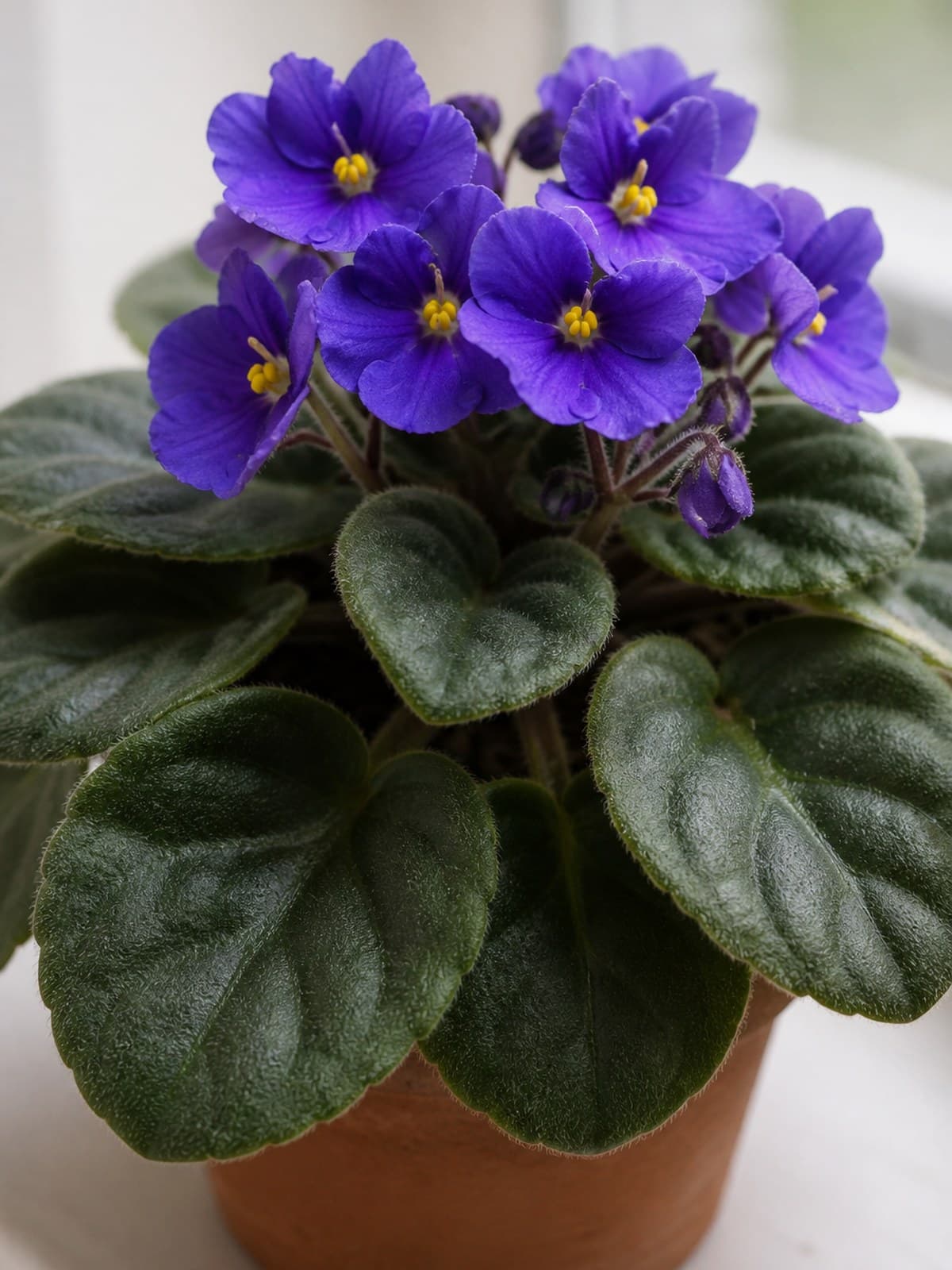
African violets, Saintpaulia, root from a single leaf. Iowa State Extension: African violets are easily propagated by leaf cuttings. The cutting is a firm, healthy leaf with part of its petiole, the leaf stem, attached. New roots and small plantlets form at the base of the petiole where it sits in the media. UVM Extension adds two more routes: a leaf with its stem in a jar of water, and a large sucker cut from the root ball and potted as a second plant.
Drained-mix technique for any houseplant is on soil propagation, jar care is on water propagation, and the main methods across houseplants are compared on plant propagation.
Best way indoors
A leaf with its petiole in moist rooting media is the standard method. Iowa State describes it in its African violet FAQ, and it lists Saintpaulia among the houseplants best propagated by leaf petiole cuttings, alongside peperomia, jade plant, gloxinia, cape primrose, and ZZ plant. Illinois Extension inserts the petiole of an African violet leaf into pre-moistened media. University of Nebraska Lincoln Extension lists seeds, whole leaf cuttings, and division for African violet.
| Situation | Method | Source support |
|---|---|---|
| A firm, healthy leaf with a petiole | Leaf petiole in moist media | Iowa State: 1 to 1½ inches of petiole, inserted at a 45 degree angle in a 50:50 mix of vermiculite and coarse sand. Illinois: petiole into pre-moistened media under a clear bag. |
| Roots you want to watch form | Leaf stem in water | UVM: a leaf with its stem submerged in room-temperature water roots in a few weeks. |
| A large sucker beside the main crown | Division | UVM: cut between the original crown and the secondary crown, through the root ball, and pot the new plant. UNL lists division. |
| A leaf with a short petiole | Leaf petiole, planted a little deeper | Iowa State: leave as much petiole as possible, and bury a small portion of the blade if the cutting cannot stand. UNL: whole leaf cuttings can be made with or without the petiole. |
| Seeds | Possible, slower | UNL: African violets can be raised from seed at home. Seedlings take longer to reach maturity and are not necessarily identical to the parent. |
Timing is given two ways. Iowa State: roots usually form in three to four weeks, and small plantlets appear at the base of each petiole in six to eight weeks. UVM: roots form in 3 to 4 weeks, and tiny leaves emerge at the base of the stem about a month later.
The petiole length differs slightly too. Iowa State leaves 1 to 1½ inches of petiole on the leaf. UVM sets about one inch of stem into the mix.
Early spring is the ideal time to take cuttings, according to Iowa State, though most houseplants can be propagated any time of year. Illinois notes that leaf cuttings have to form both roots and shoots, so they usually take longer to become a mature plant than a stem cutting does.
Materials
- A firm, healthy African violet leaf with its petiole
- A sharp, clean knife
- A clean container with good drainage, at least 2 inches deep so the cutting can stand upright (Iowa State)
- Moist rooting media: a 50:50 mix of vermiculite and coarse sand (Iowa State FAQ), or moistened potting mix (UVM)
- A clear plastic bag, a plastic dome, or an inverted glass jar
- Tape or a rubber band to secure the bag to the pot
- A pencil or chopstick to make the planting hole
- Rooting hormone, optional
- A clean container of room-temperature water for the jar method
- A spot with bright indirect light
Other rooting media work too, according to Iowa State: perlite, sand, coarse sphagnum moss, vermiculite, and peat moss, alone or mixed, with potting soil used only as part of a mix.
A hydrated leaf roots more reliably. Without roots, a cutting has a limited capacity to take up water. Iowa State: water the parent plant the day before so the leaves are fully hydrated, then stick the cuttings as quickly as possible. If cuttings have to wait, wrap the cut ends in a moist paper towel and store them in a cool spot with low light.
Leaf in mix
Other kinds of leaf cuttings, from snake plant sections to begonia leaves, are compared on leaf cuttings.
Iowa State steps
- Select a firm, healthy leaf and cut it off with a sharp knife.
- Leave 1 to 1½ inches of petiole attached to the leaf blade, or as much petiole as possible if it is shorter.
- Fill a pot with a moistened 50:50 mix of vermiculite and coarse sand.
- Treat the lower end of the petiole with rooting hormone if desired.
- Make a hole with a pencil or chopstick, and insert the petiole at a 45 degree angle. If the petiole is small and the cutting cannot stand upright, bury a small portion of the blade as well.
- Gently firm the media around the petiole.
- Water the media and let it drain for a few minutes.
- Cover the pot with a clear plastic bag, secured with tape or a rubber band. The enclosed air sharply reduces water loss from the leaf and keeps it from wilting before it roots. Supports such as chopsticks, straws, or wire loops keep the bag off the leaf, and a bag that is not sealed tightly allows air exchange.
- Set the pot in a warm location with bright indirect light.
- Check the cutting often, moisten the media if it is dry, and adjust light, humidity, or temperature if needed.
- Roots usually form in three to four weeks. Small plantlets form at the base of each petiole and appear in six to eight weeks.
- Several plants usually form at the base of each petiole. Separate them by carefully pulling or cutting them apart, and pot each one in well-drained potting mix.
Once potted, a new plant stays well watered in bright indirect light and is usually established within a few weeks. The original leaf can be cut off once it browns or once the new plant is fully established. Removing it is not necessary, but it can improve the plant’s appearance.
UVM steps
- Carefully remove a healthy leaf and make a clean cut at the bottom of the stem.
- Make a hole in a container of moistened potting mix, and set about one inch of the stem in it at a 45 degree angle.
- Gently press the mix around the stem.
- Cover the pot with a plastic bag or an inverted glass jar to hold humidity.
- Place the pot in indirect light, and open the cover as needed to release excess moisture.
- Roots should form in 3 to 4 weeks. About a month later, tiny leaves emerge at the base of the stem.
- When the plantlets are about the size of a dime, separate them and move each to its own pot.
Illinois Extension uses the same setup for plants with thick, fleshy petioles such as African violets: petiole into pre-moistened media, a clear plastic bag over it, and bright but indirect light. New plants form at the base of the leaf or petiole, and the old leaf can be cut away and discarded.
Leaf in water
UVM roots African violet leaves in water as well as in mix.
- Place a healthy leaf in a container of room-temperature water, with its stem submerged.
- Roots should appear in a few weeks.
- When the roots have grown more than a quarter inch, plant the leaf in potting soil, following the UVM mix steps.
Iowa State adds jar rules for houseplants in general. Change the water one to two times each week, and never let the water level drop and expose the developing roots to air. Iowa State transplants water-rooted houseplant cuttings when the roots are about 1 inch long, a later point than UVM’s quarter inch for African violets.
Roots that form in water are more coarse in texture, according to Iowa State. Once potted, they may show stress such as wilting, leaf drop, browning of the leaves, or tip die-back. Good, consistent care helps the young plant recover.
A reminder for water changes is easy to set with the propagation water change calculator. More jar routines are on water propagation.
Division and suckers
With the exception of trailing varieties, African violet leaves form a circular rosette around a central crown. UVM: secondary crowns, called suckers, sometimes form and should be removed, except on trailing varieties, because a growing sucker affects the plant’s shape. Small suckers come out easily with tweezers.
A sucker that is left in place can grow large enough to compete with the original crown. That large sucker can be removed intact and potted to grow into a clone of the parent. If it sits near the soil, it may already have its own roots.
- Remove the plant from its pot.
- Insert a clean, sharp knife between the original crown and the secondary crown.
- Cut through the root ball.
- Return the original plant to its pot, adding soil as needed.
- Pot the new plant.
UVM sizes an African violet’s pot at about one-third the diameter of the leaf rosette, filled with a light, airy mix. Standard potting soil can be lightened with coarse perlite, two parts soil to one part perlite. Some growers mix equal parts peat, perlite, and vermiculite.
Seed is a third route. UNL: African violets can be raised from seed in the home, the plants take longer to reach maturity, and variation among seedlings is part of the interest. Small seeds like African violet seeds should not be covered when sown.
Light while propagating
Iowa State: cuttings need 4 to 6 hours of bright indirect light for root and shoot growth. Too much light can burn foliage, especially under plastic bags or domes. Too little light slows root formation, and cuttings may rot or dry out before new roots form. Cuttings root faster in warm air and warm media. Air between 65 and 75°F is ideal, and a heat mat can raise the media to 75 to 80°F.
The growing plant has its own range. UVM: African violets prefer bright, filtered light and temperatures between 65 and 80°F. They do well on an east or north windowsill or on a plant stand under grow lights. Grow lights go about 12 inches above standard-sized African violets and 8 inches above miniatures and semi-miniatures.
A dim window is easier to judge with numbers. The propagation light DLI calculator estimates daily light at the cutting, and fixture options are compared in best grow lights for indoor propagation.
Care after potting
UVM: when the soil feels dry, water from beneath the leaves, giving the soil a good drink, or fill a saucer and let the soil soak up the water. Remove any water left in the saucer after 30 minutes, because excess water can lead to root rot. Iowa State begins regular fertilization once the new plant is established, and UVM uses a flowering houseplant food or African violet food according to package directions.
Troubleshooting
The leaf wilts before it roots. A cutting without roots takes up little water, and the bag is what keeps it from wilting, according to Iowa State. Start with a fully hydrated leaf, stick it quickly, and keep humidity high under a bag or dome.
Moisture drips inside the cover and the petiole softens. UVM releases excess moisture by opening the cover as needed. Iowa State notes that cuttings in too little light root slowly and may rot before roots form, so bright indirect light matters as much as venting.
Leaves brown or scorch under the bag. Too much light can burn foliage, especially under plastic bags or domes, according to Iowa State. Move the pot from direct sun to bright indirect light.
No roots after two weeks. Iowa State and UVM both give 3 to 4 weeks for roots in mix, and UVM gives a few weeks in water. A firm leaf is still inside that range.
Roots have formed, but no plantlets yet. Iowa State gives six to eight weeks for plantlets. UVM gives about a month after roots for the first tiny leaves.
A water-rooted leaf wilts after potting. Water-formed roots are more coarse, and Iowa State lists wilting, leaf drop, browning, and tip die-back as signs of stress after the move. Keep the young plant well watered in bright indirect light while it adjusts.
The rosette turns lopsided. A sucker growing beside the main crown affects the plant’s shape, according to UVM. Remove it with tweezers while small, or divide it once it is large.
Common mistakes
- Returning leftover rooting hormone powder to its original container, or dipping the cutting straight into it. Iowa State warns that disease spreads easily this way.
- Applying too much rooting hormone. Iowa State notes that too much can slow root development.
- Letting the jar water drop until developing roots sit in air.
- Separating plantlets before they reach about dime size (UVM).
- Leaving saucer water under a potted plant for more than 30 minutes (UVM).
- Starting regular fertilizer before the new plant is established (Iowa State).
- Covering African violet seeds when sowing them (UNL).
- Counting on seed for a copy of the parent. UNL notes seedlings are not necessarily identical to the parent plant.
People also ask
How long does an African violet leaf take to root?
Roots usually form in 3 to 4 weeks in mix, according to Iowa State and UVM. Iowa State gives six to eight weeks for plantlets, and UVM gives about a month after roots for the first tiny leaves. In water, UVM expects roots in a few weeks.
Should an African violet leaf root in water or soil?
Both work. Iowa State and Illinois root the petiole in moist media. UVM roots the leaf in either potting mix or room-temperature water, then pots the water leaf once roots pass a quarter inch.
How much petiole should an African violet leaf keep?
Iowa State leaves 1 to 1½ inches of petiole, or as much as possible if it is shorter. UVM sets about one inch of stem into the mix.
Can an African violet leaf root with no petiole?
UNL describes whole leaf cuttings made from leaves with or without their petioles, and names African violets as a plant commonly started this way. Iowa State keeps as much petiole as possible and buries a small portion of the blade when the petiole is too short to stand.
Can an African violet be divided?
Yes, when it has a large sucker. UVM cuts between the original crown and the secondary crown, through the root ball, and pots the new plant. UNL lists division for African violet.
Does an African violet leaf need rooting hormone?
Rooting hormone is optional for leaf petiole cuttings, according to Iowa State. UVM’s leaf steps do not use it.