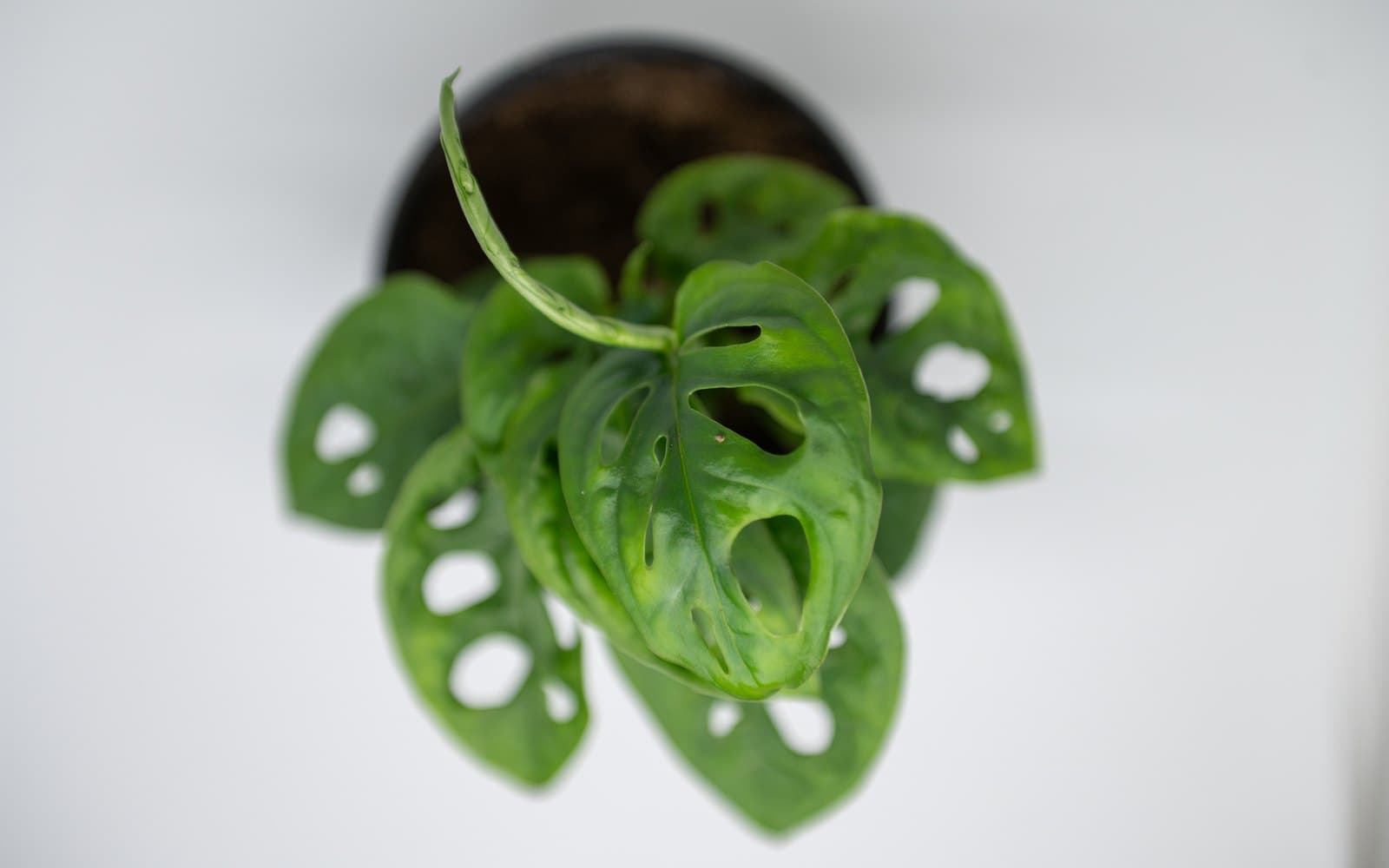
Monstera adansonii is not Monstera deliciosa. NCSU warns not to confuse the two under the shared Swiss cheese plant label: deliciosa is the larger plant with bigger leaves; adansonii is the smaller, faster-growing climber. RHS How to grow Swiss cheese plants names deliciosa as the original large Swiss cheese plant and adansonii as the smaller Mexican breadfruit plant. Iowa State Extension lists swiss cheese vine (Monstera adansonii) and swiss cheese plant (Monstera deliciosa) as separate related species. The live deliciosa page stays at how to propagate Monstera. This page is adansonii only.
Labels may say Swiss cheese vine, Adanson’s monstera, five hole plant, cheese plant, or Mexican breadfruit plant. Same URL. Family Araceae. RHS synonym note: Monstera pertusa. NCSU: Southern Mexico to tropical America; heart-shaped, glossy, fenestrated (oval-hole) leaves; climbing habit with aerial roots; indoor size about 3 to 8 feet tall and 1 to 3 feet wide with a trellis or moss pole; outdoors to about 10 to 13 feet. RHS adansonii profile: climb or trail to about 2 m; stems with adventitious roots; heart-shaped leaves with oval holes between the main veins.
NCSU Recommended Propagation Strategy for this species is stem cutting. RHS adansonii profile: sow seed at 18–24°C when ripe; tip or leaf cuttings with bottom heat in summer; layer in autumn. UF/IFAS Charlotte County (Ralph E. Mitchell): stem cutting with at least one node or with preexisting roots; long vines can yield several new plants. RHS How to grow Swiss cheese plants (Monstera genus guide that names both species): stem cuttings from spring to late summer, stood in a glass of water until a good set of roots forms, then pot up.
Indoor climbing or trailing focus. For mix, see soil propagation. Water lives on water propagation.
Stem and tip cuttings
NCSU: Recommended Propagation Strategy is Stem Cutting. No cutting length, node count, or days-to-root on that species page.
UF/IFAS Charlotte County (adansonii): take a stem cutting with at least one node or with preexisting roots. Long out-of-bounds vines can make several new plants. No inch length or week count on that page.
RHS adansonii profile: tip cuttings with bottom heat in summer (paired with leaf cuttings and seed on the same line).
RHS How to grow Swiss cheese plants (genus guide naming M. deliciosa and M. adansonii): stem cuttings from spring to late summer; stand in a glass of water in a bright location until they produce a good set of roots, then pot up. That water-then-pot step is genus Monstera guidance on a page that treats both houseplant species, not an adansonii-only measurement.
RHS Monstera ‘Monkey Mask’ (synonyms include Monstera adansonii ‘Monkey Mask’): internodal softwood cuttings, or tip cuttings with one leaf attached, with bottom heat in a sandy propagating mix in summer. Treat as cultivar/synonym guidance adjacent to adansonii, not a substitute for the species NCSU/UF pages.
Iowa State stem-tip how-to lists Monstera deliciosa among plants suited to stem cuttings (3 to 6 inch pieces with at least two nodes; media or water; roots often in 3 to 6 weeks on that general protocol). Those lengths and weeks are not an adansonii-only claim. Iowa State Growing Philodendrons names M. adansonii as swiss cheese vine for identity, but its numbered 3 to 6 inch trailing philodendron recipe is written for philodendron, not for adansonii.
Leaf cuttings
RHS adansonii profile: leaf cuttings with bottom heat in summer, listed with tip cuttings.
RHS ‘Monkey Mask’: leaf cuttings with bottom heat in a sandy propagating mix in summer.
Opened NCSU and UF/IFAS Charlotte pages do not give a leaf-cutting protocol for this species. Do not invent a leaf-only recipe from blogs.
Water
RHS How to grow Swiss cheese plants: Monstera stem cuttings may stand in a glass of water until they produce a good set of roots, then pot up. Attribute as genus Swiss-cheese / Monstera guidance on the page that names both deliciosa and adansonii.
UF/IFAS Charlotte names stem cuttings with a node for adansonii but does not specify water versus soil on that page.
Iowa State general stem-tip water notes (change water one to two times each week; transplant when roots are about 1 inch long; water-formed roots coarser) apply to the listed houseplants that include M. deliciosa. Do not treat those figures as adansonii-specific.
Layering and seed
RHS adansonii profile: layer in autumn; sow seed at 18–24°C as soon as ripe.
RHS ‘Monkey Mask’: air-layering in autumn.
NCSU lists stem cutting as the Recommended Propagation Strategy and does not detail seed or layering on the opened adansonii page. Wisconsin Hort and UMN Extension pages opened for contrast are written for Monstera deliciosa (layering, stem sections, fruit notes). Keep those deliciosa methods off this page.
Common mistakes
- Treating this page as Monstera deliciosa or copying how to propagate Monstera methods here without attribution.
- Inventing blog week counts for soil or water rooting that opened NCSU, RHS adansonii, and UF/IFAS pages do not state for adansonii.
- Copying Wisconsin Hort or UMN deliciosa inch lengths, fruit, or air-layer recipes onto adansonii.
- Treating Iowa State’s 3 to 6 inch / 3 to 6 week stem-tip figures as an adansonii-only measurement when the species list names M. deliciosa.
- Taking a leaf with no node and expecting a new vine when UF/IFAS stresses at least one node (or preexisting roots).
- Ignoring NCSU/RHS size and habit differences: adansonii is the smaller fenestrated climber or trailer, not the large deliciosa specimen plant.
- Overwatering cuttings; NCSU flags root rot on adansonii; RHS Swiss cheese guide warns against waterlogged compost.
People also ask
Is Monstera adansonii the same as Monstera deliciosa?
No. NCSU: deliciosa is larger with bigger leaves; adansonii is smaller and fast-growing. RHS: deliciosa is the original large Swiss cheese plant; adansonii is the smaller Mexican breadfruit plant. Iowa State lists swiss cheese vine (adansonii) and swiss cheese plant (deliciosa) separately. Use how to propagate Monstera for deliciosa.
What is the main way to propagate Monstera adansonii?
Stem cutting. NCSU Recommended Propagation Strategy: Stem Cutting. UF/IFAS Charlotte: stem cutting with at least one node or preexisting roots. RHS adansonii: tip or leaf cuttings with bottom heat in summer; also seed and autumn layering.
Can cuttings root in water?
RHS How to grow Swiss cheese plants supports standing Monstera stem cuttings in a glass of water until rooted, then potting up. That guide covers the genus and names both houseplant species. Opened adansonii-only NCSU and UF pages do not give water week counts.
Do I need a node?
UF/IFAS Charlotte: at least one node or preexisting roots on the stem cutting. RHS tip-cutting language for related ‘Monkey Mask’ calls for a tip with one leaf attached. Opened pages do not support a leafless-blade-only method as a complete plant recipe.