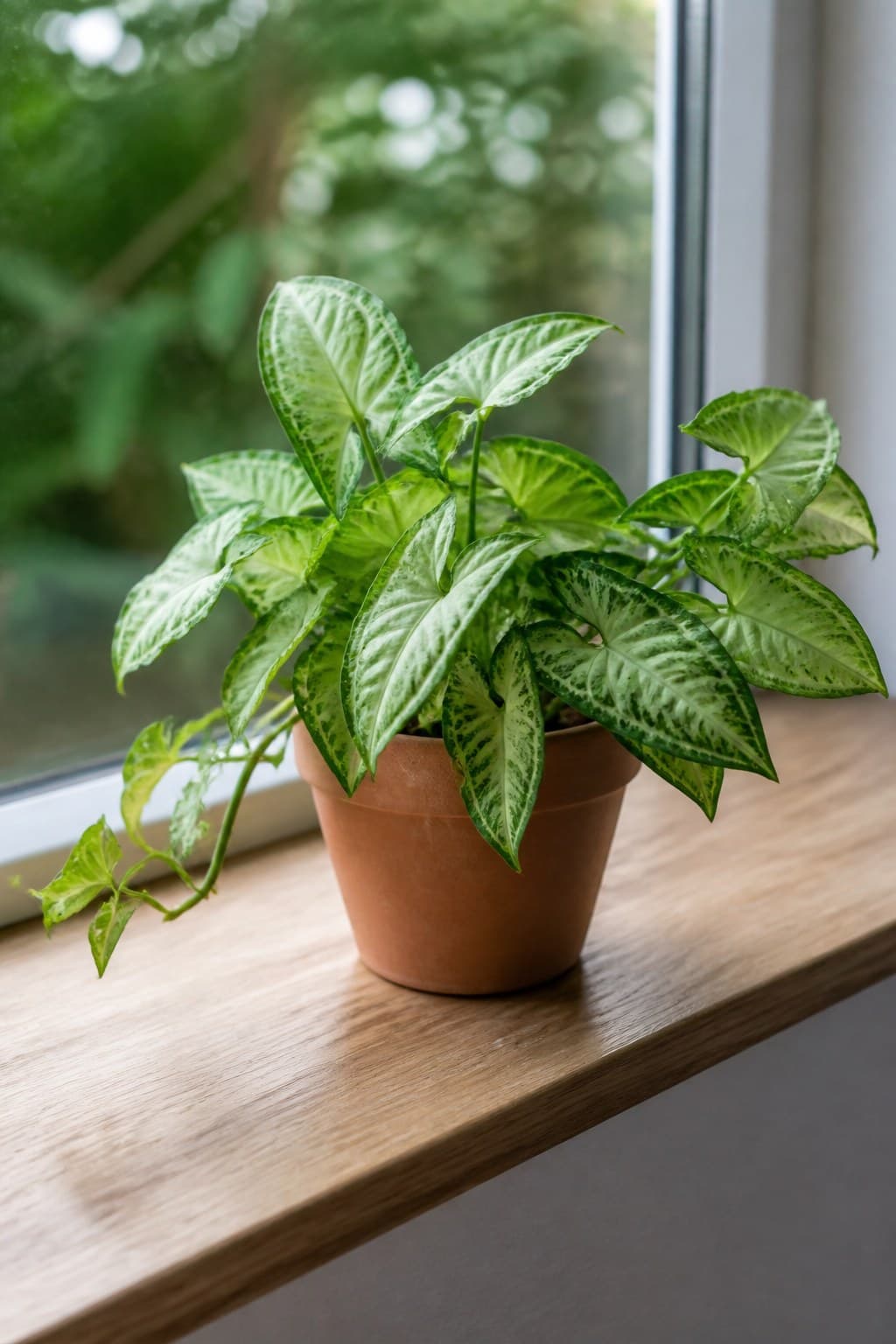
Syngonium is Syngonium podophyllum. Arrowhead plant and nephthytis belong in this guide. UF/IFAS EP244 also lists African evergreen and goosefoot plant. Arkansas UAEX explains that nephthytis is a historical mix-up with an African genus. The American species was reclassified in 1879, but the common name stuck. The houseplant on nursery benches is still Syngonium. It is not a philodendron. UAEX’s older “Arrowhead Philodendron” title is a common-name leftover, not a botanical claim. For true Philodendron cuttings, use how to propagate philodendron. That page is a different plant.
Can you propagate syngonium? Yes. EP244 names nodal cuttings, tip cuttings, and air layers, and calls a single node or single eye the simplest start under mist. Arkansas UAEX names single-eye cuttings in a 6-inch pot under a plastic bag. Missouri G6560 marks Arrowhead (Nephthytis) for herbaceous cutting, compound layer, and division, and notes that cuttings may be rooted in water. Illinois names stem cuttings and keys Arrowhead / Nephytis Syngonium spp. to A and D (stem and division). NCSU lists division, layering, and stem cutting. UMD Maryland Grows and DUMN support a water jar for this plant by name.
Tissue culture is commercial (EP244, UAEX). Seed is a commercial note on EP244 for some cultivars. Those are not home how-to sections below. These sources don’t name a rooting hormone for Syngonium. Indoor only.
For drained mix after roots form, see soil propagation. Jar technique shared across easy water plants lives on water propagation. Overview of cuttings vs division: plant propagation.
Best way indoors
| Situation | Method the sources support | Why |
|---|---|---|
| Greenhouse or mist bench, commercial-style single node | Single-eye / single-node cutting under mist (EP244) | EP244 air 75 to 95 °F, bottom heat if root zone 70 to 75 °F, shade 80 percent / 2500 fc. Greenhouse figures, not a windowsill recipe. |
| Home windowsill, bag over a pot | Single-eye cuttings in a 6-inch pot under plastic (UAEX) | Stem with 10 leaves → eight single-eye + one terminal with two leaves. About two months until the leaf bud at the petiole base begins growing. |
| Clear jar, watch roots form | Stem cutting in water (Missouri G6560, UMD, DUMN) | UMD: 3 to 5 inches, ≥1 node, leaves at tip, ~70 °F, change water ≥twice/week. For jar care, see the propagation water change calculator and water propagation. |
| Crowded pot with several stems | Division (Missouri G6560, Illinois key A and D, NCSU) | Named methods. No Syngonium-specific clump count or weeks. General steps: how to divide houseplants. |
| Long vine you want to multiply without cutting yet | Layering / compound layer / air layer (Missouri compound layer; NCSU layering; EP244 air layers) | Named only. No Syngonium-specific lengths or weeks. |
EP244 is a greenhouse mist method and UAEX a home bag method. UAEX gives about two months to bud growth, and UMD gives several weeks to roots in water.
Stem cuttings in mix
Mix is the primary path on EP244 and UAEX. The two pages are not one recipe. EP244 is a commercial interiorscape production sheet with mist, air temperature, bottom heat, and greenhouse shade. UAEX is a home single-eye cutting under a plastic bag. Read each line as its own protocol.
EP244 greenhouse mist (single node / single eye)
UF/IFAS EP244. Propagation via nodal cutting, tip cuttings, or air layers. Simplest: a single node or single eye (a single node with an attached leaf and adventitious roots) into a rooting medium under mist.
Air and root-zone temperatures on that sheet. Air 75 to 95 °F. Bottom heat is beneficial if the root zone stays 70 to 75 °F. Those are EP244 figures for the mist bench. They are not a windowsill thermostat target and they are not averaged into a home room recipe.
Shade on that sheet. Shade of 80 percent (2500 fc) required for rooting. That is a greenhouse production figure. It is not a home windowsill light recipe.
What EP244 does not give. EP244 does not give weeks to roots for the single-node mist path. EP244 uses a single node, while the general Illinois and Iowa sheets want at least two. Those generals are not Syngonium-named.
Commercial note on the same sheet: some cultivars by seed; almost all commercial production has shifted to tissue culture liners. Seed and tissue culture stay out of the home methods below.
UAEX home bag (single-eye cuttings)
Arkansas UAEX. Single-eye cuttings. A stem with 10 leaves yields eight single-eye cuttings and one terminal cutting with two leaves. Into a 6-inch pot under a plastic bag. In about two months the leaf bud at the base of the petiole begins growing. UAEX notes milky sap, a rarity in this family.
Home recipe, not greenhouse mist. UAEX’s pot-and-bag path is the home single-eye recipe here. It does not use EP244’s air 75 to 95 °F, bottom heat 70 to 75 °F, or 80 percent shade / 2500 fc. Do not paste greenhouse mist numbers onto a bagged 6-inch pot on a windowsill.
Clock stays on UAEX. About two months until the leaf bud at the petiole base begins growing. That is a bud-growth cue, not the same as UMD’s several weeks to roots in water.
Hormone. These sources don’t name a rooting hormone for Syngonium.
After roots or active bud growth on the page you followed, move into drained mix and grow on. Shared potting habits: soil propagation.
Water cuttings
Water is a supported path for this plant on Missouri G6560, UMD Maryland Grows, and DUMN. EP244 teaches mix under mist, not a water protocol. Illinois’s general propagation page does not recommend water as a rooting medium for houseplant cuttings. Keep those stances labeled.
Missouri Extension (G6560). Arrowhead (Nephthytis) marked for herbaceous cutting. Cuttings may be rooted in water. Most cuttings should be 4 to 6 inches long on that sheet. That length is general sheet guidance, not a Syngonium-named length.
UMD Extension (Maryland Grows, November 2017). Arrowhead (Syngonium podophyllum) listed among plants that root easily in water. A 3- to 5-inch stem, at least one node, some leaves at the tip. No leaves submerged. About 70 °F. Change water at least twice a week. Several weeks to roots. After roots appear, another week or two in water, then pot.
DUMN (University of Minnesota Duluth Biology greenhouses). Syngonium or Nephthytis (Arrowhead vine): can be grown in water; propagate from stem cuttings.
Lengths are not one number. UMD names 3 to 5 inches for this plant. Missouri’s 4 to 6 inches is general sheet guidance.
Weeks stay on UMD only for the jar. UMD: several weeks to roots, then another week or two in water before potting. EP244 has no water weeks. Missouri does not give a Syngonium water week clock.
Water hygiene. UMD changes water at least twice a week. Leaves stay out of the jar. Cloudy water stalls roots and softens stems. For change timing and jar habits shared across easy water plants, use the propagation water change calculator and water propagation.
Light and temperature while rooting in water. UMD sits near about 70 °F. A dim interior shelf stalls starts and softens tissue. If the jar sits in a dark corner, raise light before you blame the cultivar. Check the propagation light DLI calculator and, when windows cannot deliver, best grow lights for indoor propagation.
After roots form and the extra week or two in water on UMD’s page, pot into drained mix. Shared habits: soil propagation.
Division and layering
Division. Missouri G6560 checks division for Arrowhead (Nephthytis). Illinois’s propagation key marks Arrowhead, Nephytis Syngonium spp. as A and D (stem and division). NCSU names division among recommended strategies. These sources don’t give a clump count or weeks for Syngonium division. Shared division habits for crowded houseplants: how to divide houseplants.
Compound layer. Missouri G6560 checks compound layer for Arrowhead (Nephthytis). That is a layering mark on the houseplant sheet, not an air-layer protocol with lengths or weeks.
Layering (NCSU) and air layers (EP244). NCSU names layering. EP244 names air layers among production methods. Neither gives Syngonium-specific lengths or weeks for layering or air layering.
Light while propagating
Bright-indirect light suits most home starts once they leave a sealed bag or mist bench. EP244’s 80 percent shade / 2500 fc is a greenhouse rooting figure for the mist path. It is not a home DLI target and it is not averaged into a windowsill recipe.
Dim rooms stall water jars and bagged pots. Pale, stretched tissue under plastic is a light problem before it is a cultivar problem. Measure or estimate light with the propagation light DLI calculator. When windows cannot deliver, use best grow lights for indoor propagation.
Troubleshooting
No roots yet. Check which clock and method you are on. UMD water: several weeks to roots, then another week or two before potting. UAEX mix bag: about two months until the leaf bud at the petiole base begins growing. EP244 mist: no weeks given on that sheet. Pulling a jar at day five or a bag at day ten because “nothing happened” is too early for UMD and far too early for UAEX. Confirm tip length matches the source (UMD 3 to 5 inches for water; do not force Missouri’s general 4 to 6 onto a Syngonium-named tip), nodes in water or mix as required, and leaves out of the water or off wet media. Soft, brown tissue will not recover; take a fresh cutting from firm green growth.
Rot in the jar. UMD keeps leaves out of the water and changes water at least twice a week. Submerged leaves foul the jar and soften the stem. Strip the submerged section, refresh the water, and restart from firm green tissue if the base has collapsed. Shared jar timing: propagation water change calculator and water propagation. Illinois does not recommend water for houseplant cuttings. If jars keep failing, switch to UAEX’s bagged single-eye mix path or EP244-style mix under humidity rather than waiting longer in water.
Single-eye without a leaf. EP244’s simplest single eye is a single node with an attached leaf and adventitious roots. UAEX’s single-eye path assumes a cutting taken from a leafy stem (10 leaves → eight single-eye plus one terminal with two leaves). A bare node with no leaf and no adventitious roots is not the “single eye” those pages describe. Take a fresh eye that still has its leaf (and any adventitious roots already present), or use a terminal piece with leaves as UAEX describes.
Vine too long before the cut. Long, leafless runners waste tissue and leave few viable eyes. UAEX’s math starts from a stem with 10 leaves. Cut while nodes still carry leaves so each eye has something to support it. Do not wait until the vine is a bare string and then expect every node to behave like EP244’s single eye with an attached leaf.
Confusion with philodendron. Nursery tags and older titles sometimes say “Arrowhead Philodendron.” UAEX uses that phrase as a common-name title while stating the Latin is Syngonium podophyllum. The houseplant here is Syngonium, not Philodendron. Heartleaf and other philodendron cuttings live on how to propagate philodendron. Confirm the label before you apply UMD’s 3 to 5 inch water tip or UAEX’s single-eye bag recipe.
Mold under a bag. UAEX uses a plastic bag over the 6-inch pot. Closed plastic in low light is a mold chamber. Crack or remove the cover briefly for air, keep leaves off wet media, and raise light with the propagation light DLI calculator or grow lights for indoor propagation rather than sealing tighter.
Applying EP244 greenhouse numbers to a windowsill. Air 75 to 95 °F, bottom heat for a 70 to 75 °F root zone, and 80 percent shade / 2500 fc belong on EP244’s mist bench. They are not a home thermostat script. For home, use UAEX’s bagged pot or UMD’s water jar, and keep EP244’s production numbers labeled as greenhouse.
Common mistakes
- Writing a separate guide for arrowhead plant or nephthytis. Syngonium, arrowhead plant, and nephthytis belong here.
- Expecting one cutting length. UMD gives 3 to 5 inches and Missouri’s general sheet 4 to 6 inches.
- Expecting one timeline. UAEX gives about two months of bud growth and UMD several weeks to roots.
- Treating EP244’s single node under mist like a general two-node stem cutting.
- Pasting EP244 air 75 to 95 °F, bottom heat 70 to 75 °F, or 80 percent shade / 2500 fc onto a home windowsill bag and calling it one recipe.
- Treating the houseplant as true African Nephthytis, or as a philodendron. Disambiguation: how to propagate philodendron.
- Expecting more water weeks than UMD gives, or a week count for the EP244 mist path, which has none.
- Assuming hormone is required. No cited extension source names hormone for Syngonium.
- Leaving leaves submerged in the water jar (UMD: leaves at the tip, none under water).
- Cutting a bare node and calling it EP244’s single eye (that eye includes an attached leaf and adventitious roots).
- Sealing UAEX’s bag tight in low light until mold forms.
People also ask
Can you propagate syngonium?
Yes. Stem cuttings in mix under mist (EP244) or in a bagged pot (UAEX), stem cuttings in water (Missouri, UMD, DUMN), and division (Missouri, Illinois, NCSU) are all supported. Layering and air layers are named (Missouri compound layer; NCSU layering; EP244 air layers) without Syngonium-specific lengths or weeks. Tissue culture and seed are commercial notes, not home methods.
Is syngonium a philodendron?
No. The plant is Syngonium podophyllum. UAEX’s “Arrowhead Philodendron” wording is a common-name leftover; the Latin on that page is still Syngonium podophyllum. For true philodendron cuttings, see how to propagate philodendron.
Arrowhead plant, nephthytis, or syngonium?
Same houseplant for this guide. EP244 lists arrowhead plant, nephthytis, African evergreen, and goosefoot plant under Syngonium podophyllum. UAEX: nephthytis is a historical mix-up with an African genus; the houseplant remains Syngonium. NCSU also lists American evergreen, arrowhead vine, and trileaf wonder among common names.
Mix or water?
EP244 is mix under mist, with greenhouse air and bottom-heat numbers. UAEX is mix in a 6-inch pot under a bag. Missouri and UMD teach water. DUMN: can be grown in water. Illinois does not recommend water for houseplant cuttings. Those are not one method. For jar care, see the propagation water change calculator and water propagation.
How long until roots?
UMD water: several weeks to roots, then another week or two before potting. UAEX mix: about two months until the leaf bud at the petiole base begins growing. EP244 does not give weeks for the mist path. Those are not one number. Match your wait to the page you followed.
Do I need rooting hormone?
No cited extension source names a rooting hormone for Syngonium.
Can I air-layer it?
EP244 names air layers. NCSU names layering. Missouri G6560 checks compound layer, not air layer. None gives Syngonium-specific lengths or weeks.
Single node or two nodes?
EP244’s simplest start is a single node or single eye. Follow the source you are using.
What about greenhouse vs windowsill?
EP244’s air 75 to 95 °F, root-zone bottom heat 70 to 75 °F, and 80 percent shade / 2500 fc are greenhouse mist-bench figures. UAEX’s 6-inch pot under a plastic bag is the home mix recipe. UMD’s jar at about 70 °F is the home water recipe. Keep those paths separate.