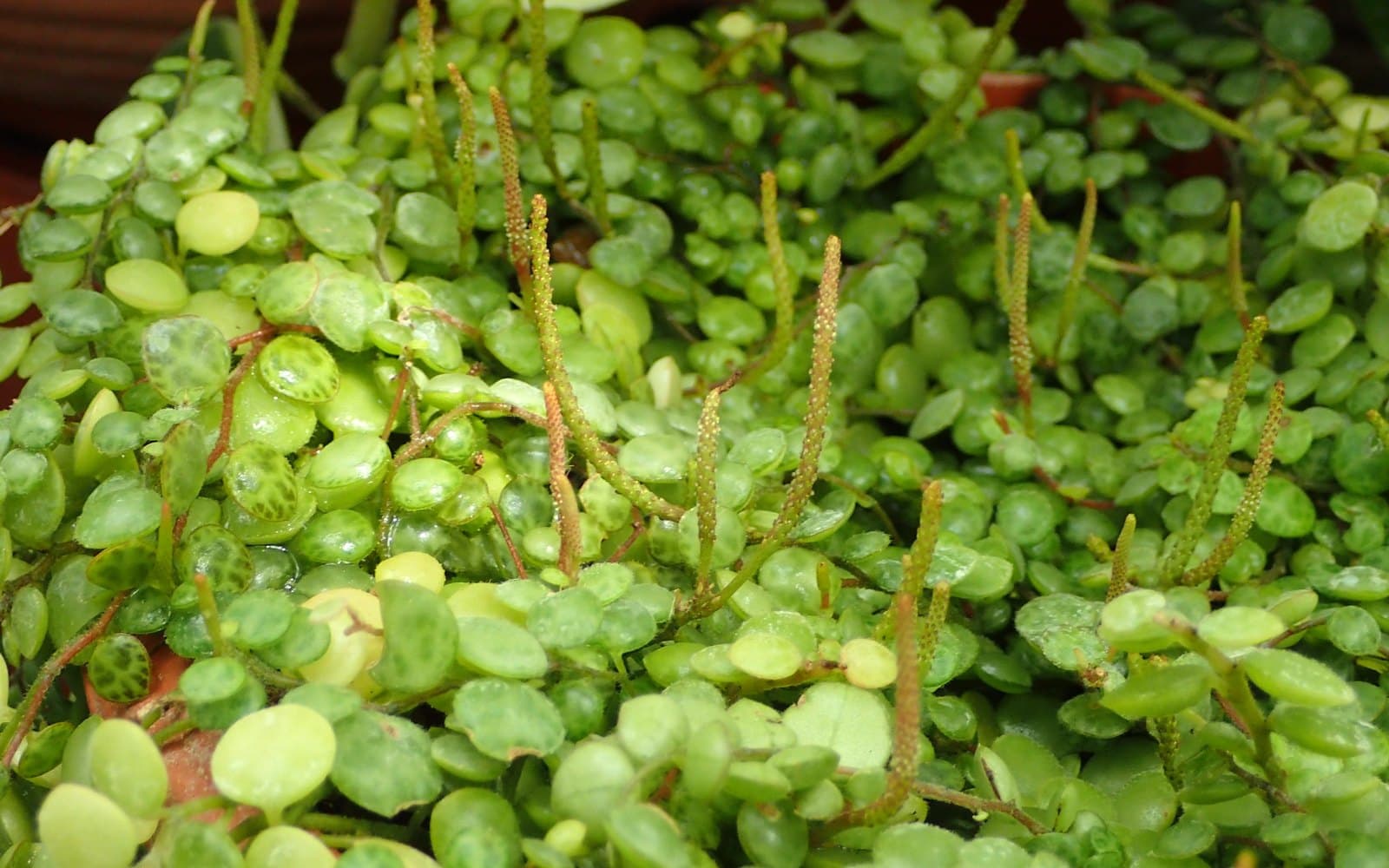
String of turtles is Peperomia prostrata. Labels may say trailing peperomia. Same URL. Family Piperaceae. Native to wet tropical Ecuador. Tiny round marbled leaves that look like turtle shells sit on delicate red trailing stems. NCSU: stems to about 12 inches; leaves less than 1 inch across.
Distinct from string of pearls (Curio / Senecio rowleyanus), string of hearts (Ceropegia), and string of bananas (Curio radicans). Those plants have their own guides. This is a peperomia, not a Curio or Ceropegia trailer. Genus methods also live on how to propagate a peperomia.
NCSU Recommended Propagation Strategy for this species is leaf cutting. The RHS plant profile names stem cuttings in summer and seed. RHS How to grow peperomia names softwood cuttings in spring and summer (soil or water) and leaf cuttings for fleshy-leaved types. Clemson HGIC profiles string of turtles on its Peperomia spp. page and gives genus stem, leaf, and (for some species) water steps. Iowa State and UNL support Peperomia leaf-petiole / whole-leaf methods at genus level.
Indoor trailing focus. For mix, see soil propagation. Water lives on water propagation.
Leaf cuttings
NCSU: Recommended Propagation Strategy is leaf cutting. No petiole length or days-to-root on that species page.
Clemson HGIC (Peperomia spp., the page that also describes string of turtles): remove a leaf with at least an inch of the petiole; insert into a rooting medium; new plants form at the base of the petiole; then pot on.
Iowa State leaf-petiole how-to (lists Peperomia species): leave 1 to 1½ inches of petiole, or as much as possible if shorter; rooting hormone optional; insert at about 45 degrees; bright indirect light and high humidity (dome or bag). Roots usually in 3 to 4 weeks; plantlets in 6 to 8 weeks on that general protocol. Those timings are not a prostrata-only claim.
RHS Leaf cuttings advice: whole-leaf method suits Peperomia; cut the leaf with the stalk intact; insert so the base just touches the compost surface. Best spring to early summer. Tropical leaf cuttings need high humidity around 20°C (68°F).
UNL Propagating House Plants: Peperomia by tip cuttings, whole leaf cuttings, leaf bud cuttings, and division. Whole leaf: roots and leaves form at the base of the leaf.
Stem cuttings
RHS Peperomia prostrata profile: take stem cuttings in summer. Also sow seed at 19–24°C when ripe.
RHS How to grow peperomia: softwood cuttings in spring and summer are the easiest genus method. Stick into gritty free-draining compost, or stand in a glass of water until roots form, then plant. Fleshy-leaved peperomias can also go from leaf cuttings.
Clemson (genus): 3 to 5 inch stem piece; remove leaves on the lower third; dip in rooting hormone; insert into potting soil or rooting medium; cover with clear plastic; keep out of direct sun.
UNL: tip cuttings generally 3 to 5 inches, cut just below a leaf.
Clemson and UNL lengths are Peperomia genus guidance, not a turtles-only measurement.
Water
RHS How to grow: softwood peperomia cuttings may root in a glass of water, then pot up.
Clemson names water for some species such as baby rubber plant (Peperomia obtusifolia), with 4 to 6 inch cuttings cut below a node in bright indirect light. That numbered example is written for obtusifolia, not for string of turtles.
Seed
RHS prostrata profile: sow at 19–24°C when ripe. Opened NCSU and Clemson pages do not give a seed protocol for this species.
Common mistakes
- Treating this page as string of pearls, hearts, or bananas.
- Inventing blog week counts for soil or water rooting that opened extension/RHS pages do not state for prostrata.
- Copying Clemson’s baby-rubber water steps onto turtles without saying the named example is obtusifolia.
- Treating Iowa State’s 3 to 4 week / 6 to 8 week leaf-petiole timings as a turtles-only measurement.
- Inventing a vine-layering or coil-on-soil method without a preferred primary for this species.
- Overwatering cuttings; NCSU and Clemson both flag root rot and turtles’ sensitivity to wet conditions.
People also ask
Is string of turtles a peperomia or a string-of-pearls type?
Peperomia prostrata (Piperaceae). Pearls and bananas are Curio / Senecio (Asteraceae). Hearts are Ceropegia. NCSU and RHS keep turtles with Peperomia.
Can I propagate string of turtles from a leaf?
Yes as a strategy. NCSU lists leaf cutting for this species. Clemson, Iowa State, RHS leaf advice, and UNL support Peperomia leaf or leaf-petiole methods. Clemson: at least an inch of petiole.
Do stem cuttings work?
Yes. RHS prostrata profile: stem cuttings in summer. RHS How to grow: softwood cuttings in spring and summer in mix or water. Clemson genus stem steps use 3 to 5 inch pieces.
Can cuttings root in water?
RHS How to grow supports water for softwood peperomia cuttings. Clemson’s numbered water example is written for species such as baby rubber plant, not turtles specifically.