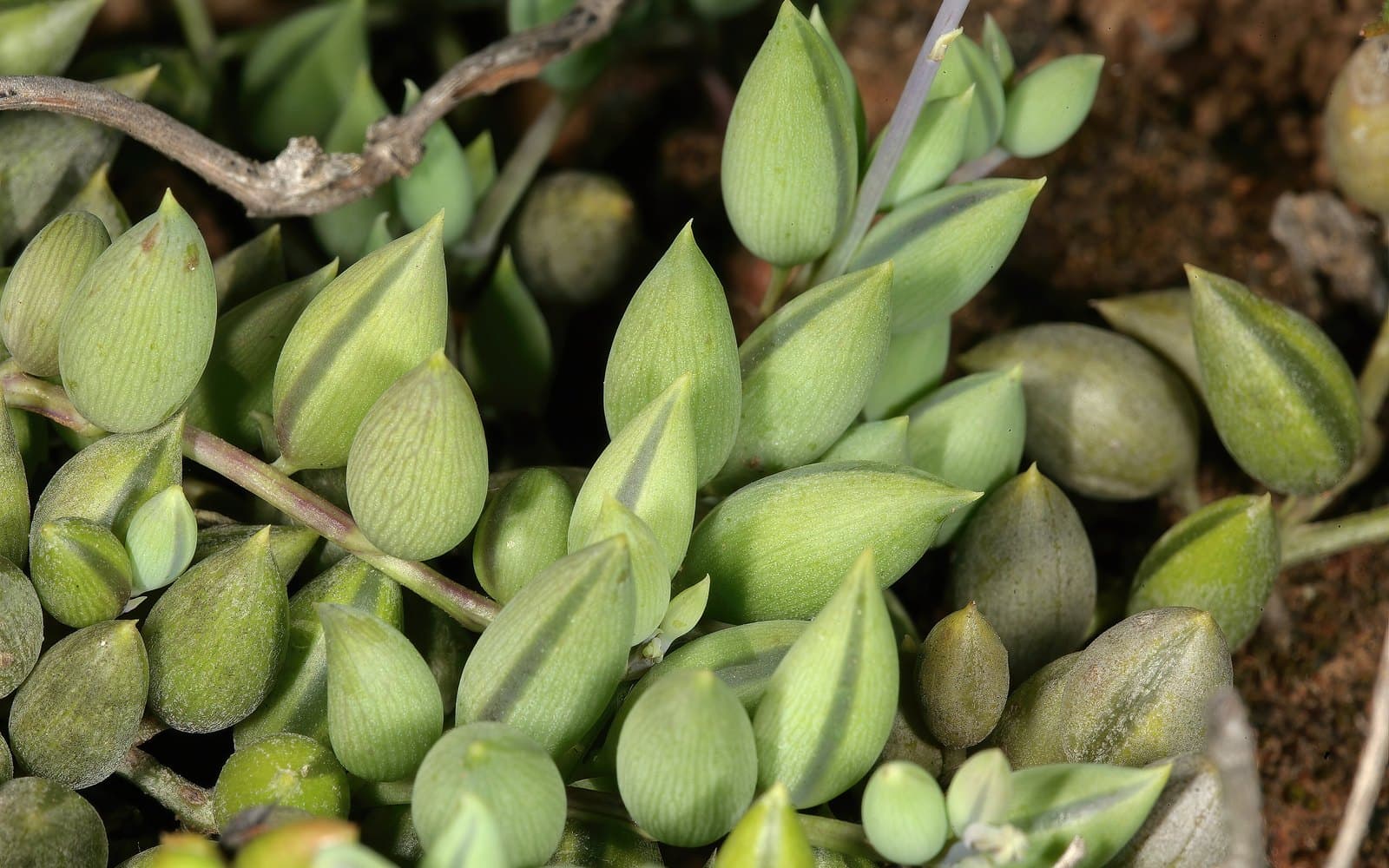
String of bananas is Curio radicans, formerly Senecio radicans (also Cacalia radicans, Kleinia adenocalyx). Labels may say banana vine, necklace plant, or string of fishhooks. Same URL. Family Asteraceae. Native southern Africa. Epithet radicans means taking root along the trailing vine.
Distinct from string of pearls (Curio / Senecio rowleyanus), string of hearts (Ceropegia), and string of turtles (Peperomia). NCSU: banana-shaped fleshy leaves with translucent leaf windows; stems thicker and less delicate than pearls. RHS groups bananas with other Curio trailers (beads, tears, watermelons, dolphins) and flags hearts and turtles as unrelated charm plants.
NCSU Recommended Propagation Strategy: seed and stem cutting; stem cuttings are the quickest and most common. RHS Growing Guide for string of beads covers Curio spp. including string of bananas: stem cuttings and layering. Wisconsin Hort's string of pearls page discusses related Senecio radicans morphology; pearls cutting lengths stay attributed to pearls.
For mix, see soil propagation. Water lives on water propagation.
Stem cuttings
NCSU: propagated by stem cuttings or seeds; stem cuttings are the quickest and most common method.
RHS (Curio group including bananas): stem cuttings root easily, in about a month. Cut a 10 cm (4 in) length of healthy stem; insert the lower part into moist, peat-free cuttings compost, or peat-free multi-purpose compost with added horticultural grit. Prune with gloves; sap is an irritant.
Wisconsin Hort (string of pearls page, related S. radicans noted): for string of pearls, take 3–4 inch stem tip cuttings, strip 3–4 leaves from the bottom, place in or on moist potting mix lightly covering the last few bottom nodes, mist the soil surface until roots are established. Also seed possible but uncommon for pearls. Do not silently relabel that pearls protocol as bananas-only.
Opened NCSU and RHS pages do not give a bananas-specific callous day count. Do not invent one. Do not invent water-prop timelines from blogs. Do not invent leaf-only propagation without a primary source.
Layering
RHS: layering. Lay a stem across the surface of a pot or tray filled with peat-free cuttings compost. Peg it down gently with a bent wire staple. Alternatively, loop a long stem back into the existing pot and pin onto the compost surface. Once rooted, detach from the parent plant. Matches the radicans habit NCSU notes (stems root along the length) without inventing coil-cutting recipes beyond that wording.
Seed
NCSU names seed in Recommended Propagation Strategy and body text; cuttings are quicker and more common. Fruit is an achene with pappus.
Common mistakes
- Treating this page as string of pearls, string of hearts, or string of turtles.
- Silently copying Wisconsin's pearls 3–4 inch cutting steps as if they were a bananas-only guide without attribution.
- Inventing water-propagation day counts or a must-callous period not stated on opened NCSU/RHS pages.
- Inventing individual banana-leaf cuttings without a primary source.
- Skipping gloves; RHS notes sap irritant, NCSU notes pyrrolizidine alkaloids and contact dermatitis.
People also ask
How do I take string of bananas cuttings?
NCSU: stem cuttings are the quickest common method. RHS Curio group: about 10 cm (4 in) of healthy stem into moist peat-free cuttings mix; roots in about a month.
Can I layer the trailing stems?
Yes. RHS describes pinning a stem onto compost in a tray or looping it back into the same pot until rooted, then detaching.
Is string of bananas the same as string of pearls?
No. Related Curio / Senecio, but NCSU and RHS treat bananas (curved leaves with windows) as distinct from pearls' spherical beads.