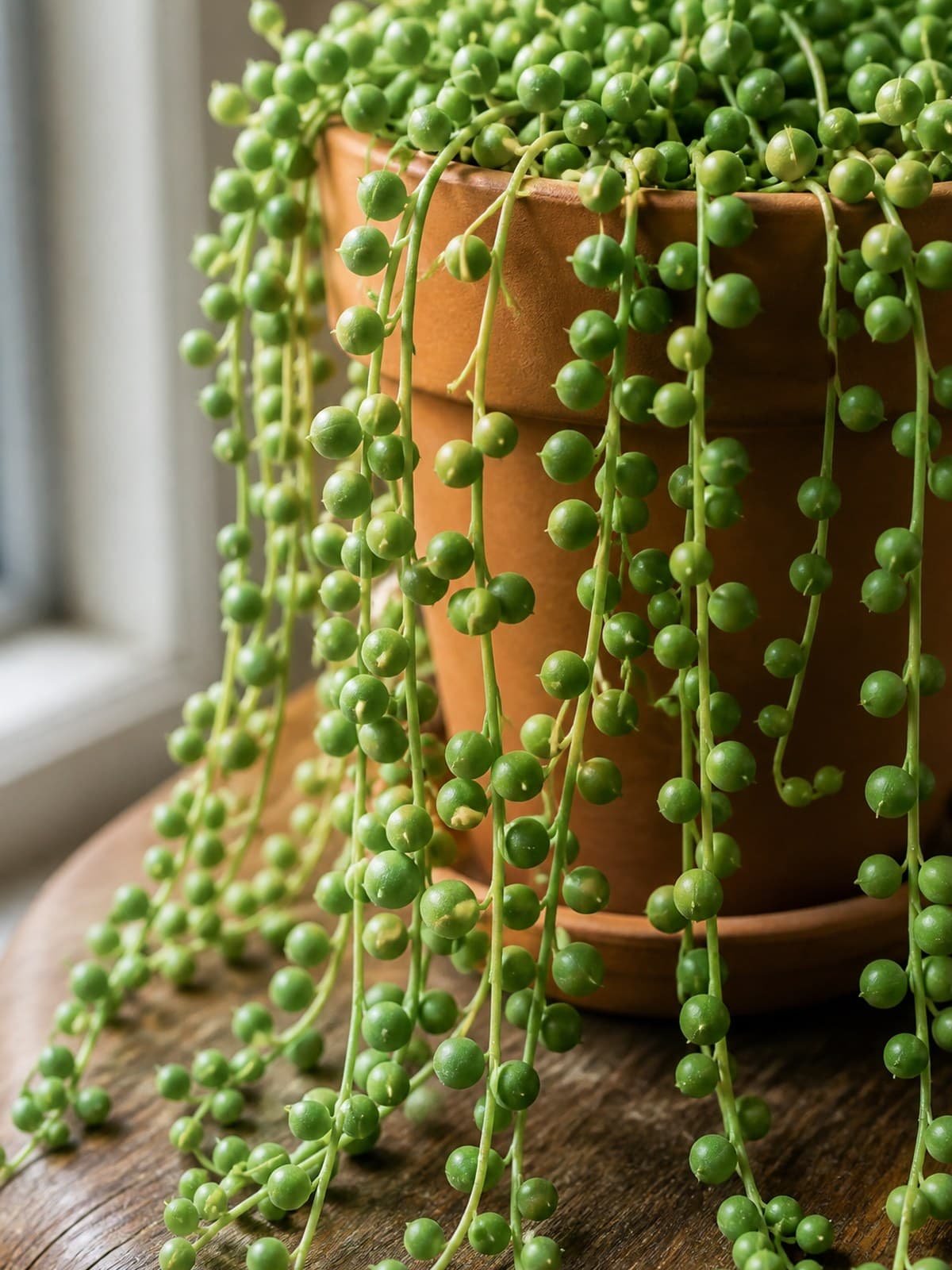
String of pearls is a trailing succulent, Curio rowleyanus, still sold as Senecio rowleyanus. NCSU Extension Gardener Plant Toolbox and Wisconsin Horticulture (Susan Mahr, UW-Madison) start this plant from stem cuttings in potting mix. Shared leaf-and-stem habits for succulents in general live on how to propagate succulents. The NCSU, Wisconsin, and Iowa Curio / Senecio pearls facts stay here.
NCSU points to cactus potting mix, or potting soil mixed with sand or perlite. Wisconsin uses cactus mix, or potting medium cut with gravel, sharp sand, poultry grit, or pumice, and puts the cutting in a shallow pot. Once nodes have rooted and the plant needs a longer home, drained-mix habits sit on soil propagation. Cuttings versus other houseplant methods in general: plant propagation.
NCSU and Wisconsin both flag that leaves and sap are slightly toxic. Ingestion can cause vomiting or diarrhea. Sap can irritate skin. Handle beads and cut stems with clean hands, wash after, and keep cuttings away from pets and kids who might nibble. Soft tissue bruises easily when strings are yanked, so support the strand while you cut rather than pulling beads free.
Can you propagate string of pearls? Yes. NCSU and Wisconsin start it from stem cuttings. NCSU also notes that a leaf dropped on the mix is slower and less reliable than a stem cutting. Iowa State lists Senecio among succulents started from stem cuttings (3 to 6 inches, callus several days, cactus mix or perlite) and notes that most succulents on that page do not root well in a glass of water. Iowa's several-day callus belongs on Iowa's Senecio line; NCSU and Wisconsin do not list a callus wait for pearls.
The practical home path is a stem with nodes seated in mix, not a jar of water as the default. The site propagation water calculator may help jar timing on other plants; on pearls it stays a related tool, not the method NCSU, Wisconsin, or Iowa put first.
Best way indoors
| Situation | Method the sources support | Why |
|---|---|---|
| Trailing stem you can cut | Stem cutting (NCSU; Wisconsin primary) | NCSU: 3 to 5 inch cutting, cover a few nodes. Wisconsin: 3 to 4 inch tip, strip 3 to 4 bottom leaves, set in or on moist mix, lightly cover last bottom nodes; mist surface until roots establish. |
| Dropped bead / single leaf | Leaf on mix only as secondary (NCSU) | NCSU: leaf dropped on mix is slower and less reliable. Wisconsin does not give a leaf recipe. Prefer a stem with nodes. |
| Clear jar as the default start | Not the primary path on cited sources | Iowa State: most succulents do not root well in a glass of water. NCSU and Wisconsin start pearls in mix. |
| Iowa Senecio stem list | Stem cutting with several-day callus (Iowa) | Iowa: 3 to 6 inches, let the cut end callus several days, then cactus mix or perlite. That callus step is Iowa's Senecio line, not a week count from NCSU or Wisconsin. |
| Generic succulent steps without this plant named | Use the succulents guide, then return here | How to propagate succulents is the shared guide. This page keeps NCSU / Wisconsin / Iowa Curio / Senecio pearls facts. |
NCSU's 3 to 5 inches and Wisconsin's 3 to 4 inches are two labeled ranges, not one averaged "ideal" length. Neither gives a rooting time for pearls. Mist notes stay with Wisconsin; callus days stay with Iowa.
Stem cuttings
Stem cuttings are the primary home path. NCSU and Wisconsin each give a short protocol. Read each block as its own recipe. Iowa's callus days sit in their own subsection; they do not overwrite NCSU or Wisconsin when those pages are silent on callus for pearls.
In practice the two stem recipes feel slightly different at the bench. NCSU is short: take the length, cover a few nodes, use cactus mix or soil loosened with sand or perlite. Wisconsin adds strip, moist start, surface mist, and a shallow pot. If you follow Wisconsin, you are managing moisture at the surface in a small volume of mix. If you follow NCSU alone, you still seat nodes in drained medium, but you do not get Wisconsin's mist-and-shallow detail from that sheet. Pick one recipe and follow it through.
NCSU Extension Gardener Plant Toolbox
NCSU. Take a 3 to 5 inch stem cutting. Cover a few of the nodes in the potting mix so new roots can form. Medium: cactus potting mix, or potting soil mixed with sand or perlite.
Nodes in the mix. Roots form where nodes contact medium. NCSU says "a few" nodes, not a buried-inch figure or a bead count. Seat enough stem that several nodes sit in contact with mix; leave the trailing tip free so beads are not crushed under soil.
No callus wait on NCSU. That page does not give a dry-down day count for pearls. If you want a several-day callus, that habit comes from Iowa's Senecio stem line below, not from NCSU.
Wisconsin Horticulture (Susan Mahr)
Wisconsin Horticulture. Take a 3 to 4 inch stem tip. Strip 3 to 4 leaves from the bottom. Set the cutting in or on moist potting mix and lightly cover the last few bottom nodes. Roots form at each node. Mist the soil surface until the roots are established, rather than soaking the pot. Medium: cactus mix, or potting medium cut with gravel, sharp sand, poultry grit, or pumice. Use a shallow pot; Wisconsin warns that a large volume of wet mix invites root rot.
Why strip bottom leaves. Clearing 3 to 4 beads at the base gives clean nodes to seat. Those stripped beads are optional leaf-on-mix starts on NCSU's slower secondary path; they are not Wisconsin's main recipe.
Mist, do not soak. Surface mist keeps the contact zone damp without filling a deep pot of mix that stays wet for days. Once roots have established, the mist-only phase is done. Move to ordinary drained-mix watering for a shallow pot: wet, then let the medium dry back rather than keeping a constant flood. Shared drained-mix habits after potting up: soil propagation.
Why shallow matters. A shallow container holds less wet volume. Wisconsin's rot warning is about a large volume of wet mix, not about misting the surface. A deep nursery pot of soggy cactus mix still fails that test even if the label says "cactus." Prefer a low pot or tray with drainage while the cutting roots.
Cutting length range. NCSU lists 3 to 5 inches. Wisconsin lists 3 to 4 inches. Both are sound labeled ranges. A tip inside either band with firm beads and visible nodes is usable material.
Iowa State Senecio stem line
Iowa State Extension (How to propagate succulents). Senecio appears on the stem-cuttings list: 3 to 6 inches, let the cut end callus several days, then cactus mix or perlite. Most succulents on that page do not root well in a glass of water.
Callus labeled Iowa. Several days of callus before the cutting goes in mix is Iowa's Senecio line. NCSU and Wisconsin do not give that wait for pearls. Following Iowa means drying the cut end for several days, then seating in cactus mix or perlite. Skipping callus while following NCSU or Wisconsin is not a failure of those sheets; they never required it.
No water-jar success path on Iowa. Iowa's line is a warning against the jar default for most succulents on that page. It is not a jar recipe to expand into pearls timing, root length, or change-water days.
Leaf cuttings
Leaf cuttings are secondary. Prefer a stem with nodes when the goal is a trailing string sooner.
NCSU. Dropping a leaf onto the mix is slower and less reliable than a stem cutting. That page does not give a leaf-plantlet week count. A single bead may eventually root on NCSU's framing, but NCSU itself ranks that path below stem cuttings.
Wisconsin. Does not give a leaf recipe on the pearls article. Beads stripped for Wisconsin's stem tip are handling leftovers, not a Wisconsin leaf how-to.
Keep stem primary. Use sound stem tips when you can cut them. Save dropped beads for the secondary NCSU leaf-on-mix try only when you have extras and time; do not build the whole batch around single pearls when trailing tips are available.
Light while propagating
String of pearls is a trailing succulent. Light while rooting should stay bright without scorching new tissue.
NCSU care light. Indoor plants want bright, indirect light; scorch comes from direct sun. Keep new cuttings out of a dim corner and also off a hot glass sill that bleaches or softens beads.
Wisconsin. The pearls article focuses on mix, mist, and shallow pots rather than a separate light figure. Keep the pot shallow and the surface misted while light stays adequate for a succulent start. Dim trays stretch new growth; hot direct sun cooks beads that were firm the day before.
Pale, stretched new growth (etiolation) is a light problem before it is a cultivar problem. Soft, bleached beads under hot glass are a scorch problem. Measure or estimate available light with the propagation light DLI calculator. When windows cannot deliver bright indirect conditions, see best grow lights for indoor propagation.
A dark cabinet is a poor rooting spot for this plant. Low light does not get fixed by soaking the pot; Wisconsin already warns that a large volume of wet mix invites rot. Raise light first, then keep mist light and shallow.
The site propagation water calculator may help jar timing on other plants. On this page it is a related tool, not a reason to switch pearls to a water default against Iowa, NCSU, and Wisconsin.
Troubleshooting
Soggy, deep pot / soft stems. Wisconsin: a large volume of wet mix invites root rot. Use a shallow, draining container. Mist the surface until roots establish rather than soaking the pot. Soft brown tissue and a pot that never dries mean rot, not a slow root clock. Discard rotten pieces. Retake a firm stem tip and return to drained mix (soil propagation).
No visible roots yet. NCSU and Wisconsin do not give a days-to-root clock for pearls. A firm cutting with nodes seated, a shallow draining pot, surface mist rather than flood (Wisconsin), and bright indirect light (NCSU) is still on protocol even when roots are not yet obvious. For light, see the propagation light DLI calculator. Mushy tissue is rot; firm tissue waiting in drained mix is not proof the method failed.
After misting stops / potting up. Wisconsin ties surface mist to the period until roots are established. Once the cutting holds and new growth shows it has rooted, stop treating the pot as a mist-only tray. Water the shallow mix thoroughly, then let it dry back. Pot up only when the shallow start is clearly root-bound or tips need room to trail. NCSU and Wisconsin don't give a time to pot up, so go by how the plant grows.
Water jar presented as the default. Iowa State: most succulents do not root well in a glass of water. NCSU and Wisconsin start pearls in mix. A jar may appear in site-wide water tools for other plants; it is not the pearls default on these sources. Prefer cactus-type or grit-opened mix and the stem recipes above.
Leaf used as the main method. NCSU: a leaf on the mix is slower and less reliable. Wisconsin has no leaf recipe. Switch to a stem cutting with nodes when beads keep stalling as single-leaf starts.
Callus confusion. Iowa's Senecio stem cuttings sit for several days before they go in mix. NCSU and Wisconsin do not give that wait for pearls. Following Iowa is fine when you mean Iowa; skipping callus on an NCSU or Wisconsin start is consistent with those sheets.
Direct hot sun scorch. NCSU: scorch comes from direct sun; indoor plants want bright, indirect light. Move scorched cuttings to bright indirect conditions. Flooding the pot does not repair scorch.
Etiolation (low light stretch). Thin, pale, stretched new growth points to insufficient light. Raise light with the propagation light DLI calculator and, when the window cannot deliver, best grow lights for indoor propagation. Wetter mix does not fix stretch.
Fragile beads and sap. Strings shed beads when yanked or twisted. Support the strand, cut with clean shears, and set stripped beads aside rather than crushing them back onto the stem. NCSU and Wisconsin: leaves and sap are slightly toxic; ingestion can cause vomiting or diarrhea; sap can irritate skin. Wash hands after handling. Keep cuttings and discarded beads out of reach of pets and small children.
Name / synonym confusion. Labels may say Senecio rowleyanus while NCSU lists Curio rowleyanus as the accepted name with that synonym. Treat them as the same trailing pearls plant on these sources. A tag that still says Senecio does not call for a different species recipe.
Common mistakes
- A soggy, deep pot. Wisconsin: a large volume of wet mix invites root rot. Use a shallow, draining container.
- A water-jar how-to as the default. Iowa State: most succulents do not root well in a glass of water. NCSU and Wisconsin start pearls in mix.
- Direct hot sun on a new cutting. NCSU: indoor plants want bright, indirect light; scorch comes from direct sun.
- Treating a dropped leaf as the main method. NCSU calls that slower and less reliable.
- Judging a firm cutting against a set rooting week. NCSU and Wisconsin don't give one.
- Fusing Iowa's several-day callus into NCSU or Wisconsin as if all three required the same dry-down.
- Blending NCSU's 3 to 5 inches and Wisconsin's 3 to 4 inches into one "perfect" length.
- Leaving cuttings on a dark shelf and blaming the cultivar for etiolation; raise light with the propagation light DLI calculator.
- Ignoring sap / ingestion warnings on NCSU and Wisconsin, or yanking strings so beads bruise and shed.
- Replacing this named Curio rowleyanus guide with an unsourced generic succulents how-to, or treating how to propagate succulents as if it erased Wisconsin's mist-and-shallow-pot steps.
People also ask
How long should the cutting be?
NCSU: 3 to 5 inches. Wisconsin: 3 to 4 inches. Iowa's Senecio stem list: 3 to 6 inches. Use a tip inside the range you are following; there is no single mandatory length across all three sheets.
Do I need to callus it?
NCSU and Wisconsin do not give a callus wait for pearls. Iowa State's Senecio stem cuttings sit for several days before they go in mix. Use callus when you are following Iowa; skip it when you are following NCSU or Wisconsin alone.
Can I root string of pearls in water?
These pearls pages use mix. Iowa State says most succulents do not root well in a glass of water. Prefer cactus-type or grit-opened mix and the stem recipes above.
Can I start it from one pearl?
NCSU: a leaf on the mix is slower and less reliable. Use a stem with nodes. Wisconsin does not give a single-bead recipe.
What mix should I use?
NCSU: cactus potting mix, or potting soil mixed with sand or perlite. Wisconsin: cactus mix, or potting medium cut with gravel, sharp sand, poultry grit, or pumice, in a shallow pot. Iowa: cactus mix or perlite for the Senecio stem line. Shared drained-mix habits: soil propagation.
How do I water a new cutting?
Wisconsin: mist the soil surface until roots are established, rather than soaking the pot. A large volume of wet mix invites root rot. After roots establish, water the shallow mix thoroughly and let it dry back. There is no day-of-week watering calendar on these sheets beyond that mist guidance.
Why are my beads scorched or stretched?
Scorch: NCSU links scorch to direct sun; keep bright, indirect light. Stretch (etiolation): low light. Check the propagation light DLI calculator; use best grow lights for indoor propagation when the window cannot deliver.
Is Curio the same as Senecio rowleyanus?
NCSU lists Curio rowleyanus with synonym Senecio rowleyanus. Wisconsin's article title still uses Senecio rowleyanus. Same trailing pearls plant on these sources.
Stem cutting or leaf cutting?
Stem cuttings are the method NCSU and Wisconsin put first. NCSU ranks leaf-on-mix as slower and less reliable. Wisconsin has no leaf recipe. Choose stem when you can cut a tip with nodes.
When do I stop misting and pot up?
Wisconsin: mist until roots are established. After that, treat the shallow pot like drained mix: water, then let it dry back. Pot up when the start is clearly crowded or tips need room to trail. NCSU and Wisconsin do not give a week-to-pot-up figure, so watch the plant rather than a calendar.
Keep reading
- How to propagate succulents for shared succulent habits (this page stays the named Curio rowleyanus guide)
- Soil propagation for drained mix after stem nodes root
- Plant propagation for cuttings vs other methods in general
- Best grow lights for indoor propagation when bright indirect light is short
- Propagation light DLI calculator to check light while cuttings establish
- Propagation water calculator for jar timing on other plants (not the pearls default on cited sources)