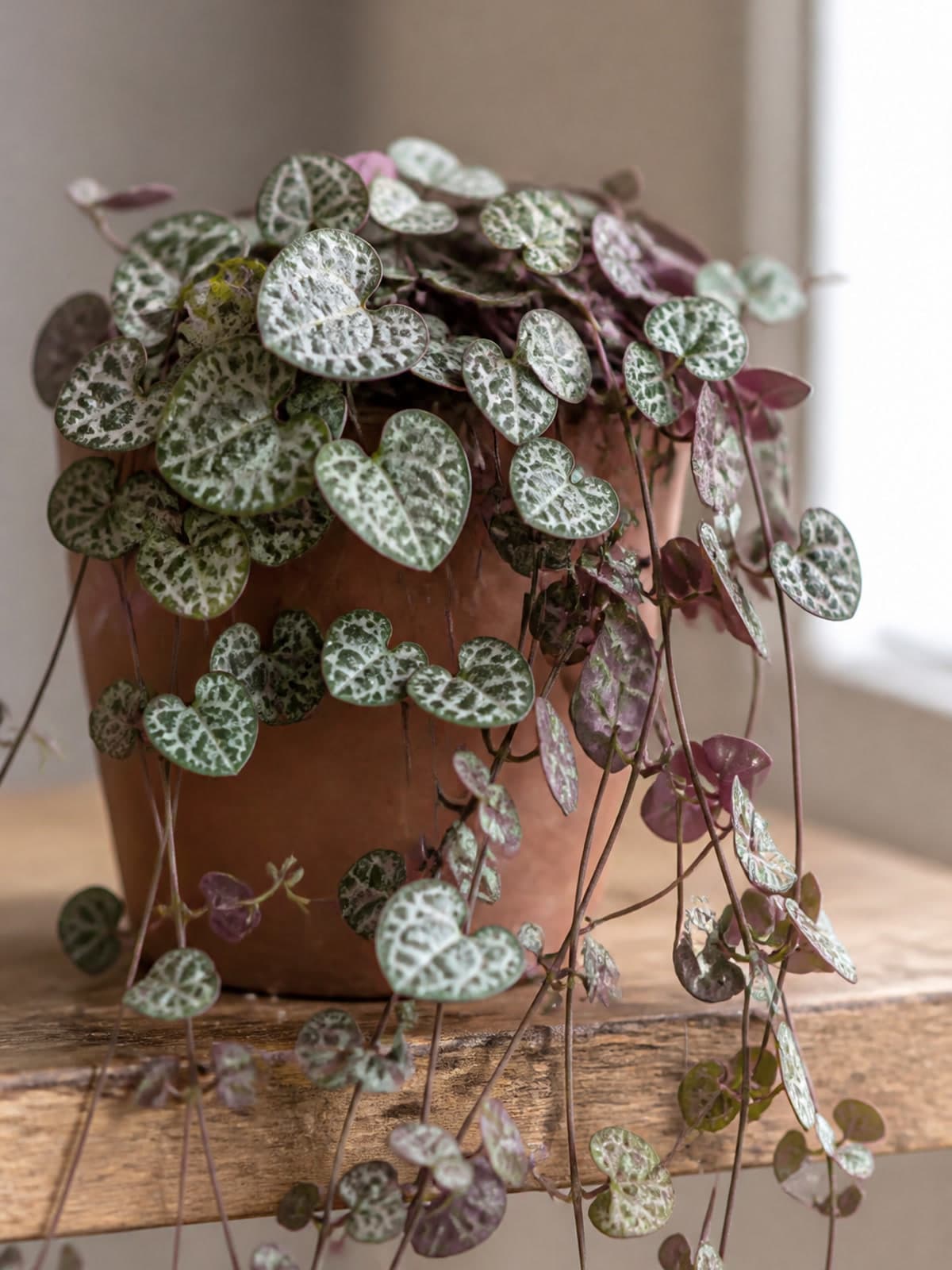
String of hearts is Ceropegia woodii, also sold as rosary vine or chain of hearts. Its heart-shaped leaves grow on long, wiry stems. Wisconsin Horticulture (Susan Mahr, University of Wisconsin-Madison) places it in the milkweed subfamily of the dogbane family, Apocynaceae, and gives its native range as southern Africa, from Zimbabwe to eastern South Africa. NCSU Extension Gardener Plant Toolbox lists other common names for the same plant, including Bushman's Pipe, Necklace Vine, and Sweetheart Vine.
String of pearls is a different plant, Curio rowleyanus, with its own steps at how to propagate string of pearls. General succulent methods are at how to propagate succulents.
NCSU lists layering, seed, and stem cutting as the Recommended Propagation Strategy for Ceropegia woodii. Wisconsin says the plant is easily propagated from cuttings, from tubers produced at the base of the leaves, or from seed. Neither source gives a cutting length, a node count, a rooting hormone, or a number of days for a cutting to root.
Wisconsin's potting advice is a freely draining medium with plenty of coarse sand, perlite, or another coarse component, such as a commercial cactus and succulent mix. The soil should dry between deep waterings. Wisconsin says the plant tolerates dry soil much better than soggy soil and is easily killed by overwatering. NCSU recommends well-drained, sandy potting soil, lets it dry out completely between waterings, and reduces watering even further during winter dormancy.
For drained-mix technique in general, see soil propagation. For how the main propagation methods compare across houseplants, see plant propagation.
Best way indoors
Wisconsin and NCSU describe two practical home methods. A tuber can be pressed into a second pot while it is still on the vine, or a length of vine can be cut and rooted with bottom heat. Which one fits depends on what the plant has to offer.
| Situation | Method with source support | Why |
|---|---|---|
| An aerial tuber ("bead") on the vine | Press the tuber into the soil of a second pot, preferably still attached | Wisconsin gives these steps. The mix stays moist but not wet, and the tuber is severed once it is rooted and growing, in a few weeks or months. |
| A trailing stem that can be cut | Stem cutting with bottom heat | NCSU lists stem cutting. Wisconsin says cuttings from the vine are best rooted with bottom heat. Neither source gives a cutting length. |
| A stem already lying on the soil of the parent pot | Layering | NCSU lists layering and says the tubercles root when the stem comes in contact with the soil. |
| A stem in a jar of water | Not named by Wisconsin or NCSU | Jar care for other plants is on water propagation and the propagation water change calculator. |
| Seed | Named, with no home method | Wisconsin and NCSU both name seed. Neither gives a sowing depth, a temperature, or days to germinate. |
| A string of pearls method | A different plant | String of pearls is Curio rowleyanus. Its steps are at how to propagate string of pearls. |
For most indoor plants, a tuber pressed into a second pot is the simplest start, because it stays connected to the parent vine while it roots. A vine cutting with bottom heat is the other named route. Wisconsin's few weeks or months applies to the tuber method. Neither source gives a time for a stem cutting.
Materials
- A healthy parent plant with tubers along the vine, or trailing stems long enough to cut
- A second small pot with a drainage hole
- Freely draining mix: a commercial cactus and succulent mix, or potting medium with plenty of coarse sand or perlite (Wisconsin)
- Clean scissors or pruners for a vine cutting
- A source of bottom heat for vine cuttings, such as a heat mat under the pot (Wisconsin names bottom heat but no temperature)
- A west or south facing window, or a bright spot out of harsh direct sun
- Optional: the propagation light DLI calculator if the window is dim
A hanging pot or basket suits the plant once the new start is growing. NCSU notes that the trailing stems are well suited to one, and Wisconsin calls it best grown as a hanging plant.
Aerial tubers
Small tubers form at the nodes or leaf bases along the stems. Wisconsin says they look somewhat like little potatoes, and they are one explanation for the name rosary vine. NCSU describes them as bead-like tubercles that develop along the cascading vines between the leaves.
How the tubers root. NCSU says the tubercles will root and produce another plant if the stem comes in contact with the soil. Its stem description adds that they root easily on contact with soil. Wisconsin notes that the small aerial tubers will root to form a new plant.
Wisconsin's steps. Press the tuber, preferably still attached to the vine, into the soil of another pot. Keep the growing medium moist, but not wet, to encourage rooting. Once the tuber is rooted and growing, in a few weeks or months, sever it from the original plant.
Why it stays attached. A tuber left on the vine stays connected to the parent while it roots in the new pot. Wisconsin makes the cut the last step, after the new plant is rooted and growing. Wisconsin gives a few weeks or months as a range, not a deadline.
Moist, then drier. A rooting tuber sits in moist mix that never turns soggy. Once the new plant is growing, it goes back to the care Wisconsin and NCSU give the adult: water deeply, then let the soil dry out between waterings. NCSU warns that overwatering causes root rot and yellow leaves.
Stem cuttings
NCSU lists stem cutting as a recommended strategy. Wisconsin says cuttings from the vine are best rooted with bottom heat. That is the full stem-cutting detail in both sources. Neither gives a cutting length, a node count, a callus time, a rooting medium, or a number of days to root.
What the stems look like. NCSU describes long, wiry stems that drape over a container and hang down about 3 feet, reaching up to 12 feet long in the plant's native habitat. The leaves occur about every 3 inches along the stem, and the beads form on the stem between the leaves. Wisconsin describes the stems as pink or purple and says the tangled, trailing branches can grow several feet long.
Rooting a cutting. Take a length of healthy vine, set it in a small pot of freely draining mix, and keep it warm from below if you have bottom heat. The mix Wisconsin recommends for the plant is the natural choice, since neither source names a separate medium for cuttings. Wisconsin's moist but not wet instruction for tubers is the closest guide for a cutting's mix while it roots. Its warning that the plant is easily killed by overwatering applies to a cutting as much as to an adult plant.
Choosing a method. A tuber pressed into a second pot comes with Wisconsin's clearest steps. A detached vine cutting with bottom heat is the other named route. Both end in the same drained mix and the same dry-between-waterings care.
Light while propagating
String of hearts is a trailing succulent. Tubers and cuttings need the same bright light as the parent plant, without scorching sun.
Wisconsin. The plant grows well indoors in a west or south facing window. In strong light the leaves are darkly colored, with distinctive marbling. In too little light they turn light green. Houseplants can go outside for the summer, but they need gradual acclimation to the stronger light to prevent sunburn. Bring them indoors before the first frost. In winter, keep them in relatively warm conditions, above 60 °F.
NCSU. The plant prefers bright, indirect sunlight. Too much sunlight results in scorched leaves. Large gaps between the leaves mean the plant is not getting enough light. NCSU's Cultural Conditions list Dappled Sunlight, meaning shade through an upper canopy all day.
Stretched spacing between the hearts points to a light shortage. Extra water will not fix it, and Wisconsin already warns that overwatering kills this plant. Raise the light first, and keep the mix drained.
If a tuber or cutting sits in a dim window, check the daily light with the propagation light DLI calculator. When the window cannot supply enough light, fixture choice and hanging distance are covered in best grow lights for indoor propagation.
Mix and watering while a start roots
Wisconsin keeps a pressed tuber in mix that is moist but not wet. The same instruction is the closest guide for a fresh cutting. Once the start is growing, water deeply and let the soil dry between waterings, as Wisconsin describes. NCSU lets the soil dry out completely between waterings.
Wisconsin feeds the plant infrequently, at most monthly when it is actively growing, with half-strength houseplant fertilizer. In winter the plant rests. Wisconsin reduces watering and stops fertilizing during that rest, and NCSU reduces watering even further while the plant is dormant.
Full drained-mix steps are on soil propagation. The propagation water change calculator goes with jar-rooted plants on water propagation. Wisconsin and NCSU do not name a water jar for Ceropegia woodii.
Troubleshooting
Soft stems, yellow leaves, or a pot that never dries. NCSU says overwatering can cause root rot and yellowing of the leaves. Wisconsin says the plant is easily killed by overwatering. Let the pot dry out, and repot a new start into freely draining cactus and succulent mix. If the tissue has gone soft, start again from a firm tuber or a healthy length of vine.
Wilted leaves. NCSU says wilted leaves are the result of underwatering. Water deeply, let the pot drain, and then let the soil dry again before the next watering.
A pressed tuber shows no new growth yet. Wisconsin gives a few weeks or months for a tuber to root and start growing. A firm tuber still attached to the vine, in moist mix and bright light, is still within that range. Leave it attached until new growth appears.
A vine cutting sits without rooting in a cool spot. Wisconsin says vine cuttings are best rooted with bottom heat. It doesn't give a temperature. Add gentle warmth under the pot and keep the mix moist but not wet.
Scorched leaves. NCSU says too much sunlight results in scorched leaves. Move the start to bright, indirect light.
Large gaps between leaves, or pale green leaves. NCSU says large gaps between the leaves mean the plant is not getting enough light. Wisconsin says leaves turn light green in too little light and stay darkly colored, with marbling, in strong light. Measure the window with the propagation light DLI calculator, and add a grow light if the window falls short.
Pests on a new start. NCSU says to monitor for aphids, mealybugs, and scale. Wisconsin says the plant has few pests, but mealybugs can be a problem.
Growth stops in winter. Wisconsin says the plant does best with a winter rest, kept above 60 °F with less water. NCSU says it is dormant over the winter. A start that slows down in winter is following that rest.
Common mistakes
- Starting with a stem in a jar of water. Wisconsin and NCSU describe tubers pressed into soil, layering, and cuttings rooted with bottom heat. Neither names water rooting.
- Cutting a tuber free before it has rooted and started to grow. Wisconsin severs it only after that point.
- Following a string of pearls method. String of pearls is Curio rowleyanus, a different plant, and its cutting steps come from other sources.
- Moving a plant outdoors for the summer without acclimating it. Wisconsin says the gradual change to stronger light prevents sunburn.
- Fertilizing during the winter rest, or feeding often at full strength. Wisconsin feeds at most monthly with half-strength fertilizer during active growth and not at all in winter.
- Repotting often into a large pot. NCSU and Wisconsin both say the plant likes to be crowded, and Wisconsin repots only when necessary, in spring before new growth starts.
People also ask
Is string of hearts the same as string of pearls?
No. String of hearts is Ceropegia woodii. String of pearls is Curio rowleyanus, with its own steps at how to propagate string of pearls.
How long until a tuber roots?
Wisconsin gives a few weeks or months for a pressed tuber to root and start growing. Cut it free after that. NCSU doesn't give a time.
How long should a cutting be?
Wisconsin and NCSU do not give a length for a string of hearts cutting.
Can I root string of hearts in water?
Wisconsin and NCSU do not name water propagation for this plant. They describe tubers pressed into soil, layering, and vine cuttings rooted with bottom heat. Jar steps for other plants are on water propagation.
Do I need bottom heat?
Wisconsin says vine cuttings are best rooted with bottom heat. It doesn't give a temperature. A pressed tuber rooting on the vine has no bottom heat instruction in either source.
Which is easier, a tuber or a cutting?
Wisconsin gives step-by-step detail only for the tuber, which roots while it is still attached to the parent vine. NCSU lists stem cutting and layering alongside seed. Use a tuber if the vine has one. Use a cutting if it does not.