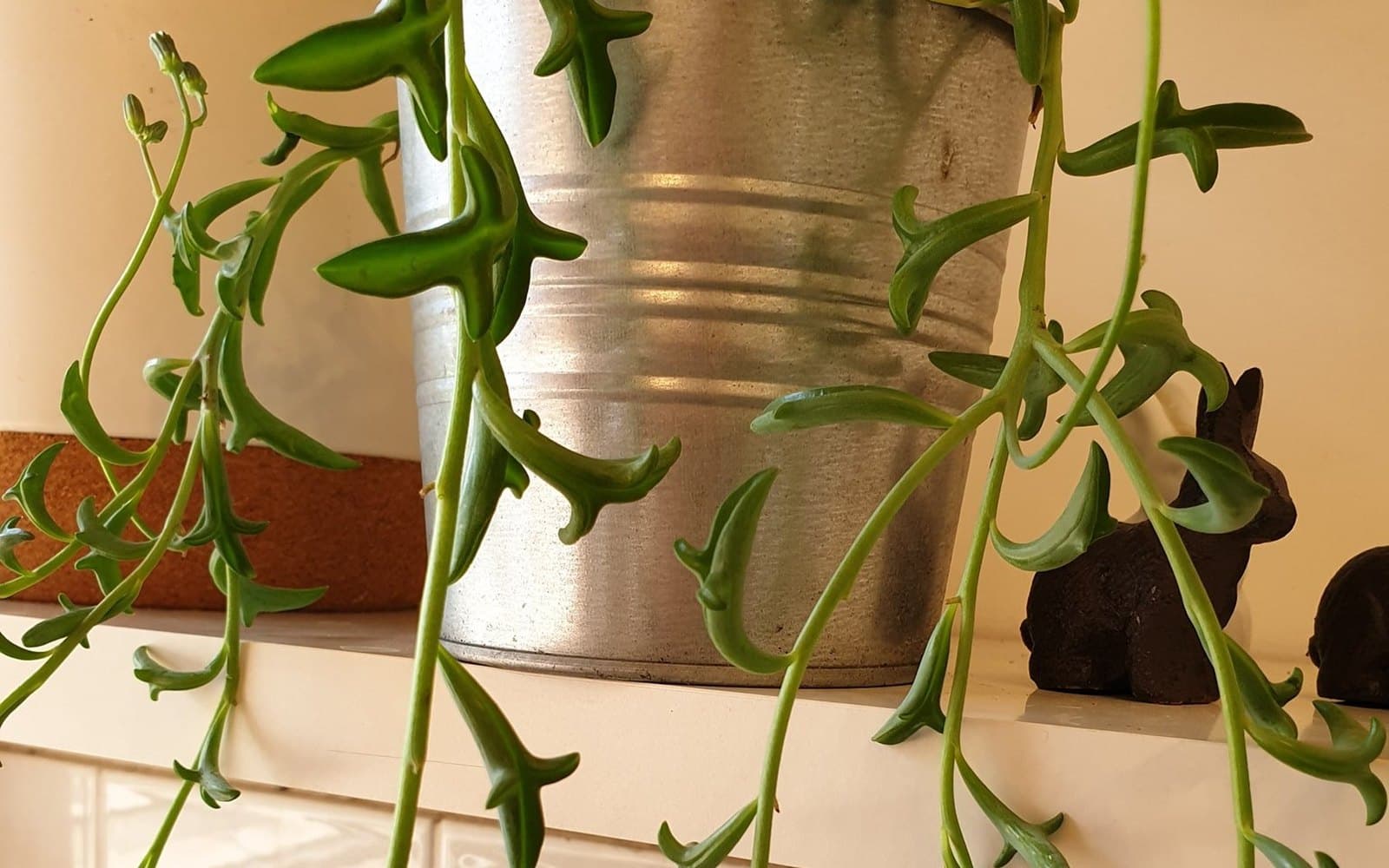
String of dolphins is sold and listed in horticulture as Curio peregrinus or Curio × peregrinus (labels may still say Senecio peregrinus or Senecio × peregrinus). Same URL. Family Asteraceae. RHS Growing Guide for string of beads lists string of dolphins as C. peregrinus among Curio trailers (previously Senecio). UCR Botanic Gardens plant-sale list uses Curio × peregrinus for string of dolphins. IPNI records the 2020 name ×Bacurio delphinatifolius Gideon F.Sm. & Figueiredo (Phytotaxa 458: 117), an intergeneric hybrid of Baculellum articulatum × Curio rowleyanus, named for leaves that resemble small jumping dolphins. IPNI also records Curio × peregrinus (G.Kunkel) P.V.Heath with a note that the basionym was not validly published. Type material for ×Bacurio delphinatifolius is ex hort. (cultivated), so opened primaries do not give a wild native range for the hybrid itself; related Curio parents and group plants are tied to arid southern Africa on RHS and NCSU pearls pages.
Distinct from string of pearls (Curio / Senecio rowleyanus), string of bananas (Curio radicans), string of hearts (Ceropegia), and string of turtles (Peperomia). RHS: dolphins have branched leaves, unlike bananas’ long curved leaves or pearls’ spherical beads. RHS also flags hearts and turtles as unrelated charm trailers. UCR: pointed leaves that resemble dolphins; tufted white flowers; hanging container in filtered light; water wise; to about 3 ft.
RHS Growing Guide covers Curio spp. including string of dolphins: stem cuttings and layering. NCSU and Wisconsin give stem-cutting detail for related string of pearls; keep those lengths attributed to pearls, not as a dolphins-only measurement. UC ANR Sacramento County succulent notes list “String of Dolphins” with Senecio string plants under low-light succulents and give genus-level leaf/stem callus guidance for succulents.
For mix, see soil propagation. Water lives on water propagation.
Stem cuttings
RHS (Curio group that names string of dolphins, C. peregrinus): stem cuttings root easily, in about a month. Cut a 10 cm (4 in) length of healthy stem; insert the lower part into moist, peat-free cuttings compost, or peat-free multi-purpose compost with added horticultural grit. Wear gloves when handling or pruning; sap can cause skin irritation. Plants are poisonous; keep out of reach of children and pets.
NCSU (Curio rowleyanus, string of pearls; one hybrid parent per IPNI): Recommended Propagation Strategy includes stem cutting. Take a 3 to 5 inch stem cutting and cover a few of the nodes in the potting mixture so new roots form. A slower, less reliable option on that pearls page is dropping a leaf onto the soil mix. Do not silently relabel those pearls steps as a dolphins-only protocol.
Wisconsin Hort (string of pearls page): take 3–4 inch stem tip cuttings; strip 3–4 leaves from the bottom; place in or on moist potting mix, lightly covering the last few bottom nodes; mist the soil surface until roots are established. Also notes seed is possible for pearls but not commonly available. Attribute as pearls guidance.
RHS Curio rowleyanus plant profile (related pearls): propagate by softwood cuttings, internodal cuttings, and division in spring and summer.
Opened RHS Curio-group pages that name dolphins do not give a dolphins-only callous day count. UC ANR Sacramento general succulent note: leaf or stem cuttings; allow cuttings to callus for a few days before planting in succulent/cactus mix; keep moist but not wet until roots form; keep out of the sun until rooted. That callus wording is general succulent guidance on a page that also lists string of dolphins, not a species-only recipe.
Do not invent water-propagation week counts from blogs. Do not invent individual dolphin-leaf cuttings as a preferred method without a dolphins-specific primary.
Layering
RHS (Curio group including dolphins): layering. Lay a stem across the surface of a pot or tray filled with peat-free cuttings compost (or the grit-amended mix above). Peg it down gently with a bent wire staple. Alternatively, loop a long stem back into the existing pot and pin onto the compost surface (helps fill a sparse pot). Once rooted, detach from the parent plant.
Seed
Opened RHS Curio-group how-to that names string of dolphins lists stem cuttings and layering only for propagation of these plants. NCSU names seed for Curio rowleyanus (pearls). IPNI treats the dolphin plant as a named hybrid (×Bacurio delphinatifolius / horticultural Curio × peregrinus names). Do not invent a seed protocol or germination temperature for string of dolphins from blogs.
Common mistakes
- Treating this page as string of pearls, bananas, hearts, or turtles.
- Silently copying NCSU or Wisconsin pearls cutting lengths as if they were written only for dolphins.
- Inventing water-propagation day counts or blog week counts not stated on opened RHS/extension pages for this plant.
- Inventing leaf-only dolphin propagation as the main method without a dolphins-specific primary.
- Misting the foliage; RHS says these Curio trailers dislike humidity and should not be misted (Wisconsin’s pearls note is misting the soil surface while rooting, not fogging leaves).
- Overwatering cuttings; RHS flags stem rot from damp compost.
- Skipping gloves; RHS notes sap irritant and toxicity for the Curio string group.
People also ask
What is the botanical name of string of dolphins?
RHS lists it as Curio peregrinus (previously under Senecio in trade). UCR lists Curio × peregrinus. IPNI records ×Bacurio delphinatifolius (2020) for the hybrid Baculellum articulatum × Curio rowleyanus, and notes nomenclatural issues around earlier Curio × / Senecio × peregrinus names. Labels may still say Senecio peregrinus.
How do I take string of dolphins cuttings?
RHS Curio group (page that names dolphins): about 10 cm (4 in) of healthy stem into moist peat-free cuttings mix with grit as needed; roots in about a month. Related pearls pages (NCSU 3–5 in; Wisconsin 3–4 in tip cuttings) give node-covering detail; attribute those as pearls.
Can I layer the trailing stems?
Yes. RHS describes pinning a stem onto compost in a tray or looping it back into the same pot until rooted, then detaching.
Is string of dolphins the same as string of bananas or pearls?
No. Related Curio / Senecio trailers in the Asteraceae group, but RHS separates dolphins (branched leaves) from bananas (long curved leaves) and pearls (spherical beads). Hearts are Ceropegia; turtles are Peperomia.