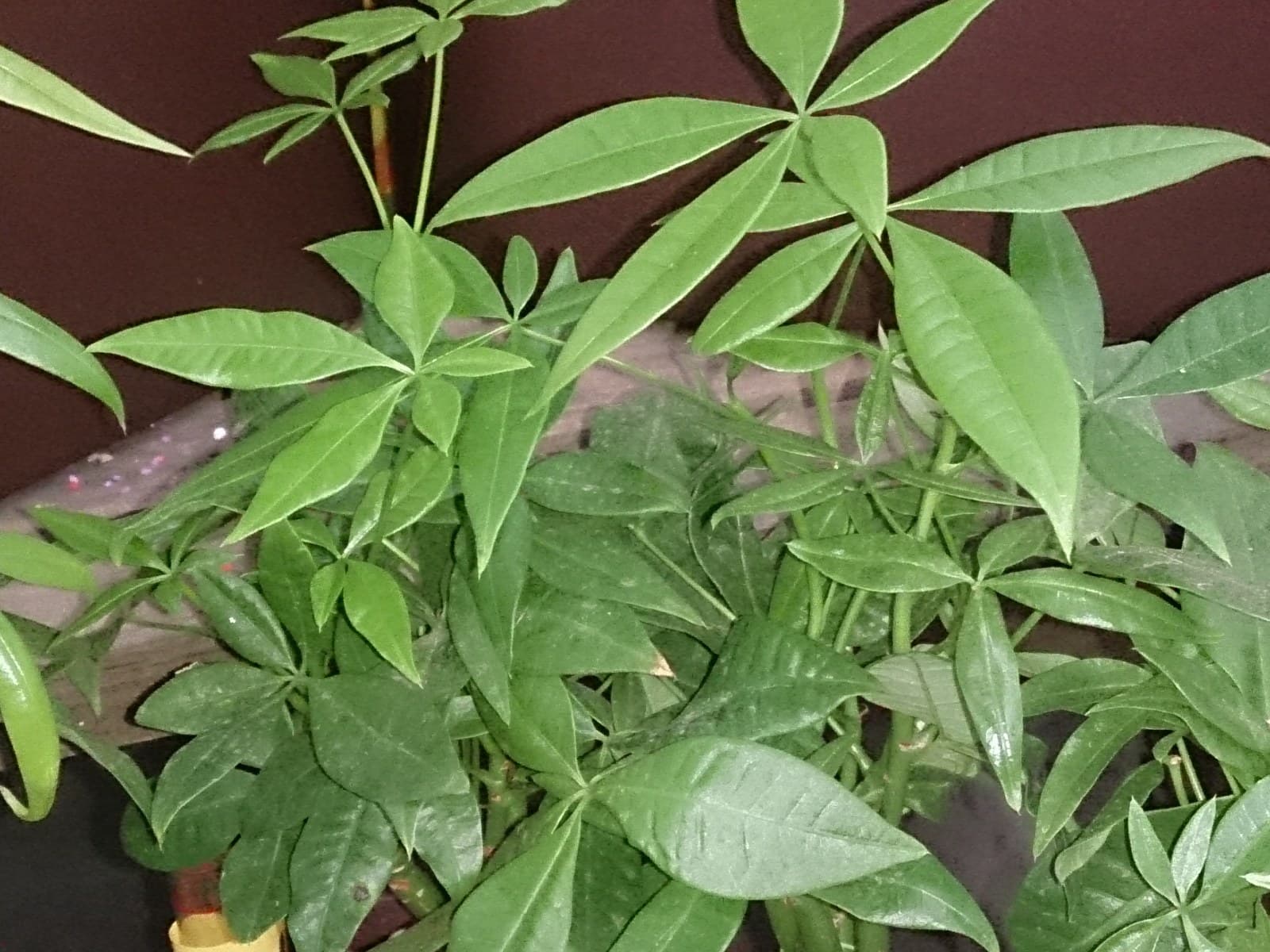
The money tree is Pachira aquatica. Shops also sell it as Malabar chestnut, Guiana chestnut, French peanut, Mexican fortune tree, or money plant. It belongs to the mallow family, Malvaceae.
It is a different plant from the Chinese money plant, Pilea peperomioides, which has round leaves attached at the center. That plant has its own guide at how to propagate a Chinese money plant. Jade plant (Crassula ovata) sometimes carries a "money tree" nickname too. Jade is a succulent, and its steps are at how to propagate a jade plant.
NCSU Extension Gardener Plant Toolbox lists layering, seed, and stem cutting as the Recommended Propagation Strategy for Pachira aquatica. The culture text calls the cuttings softwood cuttings. NCSU does not give a cutting length, a node count, a rooting week count, a rooting temperature, a hormone recipe, or a water-jar method for this species. The general method guides linked below cover technique. None of them turns into a Pachira rooting clock.
Indoor trunks stay flexible enough to braid. According to NCSU, the tree will not flower indoors or if braided. Outdoor plants may flower in 4 to 5 years, and houseplants are unlikely to produce fruit. NCSU also notes that houseplants never produce seeds, so a braided shop plant will not give you nuts to sow.
For a drained mix that suits container culture, see soil propagation. Jar steps for soft vines are on water propagation. Those steps are written for other plants. NCSU does not name a water jar as a way to clone Pachira.
Best way indoors
NCSU names three strategies. The right one depends on the plant in front of you.
| Situation | Method NCSU supports | Why |
|---|---|---|
| Healthy indoor Pachira with soft new growth to spare | Softwood (stem) cutting | NCSU lists stem cutting in Recommended Propagation Strategy, and the culture text says softwood cuttings. NCSU does not give a length, node count, or week count. |
| A trunk or branch you want to root while it stays attached | Layering | NCSU lists layering. It does not give a moss wrap, plastic, stem diameter, or week count for Pachira. The general houseplant method is on air layering. |
| Fresh seed from an outdoor, fruiting tree | Seed | NCSU lists seed. It does not give a sowing recipe or days to germinate. Outdoor trees may flower in 4 to 5 years. Houseplants are unlikely to flower or fruit. |
| A cutting in a jar of water as the main plan | Not named for Pachira by NCSU | NCSU does not describe water propagation for this species. Jar care for other plants is on water propagation and the propagation water change calculator. |
| A fixed cutting length or rooting timer | Not given by NCSU | NCSU does not specify cutting length or rooting time for Pachira. Generic softwood numbers from other plants do not carry over. |
| Round, center-attached leaves | Different plant | That is the Chinese money plant, which grows from pups and stem cuttings. Start at how to propagate a Chinese money plant. |
For most braided shop money trees, softwood cuttings or layering are the realistic ways to make a copy. Seed only makes sense for growers who can get fruit from an outdoor tree. NCSU says houseplants never produce seeds.
Materials
- Parent Pachira aquatica with soft new growth, or a branch you can layer
- Small pots with drainage holes
- Moist, well-drained potting mix of peat moss, perlite, loam, or sand (the container mix NCSU describes)
- A clean, sharp tool for a stem cutting or a layering wound
- A bright spot out of harsh direct sun (NCSU: indirect sunlight or a mix of sun and shade)
- For layering, the supplies listed on air layering. NCSU does not prescribe a moss wrap for Pachira.
- Optional: the propagation light DLI calculator if the window is weak
A water jar is not part of the kit for this species, because NCSU does not name that path for Pachira.
Softwood cuttings
NCSU names softwood cuttings, and its Recommended Propagation Strategy list says stem cutting. Softwood means current-season soft growth on a woody plant, as opposed to older, hardened wood. NCSU does not give a cutting length, a node count, a rooting hormone, or a number of weeks to root for Pachira. General hormone use for softwood cuttings: rooting hormone. Where the node sits on a stem, with a diagram: what is a node on a plant.
Take a healthy soft tip while the parent is growing well. Pot it into the moist, well-drained mix NCSU recommends for containers. Water it once so the mix is moist, then keep the saucer empty. NCSU says the adult plant does not tolerate standing water and can get root rot from it. A fresh cutting sitting in a wet saucer runs the same risk.
General drained-mix technique is on soil propagation. If the window is dim while the cutting settles, measure the light with the propagation light DLI calculator. Extra water does not make up for weak light.
Cutting lengths and rooting times in generic softwood articles come from other plants. NCSU gives none for Pachira, and it describes no water-jar recipe.
What a Pachira rooting trial found
A Zagazig University trial tested stem cuttings of Pachira aquatica over two outdoor nursery seasons in Egypt in 2015 and 2016. Hamad, Eisa, and Abdelkader took 15 cm semi-hardwood cuttings from five-year-old trees grown outdoors at King Garden in Sharkia. Cuttings were treated with IBA as a potassium salt at 0, 1000, 2000, or 4000 ppm. Media by equal volume were sand, peat moss, sand and peat moss 1:1, and sand and clay 1:1.
In most cases the best values came at IBA 4000 ppm. Peat moss alone or peat moss with sand 1:1 rooted best among the media, with no significant difference between those two. The authors named IBA 4000 ppm then peat moss with sand 1:1 as the best combination. About 43.67% of cuttings rooted without auxin. The authors call that low root ability.
Those cuttings were outdoor semi-hardwood from nursery trees in Egypt. NCSU names softwood cuttings for houseplants but does not give a length. The trial and NCSU cover different wood types and settings. Do not treat them as one shared recipe. For general softwood cutting hormone use, see rooting hormone.
Layering
NCSU names layering. It does not describe moss, plastic, stem diameter, a humidity wrap, or a number of weeks for a money tree.
The general houseplant method is on air layering. While the layer forms, keep the parent in the light NCSU gives for culture: indirect sunlight or a mix of sun and shade. A layered trunk in a dark, wet corner is set up to fail.
Layering suits a thicker trunk section that you want to root while the parent still feeds it. Softwood cuttings suit a plant with soft tips to spare. NCSU lists both but does not give a timeline for either.
Seeds
NCSU names seeds. It also says the tree will not flower indoors or if the trunks are braided, and that houseplants are unlikely to flower. Outdoor plants may flower in 4 to 5 years. Houseplants are unlikely to produce fruit. NCSU does not give a Pachira sowing recipe, planting depth, soak time, or days to germinate.
NCSU reports that some sources call the seeds potentially toxic, containing cyclopropenoid fatty acids. It advises caution and further research before eating the seeds or nuts. NCSU also notes that houseplants never produce seeds, so a braided indoor plant is not a seed source.
If you do have seed from an outdoor tree, treat it as a separate path. It does not replace softwood cuttings or layering on a houseplant that will not fruit.
Mix and drainage
For containers, NCSU recommends a moist, well-drained potting mix of peat moss, perlite, loam, or sand. Standing water is not tolerated and can cause root rot. Leaf drop can occur if the soil is too dry.
Those two problems sit at opposite ends. Drowned roots and bone-dry soil both come from watering, and neither means the plant is difficult. Empty the saucer the same day water collects. A fresh cutting or a new layer needs the same care. More drained-mix technique is on soil propagation.
What you are looking at
NCSU says the money tree typically grows no more than 6 to 8 feet tall as a houseplant. Its overall dimensions reach much taller outdoors. The trunks are flexible and can be braided. The leaves are shiny, green, and palmately compound, with 5 to 9 leaflets about 5 to 10 inches long.
NCSU lists container and houseplant use and says the tree thrives in a humid environment. It is hardy outdoors in USDA zones 10 to 12. In colder climates, bring the tree indoors before temperatures drop to 45 °F.
NCSU names the seeds as the poisonous part. Symptoms listed for cats are mild to moderate gastrointestinal distress. NCSU also notes that houseplants never produce seeds.
Light while propagating
Fresh starts want the same light as the adult plant: bright, but short of scorching. A dark cabinet does not work as a rooting chamber, and neither does a dim shelf over a wet saucer.
NCSU culture. The money tree prefers indirect sunlight or a mix of sun and shade. Leaf scorch can occur from direct sunlight. It thrives in a humid environment with temperatures between 65 and 75 °F. In colder climates, bring it indoors before temperatures drop to 45 °F. The Cultural Conditions list gives Partial Shade, meaning direct sunlight only part of the day (2 to 6 hours), with good drainage and moist soil.
Those numbers describe how to grow the parent plant. They are not a rooting schedule. Softwood cuttings and layers still root without a printed clock.
If the window is weak and a cutting or layer stalls while the mix stays clean, check daily light with the propagation light DLI calculator. When the sill cannot supply enough light, fixture choice and distance are covered in best grow lights for indoor propagation.
Mix and watering while a start roots
NCSU recommends a moist, well-drained potting mix of peat moss, perlite, loam, or sand. Standing water can cause root rot. Leaf drop can occur if the soil is too dry. Yellow leaves can occur if humidity is too low or the soil lacks nutrients. A Zagazig University trial found peat moss alone or peat moss with sand 1:1 rooted best among the media tested, which fits that peat, perlite, loam, or sand list.
Right after you pot a cutting or close a layer, water once so the mix is moist, then let it drain. Empty any standing water the same day. Root rot on a fresh start usually begins with a wet saucer.
Full drained-mix steps are on soil propagation. The propagation water change calculator goes with jar-rooted plants on water propagation. NCSU does not name a water jar for Pachira.
Troubleshooting
Cutting or layer is slow to root. NCSU does not give a rooting time for Pachira. In a Zagazig University trial, untreated cuttings rooted less well than IBA-treated ones. Check that the cutting came from soft current-season growth, that the mix is moist and drains, and that the light is indirect or a sun and shade mix. If the start sits in a dim corner, measure it with the propagation light DLI calculator.
Root rot or a soft base. NCSU says standing water is not tolerated and can cause root rot. Empty the saucer, move the start to a drained mix of peat moss, perlite, loam, or sand, and restart only from firm tissue.
Leaf drop after potting. NCSU says leaf drop can occur if the soil is too dry. Check that the mix has not dried out, then check the light. Dry mix behind a sunny pane is two problems at once.
Yellow leaves on a start or the parent. NCSU links yellow leaves to low humidity or too few nutrients in the soil. Raise the humidity first. Look at fertilizer only once drainage and light are right. Extra water will not fix yellow leaves.
Scorched leaves. NCSU says direct sunlight can scorch the leaves. Move the plant to indirect light or a mix of sun and shade.
Pests on a stressed start. NCSU lists aphids, mealybugs, scale, and fungus gnats to watch for. Diseases it names are anthracnose, powdery mildew, and root rot from standing water. Clean the foliage, fix drainage, and improve light before reaching for fertilizer.
Braided indoor trunk never flowers or fruits. NCSU says the tree will not flower indoors or if braided. Outdoor plants may flower in 4 to 5 years. Houseplants are unlikely to flower or produce fruit. A braided tree without flowers is behaving normally.
Cold snap after a summer outdoors. NCSU says to bring the tree indoors before temperatures drop to 45 °F. A sudden chill after patio time can stall a fresh cutting even when mix and light look fine.
Common mistakes
- Mixing up the money tree with the Chinese money plant (Pilea peperomioides) or with jade sold as "money tree." Check for palmate leaves with 5 to 9 leaflets.
- Expecting a set cutting length or rooting time. NCSU does not specify either for Pachira. One outdoor nursery trial used 15 cm semi-hardwood cuttings. Neither source gives a rooting clock.
- Starting with a stem in a jar of water. NCSU does not describe water propagation for this species. Softwood cuttings in drained mix or layering are the named paths.
- Taking an old woody stick when NCSU names softwood cuttings.
- Potting a start in a container with no drainage hole.
People also ask
Is a money tree the same as a Chinese money plant?
No. The money tree is Pachira aquatica. The Chinese money plant is Pilea peperomioides, a different species with its own guide at how to propagate a Chinese money plant.
How long should the cutting be?
NCSU does not specify a cutting length for Pachira. A Zagazig University trial on outdoor nursery trees in Egypt used 15 cm semi-hardwood cuttings from five-year-old trees. That length applies to the wood and setting in the trial, not to softwood tips from a braided houseplant.
How long until cuttings root?
NCSU does not give a week count for Pachira.
Do money tree cuttings need rooting hormone?
A Zagazig University trial found IBA at 4000 ppm gave the best rooting values in most cases. About 43.67% of untreated cuttings rooted, which the authors call low root ability. Home powders vary in strength. For general softwood cutting hormone use, see rooting hormone.
Can I root a money tree in water?
NCSU does not describe a water method for Pachira. It names softwood cuttings, layering, and seeds.
Will a braided indoor money tree flower?
NCSU says it will not flower indoors or if braided. Houseplants are unlikely to flower. Outdoor plants may flower in 4 to 5 years.
What light does a money tree need while a cutting roots?
NCSU gives indirect sunlight or a mix of sun and shade, warns that direct sun can scorch leaves, and says the plant thrives in a humid environment at 65 to 75 °F. Aim for that while a start establishes. Measure a weak window with the propagation light DLI calculator.