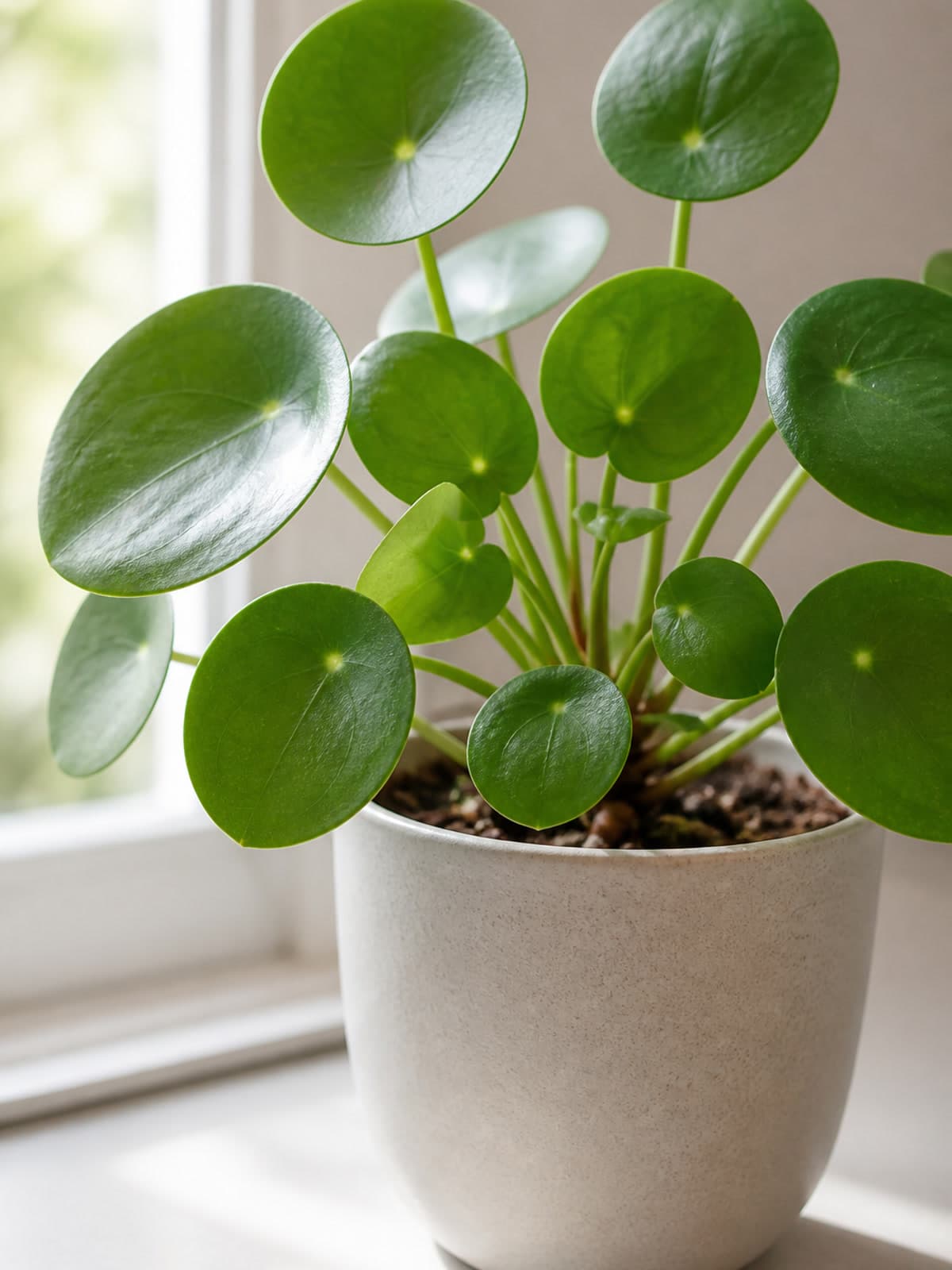
Chinese money plant is Pilea peperomioides, also sold as pancake plant, UFO plant, friendship plant, missionary plant, or coin plant. The fleshy, round leaves attach at the center of each blade, and a plant usually grows about 8 to 12 inches tall and wide, according to NCSU Extension. It is native to the cool, shady mountains of Yunnan Province in southern China, and houseplants rarely flower.
The money tree, Pachira aquatica, is a different plant, with palmate leaflets. Its steps are on how to propagate a money tree.
Drained-mix technique for any houseplant is on soil propagation, and jar care is on water propagation.
Best way indoors
A crowded pot with rooted plantlets is a division job. A stem offshoot or a top cutting without its own roots belongs in water or moist mix until roots form.
| Situation | Method | Source support |
|---|---|---|
| A plantlet in the soil with leaves, stems, and roots | Soil pup or offset | Iowa State lists Pilea peperomioides under division and offsets. Penn State: remove pups and pot them separately. Solano waits until a soil pup is 2 to 3 inches tall. |
| A baby shoot on the main stem | Stem offshoot in water | UC Master Gardeners of Solano: cut with a disinfected blade, stand the tip in water, and pot when roots are 1 to 2 inches long. |
| A leggy top you want to restart | Top cut in water | Solano: cut the top off the plant, root it in water, and replant. |
| A stem cutting in the growing season | Stem cutting | NCSU lists Stem Cutting as the Recommended Propagation Strategy, and also names offsets or pups. Penn State names stem or leaf cuttings for Pilea houseplants in general during the growing season. |
NCSU’s Recommended Propagation Strategy line is stem cutting. The same page also says the plant can be propagated by offsets or pups and by stem cuttings. Pups are the method most home growers meet first. Stem cuttings stay on the NCSU strategy line and on Solano’s water path.
NCSU, Penn State, and Iowa State do not give a week count for this species. Solano measures readiness by root length (1 to 2 inches) or by soil-pup height (2 to 3 inches). Penn State’s leaf-cutting line is for Pilea houseplants in the growing season, not a peperomioides-only recipe.
Materials
- A healthy Chinese money plant with pups, a stem offshoot, or a top worth restarting
- A clean, sharp blade or pruners (Solano wipes the blade with alcohol before cutting stem offshoots)
- Small pots with drainage holes
- Moist, well-drained potting mix (NCSU). Solano also wants well-draining soil, because the plant does not tolerate soggy pots
- A clean jar of water for a stem offshoot or top cut (Solano)
- Bright, indirect light for the new pots (Iowa State, NCSU)
Pups
Soil pups are plantlets that form at the base or nearby in the pot. You separate them and pot each one on its own.
Iowa State’s division and offsets steps, which include Chinese money plant on the offsets list:
- Remove the plant from its container.
- Lay the root ball on its side and gently loosen it with your fingers, separating it into smaller pieces. Use a knife if the root ball will not come apart by hand.
- Make sure each piece has healthy leaves, stems, and roots. Larger pieces recover more quickly. Smaller pieces give more plants.
- Replant each piece in fresh potting soil in a pot that fits, usually smaller than the original.
- Water to settle the soil.
- Place the new pots in bright, indirect light.
- Wait a few weeks before fertilizing so the roots can recover.
Early spring is the ideal time to divide on that page, and most houseplants can be divided any time of year.
Penn State notes that Pilea peperomioides produces offsets, also called pups, which can be removed and potted separately from the parent.
UC Master Gardeners of Solano describe two kinds of babies: stem offshoots and rhizome pups. Rhizome pups pop up in the soil near the mother and stay connected underneath. They wait until a soil pup is 2 to 3 inches tall, then move it to a new pot with well-draining mix. Larger plantlets have better odds of survival, and the warmer months of the growing season are the preferred time.
NCSU wants a moist, well-drained potting mix, and says propagation is best in spring or early summer during active growth. Overwatering leads to root rot. Wet foliage can spot the leaves.
A plantlet with no roots of its own is not a finished division. Iowa wants leaves, stems, and roots on each piece. A rootless stem offshoot belongs in the stem section below.
Stem cuttings
NCSU lists Stem Cutting as the Recommended Propagation Strategy and also names offsets or pups and stem cuttings on the same page. Neither NCSU nor Penn State gives a cutting length or a week count for this species. Penn State’s stem or leaf cuttings line is for Pilea houseplants in general during the growing season.
UC Master Gardeners of Solano root a stem offshoot in water:
- Wipe the blade with alcohol.
- Cut a baby offshoot from the main stem.
- Stand the cut end in a bottle of water so the tip is submerged.
- Pot the cutting when the roots are 1 to 2 inches long.
Solano also roots a top cut the same way: cut the top off the plant, root it in water, and replant. The plant is easy enough to share that Solano notes the “pass it on plant” nickname.
A stem cutting can also go straight into moist, well-drained mix under NCSU’s stem-cutting strategy. Keep the mix damp, not flooded. For jar routines while a cutting sits in water, see water propagation. A reminder for water changes is easy to set with the propagation water change calculator.
Light while propagating
According to NCSU, the plant prefers bright, indirect sunlight. Leggy growth comes from inadequate light. Moderate to high humidity helps, and the plant also tolerates average home humidity. Cold drafts and heat sources need to be avoided.
Iowa State keeps newly divided pieces in bright, indirect light. After potting a pup or a rooted cutting, keep that same bright, indirect light.
A dim window is easier to judge with numbers. The propagation light DLI calculator estimates daily light at the cutting.
Care after potting
Water to settle the mix (Iowa State). Keep the pot moist but not waterlogged. NCSU and Solano both flag root rot or failure in soggy soil.
Wait a few weeks before fertilizing (Iowa State) so roots can recover. Once the plant is established, Solano notes a monthly half-strength balanced feed (10-10-10 diluted) in the growing season to encourage more pups. That feed is care for the growing plant, not a rooting step for a fresh cutting. Remove dead or damaged leaves so light and air reach the crown (Solano).
Troubleshooting
The base turns soft, or the mix stays wet and foul. Overwatering can lead to root rot, according to NCSU, and Solano notes that the plant does not tolerate soggy soil.
Brown or spotted leaves after the foliage gets wet. Wetting the foliage can result in leaf spots, according to NCSU.
Tall, stretched stems with sparse leaves. Leggy growth results from inadequate light, according to NCSU.
A newly separated plantlet wilts. Iowa State wants healthy leaves, stems, and roots on each piece. Solano prefers soil pups that are already 2 to 3 inches tall, because larger plantlets survive better.
A water cutting still has no roots. No week count is published for this species. Solano waits until roots are 1 to 2 inches long before potting.
Common mistakes
- Treating this plant as a money tree. Pachira aquatica has its own steps on how to propagate a money tree.
- Leaving the pot soggy. NCSU links overwatering to root rot.
- Separating a plantlet that has no roots of its own and treating it as a finished division. Iowa State wants leaves, stems, and roots on each piece. Solano’s water path is for stem offshoots and top cuts.
- Cutting a soil pup before it reaches about 2 to 3 inches tall (Solano).
- Fertilizing a fresh division the day it is potted. Iowa State waits a few weeks.
- Setting the plant in a cold draft or next to a heat source (NCSU).
- Wetting the foliage when watering (NCSU).
People also ask
Is a Chinese money plant the same as a money tree?
No. Chinese money plant is Pilea peperomioides, with round leaves that attach at the center. Money tree is Pachira aquatica, at how to propagate a money tree.
When should I take pups?
NCSU prefers spring or early summer, during active growth. Iowa State calls early spring ideal for division and notes that most houseplants can be divided any time of year. Solano prefers the warmer months and waits until a soil pup is 2 to 3 inches tall.
Can I root Chinese money plant in water?
UC Master Gardeners of Solano root a stem offshoot in water and pot it when roots are 1 to 2 inches long. They also root a top cut in water. Iowa State’s recipe for this species is offsets in mix. NCSU’s Recommended Propagation Strategy is stem cutting, without a water week count.
How long until cuttings root?
NCSU and Penn State do not give a week count. Solano uses root length, 1 to 2 inches, for a water offshoot, not a number of weeks.
Does NCSU prefer stem cuttings or pups?
NCSU’s Recommended Propagation Strategy is Stem Cutting. The same page also says the plant can be propagated by offsets or pups and by stem cuttings. Both methods sit on that page.
Are leaf cuttings a Chinese money plant method?
Penn State names stem or leaf cuttings as an easy way to propagate Pilea houseplants during the growing season. That line is for the genus. For P. peperomioides, Penn State also names offsets, and NCSU and Solano focus on pups and stem cuttings.