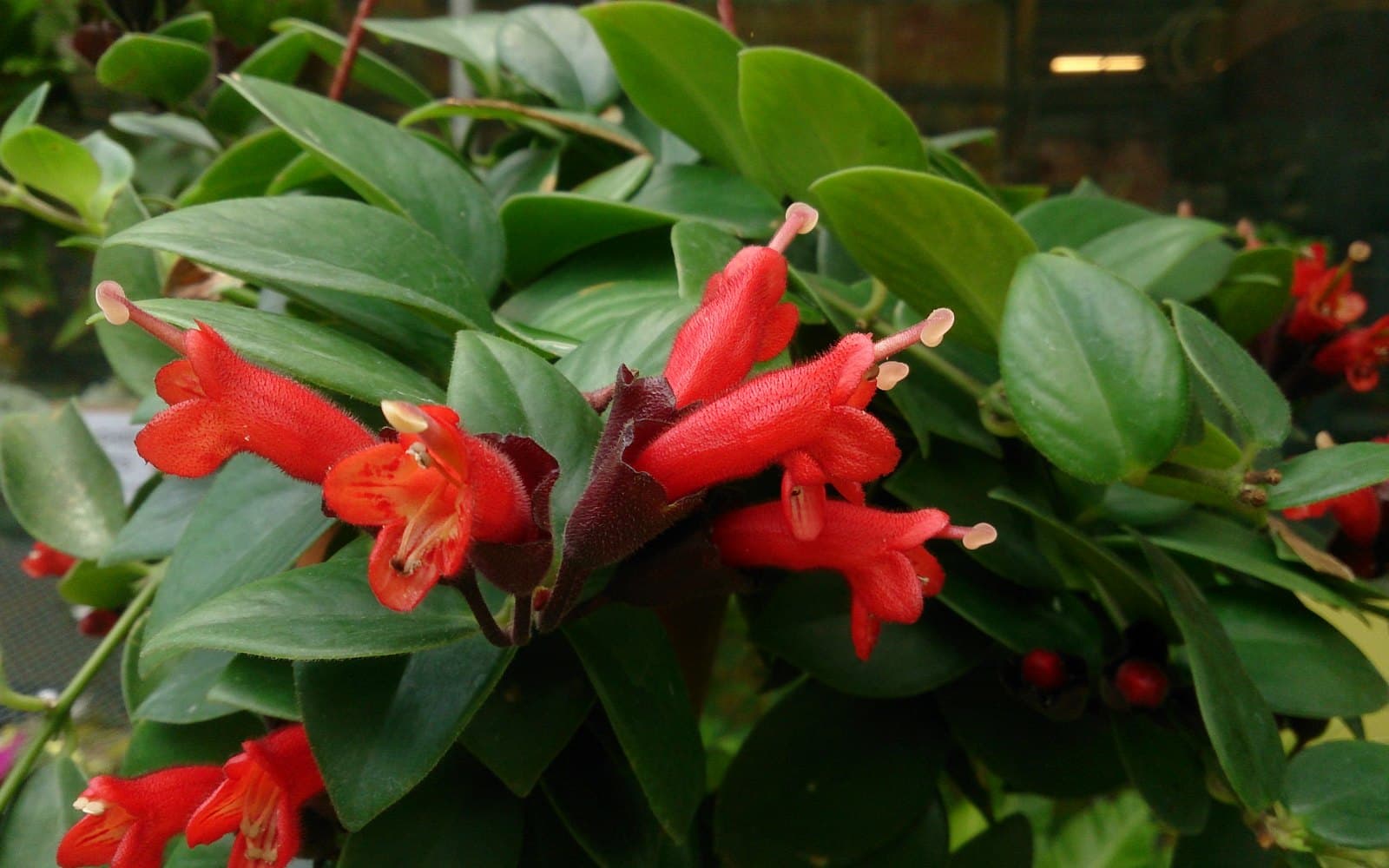
Lipstick plant is Aeschynanthus radicans. Labels may say lipstick vine or basket vine. Same URL. Family Gesneriaceae. Tropical evergreen epiphyte. NCSU: native to Thailand, the Malaysian peninsula, Sumatra, and Borneo. RHS plant range: Thailand to Malesia. Missouri Botanical Garden: Malaysia. Bright red tubular flowers emerge from darker calyces like lipstick from a tube. Waxy green leaves, often edged with red on NCSU’s description; hanging-basket trailer.
NCSU, RHS, and Mobot all use Aeschynanthus radicans for this houseplant. A UF/IFAS St. Johns pet-safety list uses Aeschynanthus humilis under the common name lipstick plant. Check the botanical name on the label. This page follows NCSU, RHS, and Mobot on A. radicans.
NCSU Recommended Propagation Strategy for this species is stem cutting. NCSU also gives a three-node soft stem cutting recipe with an equal-parts vermiculite and perlite medium and roots in about two weeks. RHS radicans profile: softwood cuttings in spring or semi-ripe cuttings in summer. Ask Extension (King County WA expert reply) names spring stem cuttings for A. radicans with a coir and vermiculite or perlite mix under a plastic bag.
Indoor hanging-basket focus. For mix, see soil propagation.
Soft stem cuttings
NCSU: Recommended Propagation Strategy is Stem Cutting. Species how-to: take a three-node soft stem cutting; remove all but the uppermost 2 to 4 leaves; dip the cut end in rooting hormone; pot in a mixture of equal parts vermiculite and perlite; keep moist. Roots should appear in two weeks.
RHS Aeschynanthus radicans: propagate by softwood cuttings in spring or semi-ripe cuttings in summer. Cultivation on the same profile: peat-free houseplant compost; bright, filtered light; water freely and half-strength general liquid feed monthly from mid spring to late summer; water sparingly in winter.
RHS Aeschynanthus ‘Japhrolepis’ (genus cultivar profile, not a radicans-only claim): softwood cuttings of young stems 3 to 5 cm long in spring, or semi-ripe cuttings in summer; root in gritty compost at 15 to 19°C (59 to 66°F).
Ask Extension (expert identification of A. radicans): most common method is stem cuttings in spring. Cut a stem below the fourth set of leaves; remove the lower two sets and leave the upper two; dip the cut end in rooting hormone; insert the bare stem into a small container of half pre-moistened coir and half vermiculite or perlite; mist; enclose in a plastic bag; warm spot with indirect light; bottom heat helps; keep out of direct sun. Mist when the mix dries; avoid overwatering; vent the bag if heavy condensation forms. Roots are ready to pot on when a gentle tug meets resistance.
Iowa State’s general stem-tip article does not list Aeschynanthus among its example species. Do not treat that page’s 3 to 6 inch / 3 to 6 week figures as lipstick-plant-specific.
Semi-ripe cuttings
RHS radicans and several RHS Aeschynanthus profiles name semi-ripe cuttings in summer alongside spring softwood. Opened NCSU and Ask Extension pages do not spell out a separate semi-ripe protocol beyond the soft stem / spring stem steps above.
Common mistakes
- Collapsing Aeschynanthus humilis (UF St. Johns list name) into A. radicans methods without checking the label.
- Inventing water-jar week counts or blog inch lengths that opened NCSU, RHS, Mobot, and Ask Extension pages do not state for this species.
- Copying Iowa State’s general 3 to 6 inch / 3 to 6 week stem-tip timings onto lipstick plant when Aeschynanthus is not on that species list.
- Ignoring NCSU’s floor near 50°F (leaf drop) and the need for humidity with air circulation, not stagnant moist air.
- Treating RHS ‘Japhrolepis’ 3 to 5 cm softwood lengths as if they were written on the radicans species page alone without saying they come from the cultivar profile.
- Leaving cuttings in direct sun under a bag; Ask Extension warns that will cook the cutting.
People also ask
What is the botanical name for lipstick plant?
NCSU, RHS, and Missouri Botanical Garden: Aeschynanthus radicans (Gesneriaceae). Common names: lipstick plant, lipstick vine, basket vine. UF/IFAS St. Johns lists Aeschynanthus humilis under lipstick plant on a pet-safety page. Confirm the label.
Can I propagate lipstick plant from stem cuttings?
Yes. NCSU Recommended Propagation Strategy is stem cutting, with a three-node soft stem recipe and roots in about two weeks. RHS: softwood in spring or semi-ripe in summer. Ask Extension: spring stem cuttings for A. radicans.
How long until cuttings root?
NCSU: roots should appear in two weeks on the vermiculite-perlite soft stem method. Ask Extension uses a gentle-tug resistance check rather than a fixed day count. Opened pages do not give a water-rooting timeline for this species.
Do softwood and semi-ripe cuttings both work?
RHS radicans names both: softwood in spring, semi-ripe in summer. NCSU’s detailed recipe is a soft stem cutting. RHS ‘Japhrolepis’ adds young softwood stems 3 to 5 cm in spring, or semi-ripe in summer, in gritty compost at 15 to 19°C.