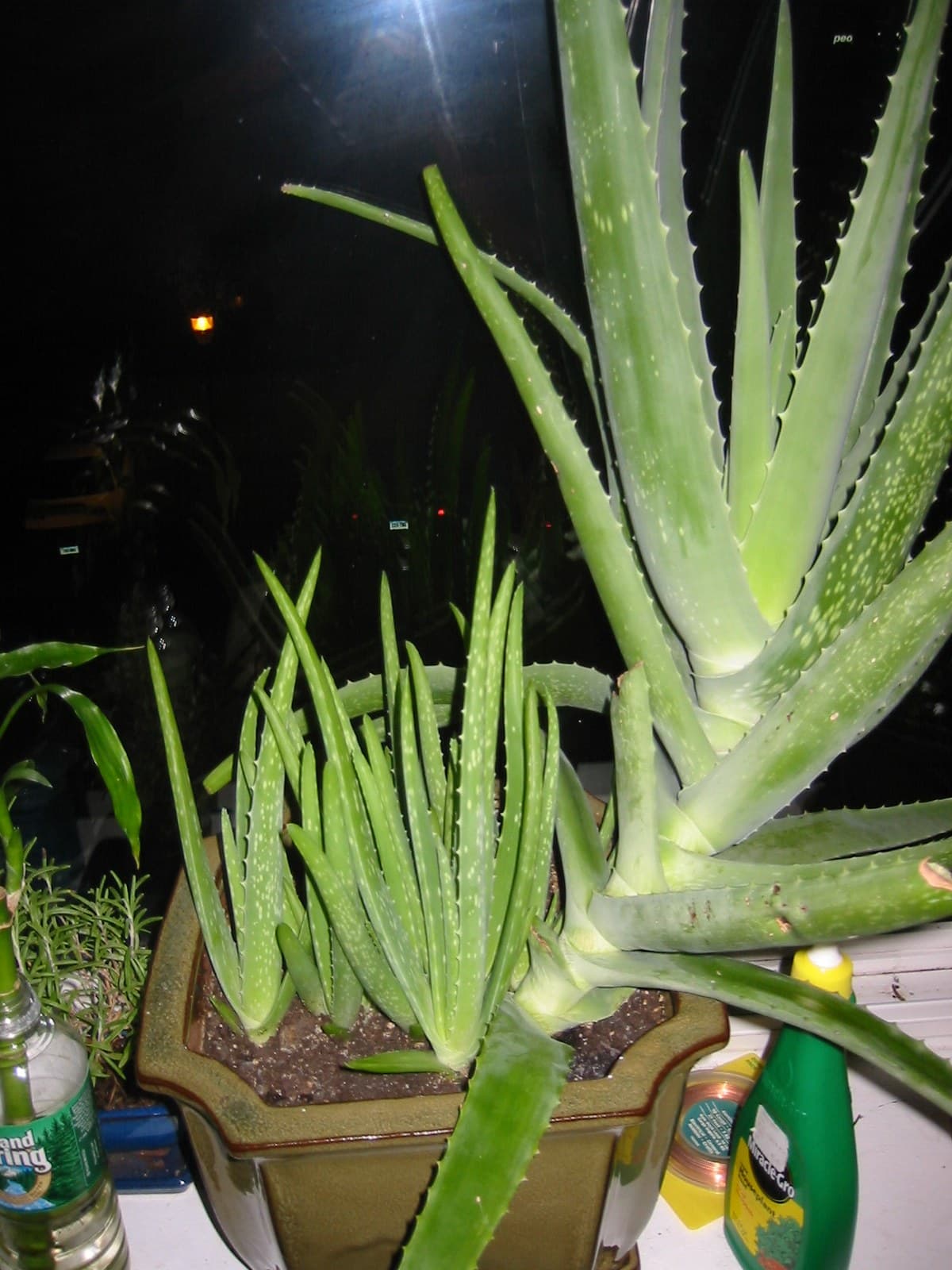
Aloe, including aloe vera, is propagated from pups, also called offsets. UC Master Gardeners of San Luis Obispo County: aloes produce small plants on short shoots at the base of the parent plant, and those juvenile plants can be removed and potted as new plants. Iowa State Extension lists Aloe species among the houseplants best propagated by division and offsets, with healthy leaves, stems, and roots on each piece.
A rooted offset in a well-drained cactus mix, under bright indirect light, is the whole method. Leaf trays belong to other succulents, covered on how to propagate succulents. Drained-mix technique in general is on soil propagation, and the main methods across houseplants are compared on plant propagation.
Best way indoors
Iowa State describes division as separating a plant into smaller, whole pieces that contain all the vegetative parts, and each piece is a genetic clone of the parent. Plants that are very large, or that have several offsets crowding the pot, are good candidates. Iowa State also notes that not every houseplant can be divided: plants without crowns or a cluster of stems that pull apart need another method, such as cuttings. Aloe, with its pups at the base, offers two versions of that: a single offset taken from the base, or a crowded pot split into several plants.
| Situation | Method | Source support |
|---|---|---|
| A small plant at the base with its own leaves and roots | Remove the offset and pot it | Iowa State puts Aloe under division and offsets. UC Master Gardeners of San Luis Obispo County: aloes produce juvenile plants on short shoots at the base that can be removed and potted. |
| A crowded pot with several offsets | Divide the root ball | Iowa State: take the plant out, loosen the root ball, and separate it into smaller pieces. Early spring is ideal, and most houseplants can be divided any time of year. |
| A leaf pulled from the parent | Not an aloe method | Iowa State’s leaf-cutting list is Graptopetalum, Pachyphytum, Sedum, Crassula, and Kalanchoe. San Luis Obispo County demonstrates leaf cuttings on Echeveria and Graptopetalum. Leaf steps for those plants are on how to propagate succulents and leaf cuttings. |
| A leaf or pup in a jar of water | Not an aloe method | Iowa State: most succulents do not root well in a glass of water. |
| A 3 to 6 inch stem cutting | Not an aloe method | Iowa State’s stem-cutting recipe lists Aeonium, Echeveria, Crassula, and other succulents. Aloe appears only on its offsets list. |
Iowa State’s offset list puts Aloe alongside Sempervivum, Agave, Lithops, Gasteria, Haworthia, and cacti, all species that grow in clusters of rosettes, produce pups, or send out runners that root. UC Master Gardeners of Butte County name Aloe, Echeveria, and Sempervivum as offset producers.
Rooting time is given two ways. Iowa State: after a few weeks, a potted offset establishes and begins growing on its own. Butte County: wait three to four weeks for strong roots to develop.
Materials
- A healthy aloe with offsets at the base, or a pot crowded enough to divide
- A container with a drainage hole, sized to the new plant, which Iowa State notes is likely smaller than the original pot
- Well-drained media: cactus potting soil (Iowa State), or cactus mix or a combination of sand and perlite (Butte County)
- Hands for gentle pulling, plus sharp, clean pruners or scissors for a runner (Iowa State), a sharp clipper (Butte County), or a knife for a root ball that will not come apart (Iowa State)
- A spray bottle for Butte County’s gentle daily spray on the offset
- A spot with bright indirect light (Iowa State)
Rooting hormone is not part of either offset routine. Iowa State mentions it only for stem cuttings of other succulents, and adds that most succulents root quickly and easily without it.
When a pup is ready
A pup is ready when it is a small plant with its own leaves and roots. Butte County defines offsets as small plants that grow at the base of the main specimen, and takes them from a mature, offset-producing plant. Iowa State: make sure each propagule is a suitable size, with healthy leaves, stems, and roots on each piece. Butte County: when removing an offset, be careful to avoid damaging any roots that have already emerged.
The recommended seasons differ. Iowa State calls early spring the ideal time to divide houseplants, while noting that most can be divided successfully any time of year. Butte County finds succulent propagation most successful in autumn and spring, a note about succulents in general.
Size takes longer than rooting. Butte County: although succulents are easy to propagate, some take a year or more to become mature.
How to separate
Iowa State, division.
- Remove the plant from its container.
- Lay it with the root ball on its side, and gently loosen the root ball with your fingers, separating the plant into smaller pieces.
- Use a knife if the root ball is too difficult to separate by hand. Iowa State also lists a sharp spade, a saw, or a reciprocating saw for root balls that resist.
- Check that each piece has healthy leaves, stems, and roots. Larger pieces recover more quickly, and smaller pieces give more plants.
- Replant each piece in fresh potting soil in an appropriately sized container.
Iowa State, succulent offsets. Gently pull or cut the offset, keeping both leaves and roots attached. Sharp, clean pruners or scissors may be needed to cut a runner or other piece that still holds the offset to the parent.
UC Master Gardeners of Butte County. Remove offsets with a sharp clipper or by twisting gently, and avoid damaging roots that have already emerged.
UC Master Gardeners of San Luis Obispo County. Remove the juvenile plants that grow on short shoots at the base, and pot them as new plants.
Potting mix and drainage
Iowa State, succulent offsets: pot the propagule in a well-drained growing medium, such as cactus potting soil, in a container with a drainage hole. Iowa State, division: use fresh potting soil in a container sized to the piece, then place the plant in bright indirect light.
Butte County: cactus mix, or a combination of sand and perlite.
Drained-mix basics for other plants are on soil propagation.
Watering
Iowa State, division: water the new pieces to settle the soil. Wait a few weeks before fertilizing so the roots have a chance to recover. Most potting soil already contains a little fertilizer.
Iowa State, succulent offsets: water lightly. After a few weeks the new plant establishes and begins growing on its own.
Butte County, offsets: spray water directly on the offset daily, gently and sparingly, without soaking the soil. Strong roots develop in three to four weeks.
The two routines differ. Iowa State waters lightly after potting, and Butte County mists the offset daily while keeping the soil from getting soaked.
Leaf cuttings and water
Aloe sits on Iowa State’s offsets list, and the leaf-cutting list on the same page is Graptopetalum, Pachyphytum, Sedum, Crassula, and Kalanchoe. Butte County names Sedum, Crassula, and Graptopetalum as the succulents best propagated by leaf cuttings. San Luis Obispo County demonstrates pups on Aloe and leaf cuttings on Echeveria and Graptopetalum. None of the three describes an aloe leaf cutting.
Water rooting is not an aloe route either. Iowa State notes that most succulents do not root well in a glass of water. San Luis Obispo County focused its propagation demonstrations on vegetative methods, not seeds, water, or grafting, and for an Aeonium stem cutting it called planting in a rooting mix a better procedure than a glass of water.
Leaf steps for the succulents that do grow from leaves are on how to propagate succulents and leaf cuttings. Plants that do root in a jar are on water propagation, where the propagation water change calculator keeps a refresh schedule for those jars.
Light while propagating
Iowa State places freshly potted division pieces in bright indirect light, and that is the light a new aloe offset gets after potting.
Butte County describes succulents in a Mediterranean climate and notes that most need some filtered shade in the heat of the Sacramento Valley. That is outdoor climate context for succulents in general, not an aloe light level or a window direction.
For a window that seems dim, the propagation light DLI calculator can estimate how much light it gives. Fixture choice and hanging distance for a supplemental lamp are covered in best grow lights for indoor propagation.
Troubleshooting
The mix stays wet or the base turns soft. Both offset routines keep water light: Iowa State waters lightly, and Butte County sprays sparingly and does not soak the soil. Iowa State pots offsets in cactus potting soil in a container with a drainage hole, and Butte County uses cactus mix or sand and perlite.
No new growth after a week or two. Iowa State gives a few weeks before an offset establishes and starts growing on its own. Butte County gives three to four weeks for strong roots. A week or two is still inside both.
The offset looks weak in a dim spot. Iowa State wants bright indirect light after potting. The propagation light DLI calculator can check whether the window supplies enough.
Growth seems slow months later. Butte County notes that some succulents take a year or more to become mature, even when they root easily.
Common mistakes
- Taking a piece with no roots. Iowa State wants healthy leaves, stems, and roots on each piece.
- Tearing roots that have already emerged while pulling a pup (Butte County).
- Fertilizing right after potting. Iowa State waits a few weeks so the roots can recover.
- Treating an aloe leaf like an Echeveria or Sedum leaf. Aloe is on the offsets lists, not the leaf-cutting lists.
- Setting a pup in a jar of water. Iowa State: most succulents do not root well in a glass of water.
- Following the 3 to 6 inch stem-cutting recipe. Iowa State gives it for other succulents, not Aloe.
People Also Ask
Is aloe vera propagated the same way?
Yes. Iowa State lists Aloe species as a group under division and offsets, and aloe vera is one of those species.
When is a pup ready to remove?
When it is a small plant with its own leaves and roots. Iowa State asks for healthy leaves, stems, and roots on each piece, and Butte County warns against damaging roots that have already emerged.
When should I divide aloe?
Iowa State: early spring is ideal, and most houseplants can be divided any time of year. UC Master Gardeners of Butte County find autumn and spring the most successful seasons for succulent propagation in general.
Can I propagate aloe from a leaf?
Aloe is listed with offsets and division, not with leaf cuttings, in Iowa State, Butte County, and San Luis Obispo County material. Leaf steps for the succulents that do grow from leaves are on how to propagate succulents and leaf cuttings.
Can I root aloe in water?
Iowa State notes that most succulents do not root well in a glass of water. Aloe offsets go into cactus mix instead.
How long until it is established?
Iowa State: after a few weeks the offset establishes and begins growing on its own, and fertilizer waits a few weeks too. UC Master Gardeners of Butte County: three to four weeks for strong roots on offsets.
What light does a new offset need?
Iowa State: bright indirect light after potting. A dim window can be checked with the propagation light DLI calculator.