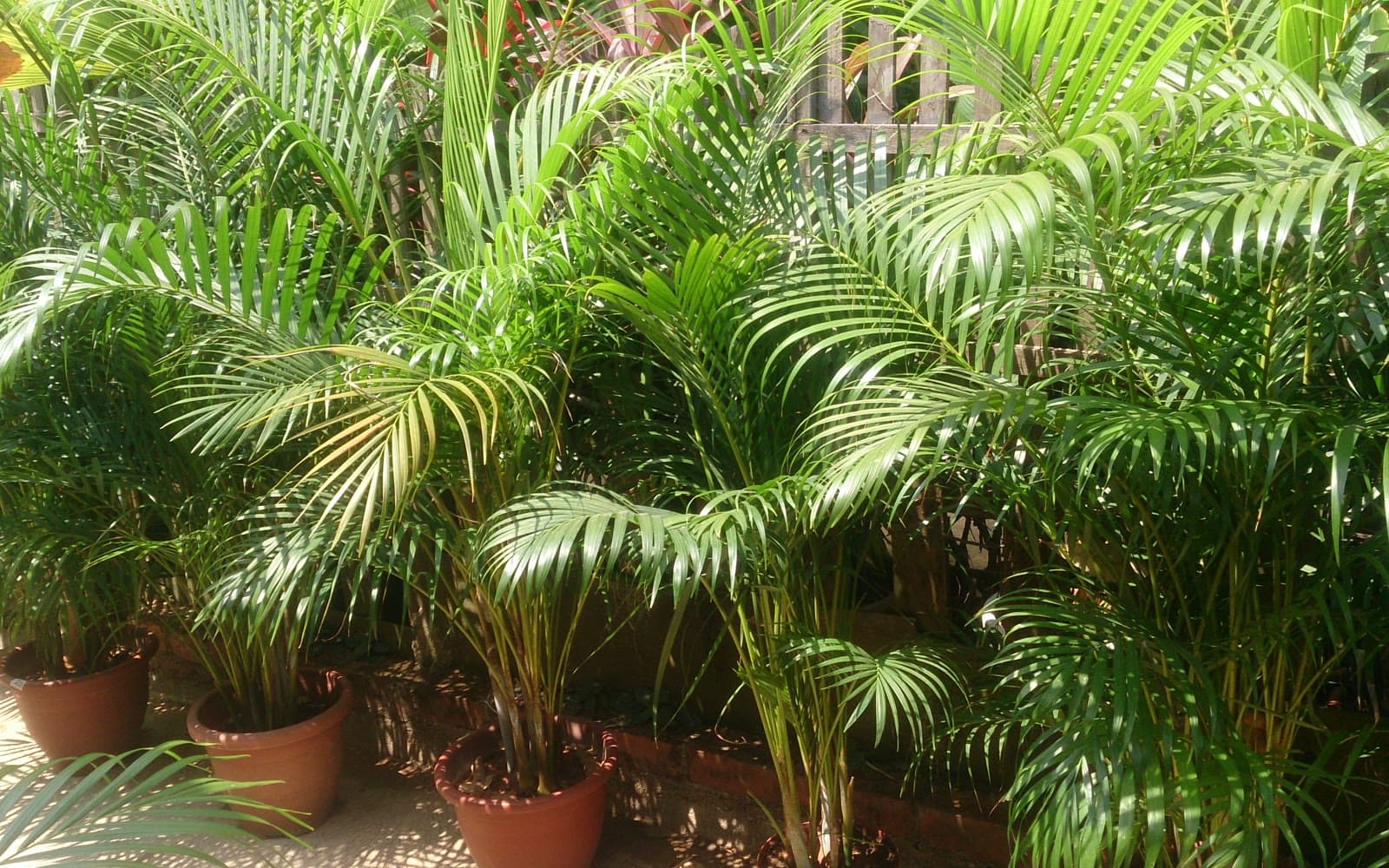
Areca palm is Dypsis lutescens. Labels may say butterfly palm, yellow butterfly palm, bamboo palm, golden cane palm, cane palm, golden feather palm, yellow palm, or Madagascar palm. Same URL. Many extension and RHS pages still list Chrysalidocarpus lutescens; RHS also lists Areca lutescens as a synonym. Family Arecaceae. Native to Madagascar. True palm, not a cycad.
NCSU (as Chrysalidocarpus lutescens; previously Dypsis lutescens): multi-stemmed clustering palm; outdoor height about 10 to 30 ft and width about 8 to 15 ft; bamboo-like ringed stems; pinnate leaves about 3 to 6 ft long with 40 to 60 pairs of leaflets forming a V along the rachis; yellow-green petioles and midribs; yellow flowers in summer then yellow-orange fruits about 0.5 to 1 inch; hardiness 10a to 11b; rarely blooms or fruits as a houseplant. UF/IFAS ST165 (as Dypsis lutescens): clump-growing 20 to 30 ft tall and 8 to 10 ft wide outdoors; uses include indoors and containers. Clemson HGIC: about 6 to 7 ft indoors; grows about 6 to 10 inches a year. RHS profile: cluster of erect stems to about 8 m; arching pinnate leaves to about 2 m. RHS indoor palms: suckering plant with numerous stems; winter minimum about 13°C (55°F); needs bright light; sometimes misleadingly sold under the name Areca palm.
NCSU Recommended Propagation Strategy for this species is Division and Seed. UF/IFAS ST165: propagation by seeds or division. Iowa State names Dypsis lutescens (areca / bamboo palm) among palms best propagated by division and marks Dypsis palms as division on its method table. RHS profile: propagate by seed sown at not less than 25°C. Texas A&M Aggie Horticulture: fresh seed or basal suckers. University of Hawaii CTAHR houseplant note: simple divisions. Clemson: most palms from seed; some can be divided (genus-level indoor palms page that also profiles areca).
Often confused with Chamaedorea seifrizii on NCSU. Keep parlor palm Chamaedorea elegans, Kentia Howea, lady palm Rhapis, and the betel nut palm Areca catechu (different species; Penn State notes the family name’s link to that palm) off as if identical. Do not invent stem, leaf, or water cuttings; opened preferred pages name seed, division, and basal suckers, not cane or tip cuttings.
Indoor container focus. For drained mix, see soil propagation.
Division and basal suckers
NCSU Recommended Propagation Strategy includes Division. NCSU describes a multi-stemmed clustering habit with multiple stems from one base. UF/IFAS ST165: clump-growing; propagation by division. Texas A&M: basal suckers. Hawaii CTAHR: simple divisions. Iowa State lists Dypsis lutescens under palms best propagated by division.
Iowa State division how-to (general protocol that includes this species on the same page): early spring is ideal, though most houseplants can be divided any time of year; remove from the pot; loosen the root ball by hand or with a knife, sharp spade, or saw if needed; each piece needs healthy leaves, stems, and roots; larger pieces recover faster; replant in fresh potting soil in an appropriately sized pot; water to settle; bright indirect light; wait a few weeks before fertilizing. Those steps are Iowa State’s general division protocol, not an areca-only measurement list.
UF/IFAS CIR1163: clustering palms that produce new erect shoots from a common base can be divided carefully to increase stock; species that send shoots farther from the parent (for example Rhapis) are the easiest; worked example there uses a sharp spade, lift with as much root ball as possible, pot, then keep shaded and well watered until established (4 to 6 months), with a broad-spectrum fungicide drench after potting as advisable. That numbered establishment window and Rhapis nursery example are CIR1163 clustering-palm guidance. Attribute them as such; do not silently rewrite them as an areca-only home recipe. Same CIR1163 page names Dypsis lutescens among nutrient Group I palms and notes fast-growing areca can finish an 8 to 10 inch container crop in about 1.5 years from seed (nursery production timing, not a division claim).
RHS indoor palms offsets section names Rhapis, Chamaedorea, and Phoenix for removing offsets in spring with as much root as possible. It does not name Chrysalidocarpus or Dypsis in that offsets bullet. Separate RHS cultivar note does call Dypsis lutescens a suckering plant. Do not merge those lines into a species-only offset recipe RHS did not write.
Clemson lady-palm note (divide in spring or early summer when actively growing) is written for Rhapis on that page, not for areca.
Seed
NCSU Recommended Propagation Strategy includes Seed. No sowing temperature or days-to-germinate on that species page. NCSU: fruit rarely produced as a houseplant.
RHS Chrysalidocarpus lutescens profile: sow seed at not less than 25°C. No days-to-germinate on that profile.
UF/IFAS EP238 (Palm Seed Germination) names areca (Dypsis lutescens) repeatedly:
- Adjacent germination type (button against the seed; radicle short-lived; adventitious roots follow).
- Seed may begin to germinate in about 3 to 4 weeks (contrast on the same page: Washingtonia robusta under 2 weeks; parlor palm Chamaedorea elegans may take several months then continue over a year).
- Uncleaned areca seed has been known to germinate if planted immediately after harvest; thin-walled fruit can be cleaned by rubbing on a screen with a hose or by hand in water.
- Cleaned seed stored at about 73°F for over 1 year without significant loss of viability (Broschat and Donselman); more tropical species such as areca may be killed after storage for 24 hours at 40°F.
- Species listed among those responding to a water presoak; change soak water daily; plant immediately after soaking. GA3 presoaks can cause excessive elongation of areca seedlings and are not advisable.
- Dense sowing in a small pot is shown for areca when seedlings will be transplanted together for a full specimen.
- High germination temperatures generally 70 to 100°F, with best often 85 to 95°F (palm seed general range on that page).
- Transplant when about 1 to 2 leaves have formed; never plant seedlings too deep; do not sever the seed connection while it still feeds the seedling; do not prune seedling roots.
UF/IFAS CFREC Apopka foliage note RH-91-6 (Areca Palm Production Guide, Chrysalidocarpus lutescens; opened via Maui County Master Gardeners reprint): about 50 seeds per ounce; fresh yellow-to-ripe seed planted with the top barely visible; germination temperature 80 to 85°F; lower temperatures increase germination time about 100 to 200%; cleaning not essential if planted immediately; if storing, clean yellow to fully ripened red seed, air-dry, protect, store at 75°F; commercial note that viable seed soaked 10 minutes in hot sulfuric acid can germinate in about 6 weeks. That acid step is nursery production language on that page, not a home safety protocol to invent further.
Texas A&M: fresh seed (alongside basal suckers). No temperature or timeline on that short merchandising page.
RHS indoor palms (genus-level seed advice for indoor palms): sow as soon as possible after harvest or purchase; viability drops after about 8 to 16 weeks depending on species; cover to its own depth; tropical species in a propagator with bottom heat about 25 to 30°C (78 to 86°F); most species germinate within two to three months, some up to two years. That timeline band is RHS indoor-palm guidance, not an areca-only claim. Prefer EP238’s areca 3 to 4 week start when citing this species.
Clemson: most palms propagated from seed (indoor palms page). No areca sowing recipe there.
Common mistakes
- Treating Chrysalidocarpus lutescens and Dypsis lutescens as different plants; opened NCSU, RHS, UF/IFAS, Clemson, Iowa State, and Texas A&M pages treat them as the same species under shifting accepted names.
- Confusing this clustering palm with Chamaedorea seifrizii bamboo palm, parlor palm Chamaedorea elegans, Kentia, or betel nut Areca catechu.
- Inventing stem, leaf, cane, or water cuttings that opened NCSU, UF/IFAS, RHS, Iowa State, Clemson, Texas A&M, and Hawaii CTAHR pages do not name for this species.
- Copying CIR1163’s Rhapis sharp-spade and 4 to 6 month establishment notes onto areca without saying they are clustering-palm / Rhapis example guidance.
- Using parlor palm’s several-months-to-over-a-year EP238 timeline as if it were areca; EP238 says areca may start in 3 to 4 weeks.
- Treating GA3 or hot sulfuric acid nursery pretreatments as casual home must-dos; EP238 advises against GA3; RH-91-6 acid soak is a commercial production note.
- Inventing blog week counts for division recovery beyond Iowa State’s few weeks before fertilizing and CIR1163’s attributed clustering example.
- Planting seedlings too deep or cutting seedling roots; EP238 warns both.
People also ask
What is the botanical name of areca palm?
Dypsis lutescens. NCSU currently lists Chrysalidocarpus lutescens and notes Dypsis lutescens as previously known. UF/IFAS ST165 and EP238, Iowa State, and RHS indoor palms use Dypsis lutescens. RHS plant profile and Clemson use Chrysalidocarpus lutescens with Dypsis / Areca lutescens as synonyms. Same Madagascan Arecaceae palm.
Is areca palm a true palm?
Yes. Family Arecaceae on NCSU, UF/IFAS, RHS, and Clemson. Distinct from cycads such as sago palm Cycas revoluta.
Can I divide an areca palm?
Yes as a strategy. NCSU Recommended Propagation Strategy includes Division. UF/IFAS ST165 names division. Iowa State names Dypsis lutescens for division. Texas A&M names basal suckers. Hawaii CTAHR names simple divisions. Follow Iowa State’s general division steps and attribute CIR1163’s clustering / Rhapis details carefully.
Can I grow areca palm from seed?
Yes. NCSU Recommended Propagation Strategy includes Seed. RHS: sow at not less than 25°C. UF/IFAS EP238: adjacent germination; often starts in about 3 to 4 weeks; clean or plant fresh; warm germination range. Indoor plants rarely fruit (NCSU), so seed is usually purchased or collected outdoors in warm climates.
Can I take stem cuttings?
Opened preferred pages do not name stem, tip, leaf, or cane cuttings for this species. Named routes are division / basal suckers and seed.