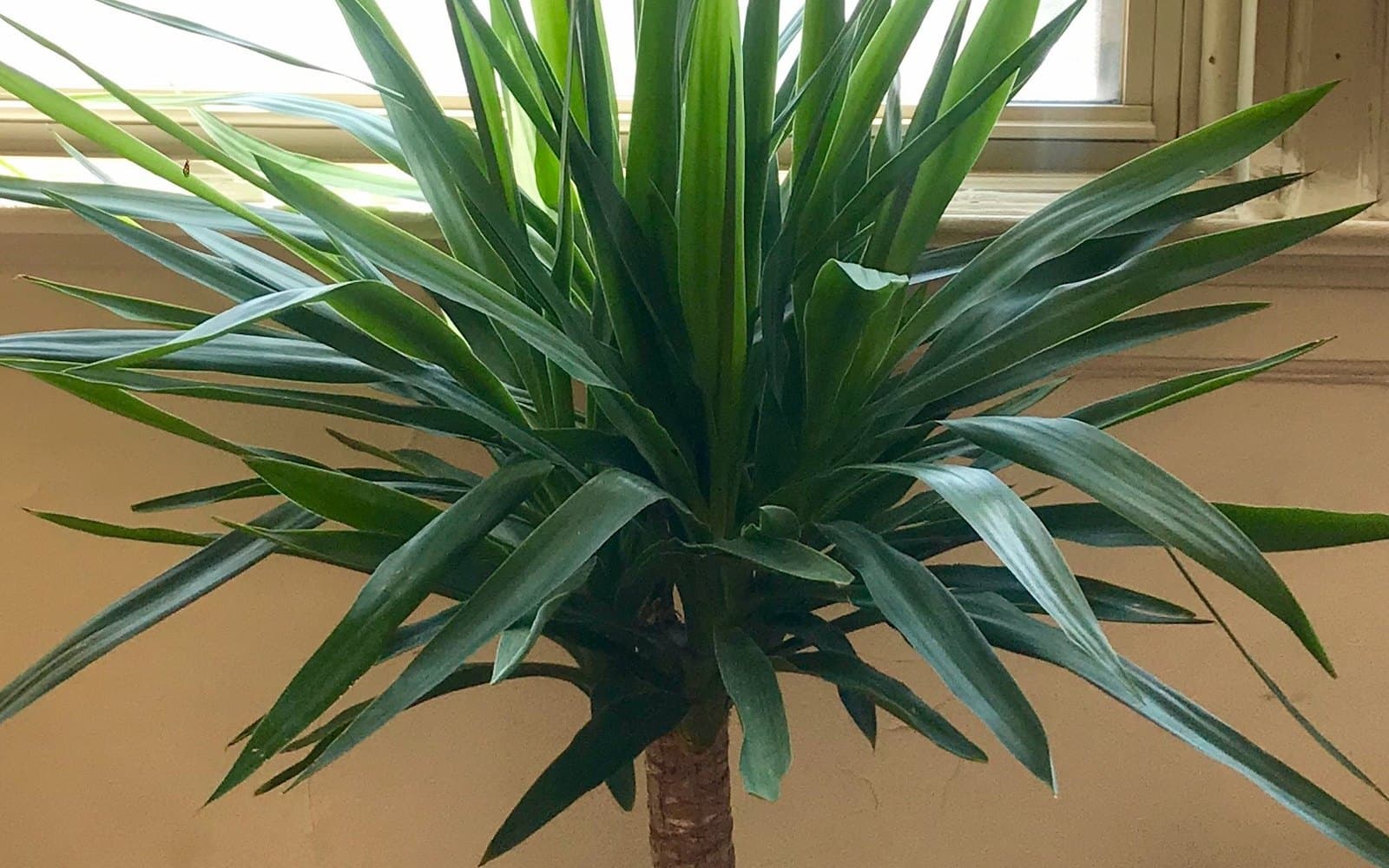
Indoor cane yucca in extension usage is Yucca gigantea, formerly Yucca elephantipes (also Y. guatemalensis). Labels still say Yucca elephantipes, spineless yucca, soft-tip yucca, or giant yucca. Same houseplant focus. Family Asparagaceae. NCSU and UF/IFAS lead with Yucca gigantea; RHS growing guide still names Y. elephantipes as the tender house or conservatory plant.
Unlike spiny landscape yuccas, this species has soft-tipped, essentially spineless leaves. Outdoors it can become a large multi-trunk plant; as a houseplant it stays much more compact (NCSU). UF: grows well as a houseplant in a well-lighted area. Bring or keep indoors when temperatures drop below about 50°F (NCSU; RHS min for Y. elephantipes 10°C / 50°F).
NCSU Recommended Propagation Strategy: seed and stem cutting; body text also names suckers at the base. UF/IFAS: seed or cuttings of any size; suckers root quite easily. RHS genus guide: spring stem cuttings, offsets, and seed, with tender Y. elephantipes called out for indoor culture.
Hardy border yuccas (Y. filamentosa, Y. gloriosa, and similar) are a different garden problem. Keep this page on the indoor cane / spineless plant.
For mix, see soil propagation. NCSU houseplant drainage note: one part potting mix and three parts perlite or sand.
Stem cuttings
UF/IFAS spineless yucca: propagation by cuttings of any size (species page also names seed). Variegated spineless page: cuttings of any size.
NCSU: stem cutting is a recommended strategy; plants are propagated by cuttings as well as seed and suckers.
RHS Yucca growing guide: in spring, place stem cuttings 20–25 cm long, measured from the tip, in coarse sandy rooting compost. Semi-shade in a propagator with bottom heat of at least 18°C (65°F). If an indoor plant is too tall, RHS notes cutting height back by about half in spring when growth resumes; the severed upper part can be used for propagation (slight risk; healthy plants should respond).
Opened UF and NCSU pages do not state a callus day count for stem sections. RHS gives “a couple of days” drying for offsets, not as a stem-cutting line.
Suckers and offsets
UF/IFAS: suckers at the base of the plant root quite easily.
NCSU: propagation from suckers found at the base of the tree or shrub.
RHS: offsets occasionally appear at the base. Remove in March or April. Expose the sucker and cut it off at the base where it joins the parent rhizome. Allow the offset to dry for a couple of days, then place in a propagator as with cuttings, or cover with polythene in a warm, light area out of direct sunlight.
Seed
UF ST675 and NCSU name seed. RHS: sow in spring; tender yuccas at 19–24°C (66–75°F); soak seed for 24 hours before sowing to speed germination. Seed is secondary when you want a clone of a variegated cane.
Common mistakes
- Treating hardy Adam’s needle types as if they were indoor cane yucca methods.
- Inventing callus hours or 4 to 6 week rooting claims from blogs.
- Ignoring drainage; UF and NCSU both warn against wet soils and overwatering.
- Planting a stem section upside down; RHS stresses tip-measured cuttings and orientation for stem segments in related guidance.
- Skipping poison awareness; NCSU: leaves and roots contain saponins; toxic if ingested for people and pets.
People also ask
Is indoor yucca Yucca elephantipes or Yucca gigantea?
Both names appear. NCSU and UF accept Yucca gigantea with elephantipes as a previous name. RHS and much of the trade still say Y. elephantipes for the tender houseplant.
How long should a cutting be?
RHS: 20–25 cm from the tip in spring. UF: cuttings of any size. Do not average those into a single invented length.
Can I pot a basal sucker?
Yes. UF: suckers root quite easily. RHS: remove in March or April, dry a couple of days, then propagator or polythene cover in warm light without direct sun.
Will a topped cane resprout?
RHS: reducing height by about half in spring has a slight risk, but healthy plants should respond, and the severed top can be used for propagation.