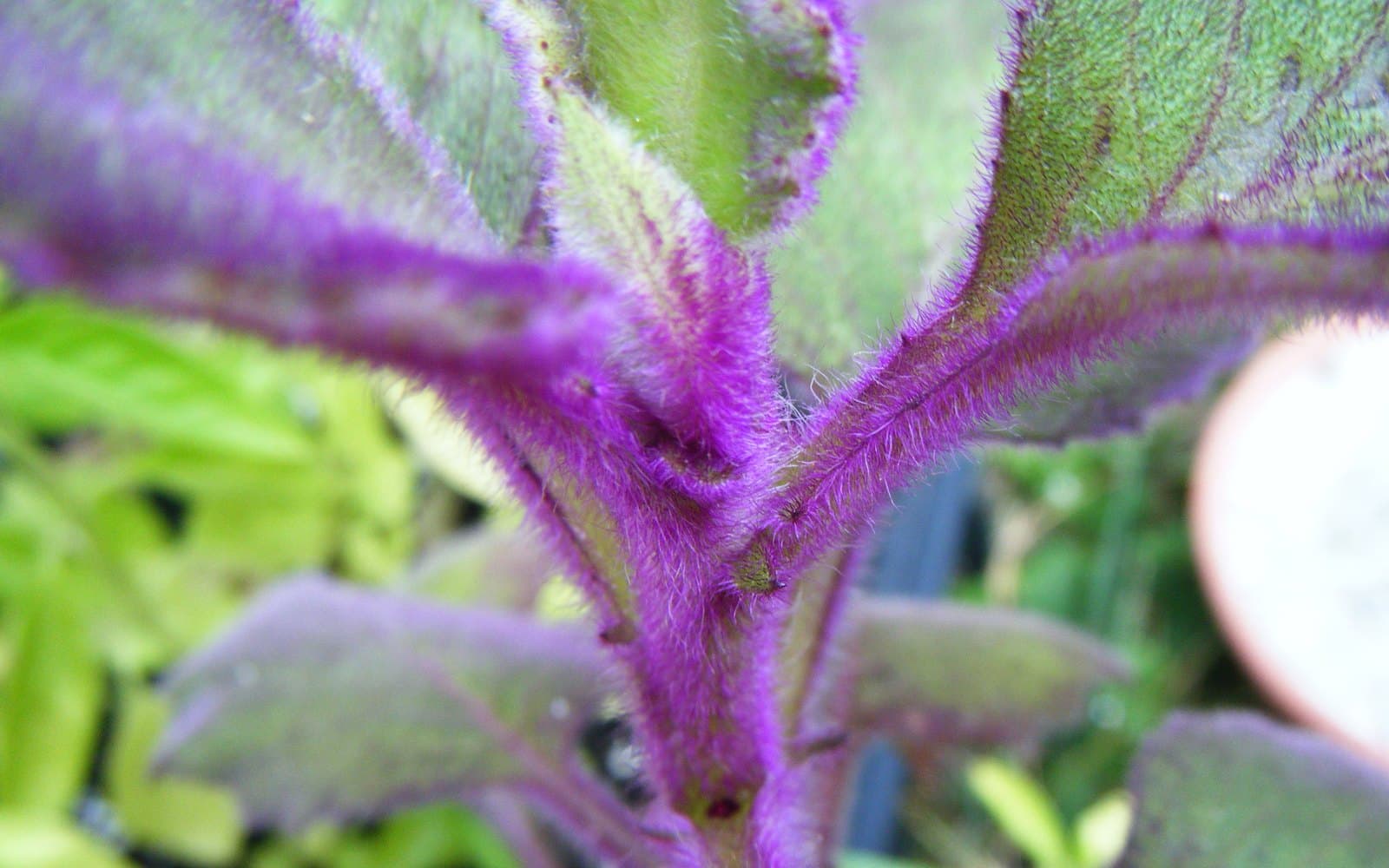
Purple passion plant is Gynura aurantiaca. Labels may say purple velvet plant, velvet plant, royal velvet plant, or purple passion vine. Same plant. Family Asteraceae (Compositae on older UF/IFAS wording). Native range: Sumatera to Jawa / Southeast Asia / Java on NCSU, RHS species profile, and Missouri Botanical Garden. Green leaves and stems densely covered in short vividly purple hairs. NCSU: height about 1 to 2 feet; width about 2 to 4 feet; leaves coarsely toothed, oval, green, up to 8 inches long, with reddish-purple hairs. Cultivar ‘Purple Passion’ has decumbent trailing or twining stems (NCSU, Missouri Botanical Garden). RHS also lists synonym Gynura sarmentosa as misapplied on the ‘Purple Passion’ profile.
Distinct from passionflower (Passiflora). This is a Gynura velvet foliage plant, not a Passiflora vine.
NCSU Recommended Propagation Strategy for this species is stem cutting. UF/IFAS commercial guide: easily propagated by stem cuttings; single or double node; year round with warmth and humidity. RHS ‘Purple Passion’ and species profiles: softwood cuttings in late spring, or semi-ripe cuttings in summer, both with bottom heat. UNL names Velvet Plant (Gynura spp.) for tip cuttings and stem cuttings, and uses velvet plant as the tip-cutting example (tips generally 3 to 5 inches). Illinois Extension lists Velvet Plant (Gynura aurantica on that page spelling) for stem cuttings and leaf-bud cuttings. Missouri Botanical Garden: easily propagated from cuttings.
Indoor hanging-basket or small-pot focus. For mix, see soil propagation. Water lives on water propagation.
Stem cuttings
NCSU: Recommended Propagation Strategy is Stem Cutting. No cutting length or days-to-root on that species page.
UF/IFAS (Gynura aurantiaca commercial production): stem cuttings may be taken at any time and root year round if warmth and humidity are sufficient. Use single or double node cuttings in plug cells, or stick multiple cuttings into finish pots or hanging baskets. Best rooting medium by volume: 50% peat, 25% bark, 25% perlite; pH 5.5 to 6.0. Roots in one to two weeks if minimum media temperature is 75°F and media moisture is kept proper. Rooting hormone may improve initiation and timing but is not required. Roots are fibrous and delicate; keep medium evenly moist, not saturated (saturation favors root rot).
RHS plant profiles (species and ‘Purple Passion’): propagate by softwood cuttings in late spring, or semi-ripe cuttings in summer, both with bottom heat.
UNL Propagating House Plants: Velvet Plant (Gynura spp.) by tip cuttings and stem cuttings. Tip cuttings for velvet plant are generally 3 to 5 inches long, cut just below a leaf. General cutting care on that guide: at least one node under the medium surface; push about 1 inch into medium; medium moist not soggy; polyethylene cover for humidity; room about 60° to 70°F; pot when roots are abundant. UNL also notes some plants root easily in water, but perlite or vermiculite generally gives more satisfactory results (genus-level care wording, not a Gynura water recipe).
Illinois Extension Cuttings page (stem method; velvet plant is keyed to stem on the Propagation list): stem cuttings usually 3 to 6 inches; minimum two nodes, not more than six; tip preferred; remove excess leaves leaving 2 to 3; remove flowers or seed if present; insert 1 to 3 inches into pre-moistened media; rooting hormone optional; plastic bag for humidity; bright light, not direct sun. Illinois Propagation tips: keep rooting media warm (75 to 80°F); evenly moist, not soggy.
Missouri Botanical Garden: easily propagated from cuttings (no length or timeline on that Plant Finder page).
Leaf-bud cuttings
Illinois Extension Propagation list: Velvet Plant, Gynura aurantica (page spelling), methods A and C (stem and leaf-bud). Illinois Cuttings page: a leaf-bud cutting is a leaf blade, petiole, and a portion of stem containing a bud; useful when leaf-alone cuttings will not make shoots, and when cutting material is limited. That page does not give a velvet-plant-only leaf-bud length or days-to-root.
UNL describes leaf bud cuttings in general (single leaf on a 1 to 1½ inch stem piece; bud about one-half inch below the medium surface) and names English ivy as the easy example. UNL’s Gynura table line lists tip and stem only, not leaf bud. Do not treat the UNL leaf-bud inch figures as a Gynura-only protocol.
Opened NCSU, UF/IFAS, and RHS pages do not name leaf-bud for this species.
Water
Opened UF/IFAS, NCSU, RHS, and Missouri Botanical Garden pages do not give a purple-passion water-rooting protocol.
Illinois Extension Propagation page: some plants such as ivy and philodendron root easily in water, but that page does not recommend water rooting; roots formed in water are often weak and adapt less easily to potting mix than roots formed in rooting media. That caution is general, not written as a Gynura recipe.
UNL: cuttings can be rooted in water, sand, perlite, or vermiculite; some plants are easy in water, but perlite or vermiculite generally gives more satisfactory results. Velvet plant is named for tip and stem methods in mix terms, not as a water example.
Seed
Opened NCSU, UF/IFAS, RHS, UNL, Illinois, and Missouri Botanical Garden pages do not give a seed-sowing protocol for Gynura aurantiaca. UNL’s velvet-plant line is tip and stem cuttings only.
Common mistakes
- Treating this page as passionflower (Passiflora) propagation.
- Inventing blog week counts for water rooting that opened extension/RHS pages do not state for this species.
- Saturating the root zone; UF/IFAS flags fibrous delicate roots and root-rot risk when the medium is saturated; NCSU and Missouri Botanical Garden also flag overwatering and rot.
- Skipping warmth: UF/IFAS wants minimum media temperature of 75°F for the one-to-two-week rooting claim; RHS wants bottom heat for softwood and semi-ripe cuttings; Illinois tips cite 75 to 80°F media.
- Treating UNL’s general 3 to 5 inch tip length or Illinois’s general 3 to 6 inch stem length as if either were a Gynura-only measurement without saying so.
- Claiming leaf-only cuttings as the NCSU strategy; NCSU lists Stem Cutting for this species. Illinois names leaf-bud (with a stem bud), not bare leaf, for velvet plant.
- Leaving malodorous flower clusters on stock or cuttings when the goal is foliage; UF/IFAS, NCSU, RHS, and Missouri Botanical Garden all note unpleasant or offensive flower scent and common bud removal.
People also ask
Is purple passion plant the same as passionflower?
No. Purple passion / velvet plant is Gynura aurantiaca (Asteraceae). Passionflower is Passiflora. NCSU, RHS, UF/IFAS, and Missouri Botanical Garden keep this plant with Gynura.
What is the botanical name?
Gynura aurantiaca. Confirmed on NCSU, UF/IFAS EP346, RHS species and ‘Purple Passion’ profiles, and Missouri Botanical Garden Plant Finder. RHS ‘Purple Passion’ notes Gynura sarmentosa as a misapplied synonym.
Can I propagate purple passion from stem cuttings?
Yes. NCSU Recommended Propagation Strategy is Stem Cutting. UF/IFAS: single or double node stem cuttings, year round with warmth and humidity; roots in one to two weeks at minimum 75°F media temperature. RHS: softwood late spring or semi-ripe summer with bottom heat. UNL: tip cuttings generally 3 to 5 inches for velvet plant.
Do leaf-bud cuttings work?
Illinois Extension lists stem and leaf-bud for Velvet Plant. Illinois defines leaf-bud as leaf blade, petiole, and stem portion with a bud. Opened NCSU and UF/IFAS pages do not name leaf-bud for this species.
Can cuttings root in water?
Opened species pages do not give a Gynura water protocol. Illinois Extension does not recommend water rooting for houseplants in general. UNL prefers perlite or vermiculite over water for most cuttings.