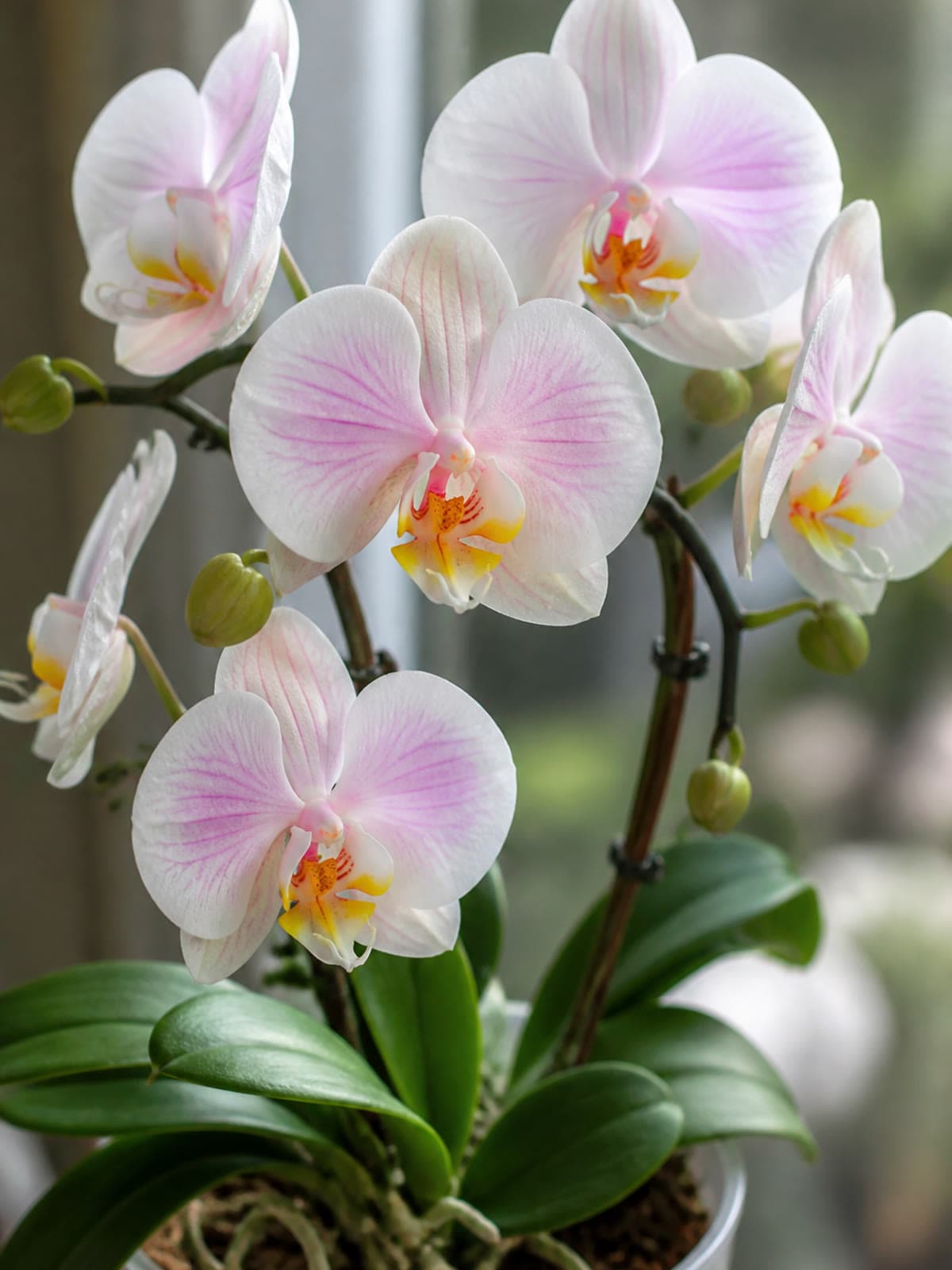
Indoor orchids multiply from offsets, often called keikis, and from division of plants that make pseudobulbs. Iowa State lists nearly all orchids as plants propagated by offsets, including Phalaenopsis (moth orchid) and Cattleya. MSU Extension describes keikis on Phalaenopsis, dendrobiums, and vandas. UF/IFAS describes backbulbs, especially on Cymbidium. Keiki and division belong in this guide.
Clemson: most of these plants are epiphytes. Use a commercial orchid mix or bark, not garden soil. For mix and a drained pot in general, see soil propagation.
Keiki
A keiki is a plantlet at a node on the stem or flower spike. MSU: once it is mature, cut it free and pot it the way you would a backbulb.
Iowa State, offsets: each piece should have healthy leaves, stems, and roots. Unpot if you are splitting a crowded plant. Pot the offset in a container that fits it. Water to settle the mix. Bright, indirect light. Wait a few weeks before fertilizer.
UMD, moth orchids: a commercial orchid bark mix and a pot with excellent drainage. If roots cling to old bark, soak the plant so you can ease them off. Cut off dead or damaged roots. Set the plant in the new pot and fill bark around the roots. Water to settle it.
MSU, Phalaenopsis after bloom: you can cut the flower spike just above a node. They describe placing that stalk in a moist, warm, dark spot so a new shoot forms, in roughly six months, then severing the stem 1 or 2 inches below the node. MSU also notes that an emerging flower spike held above 85 F for a long stretch can make a keiki at a node instead of buds.
Division
Clemson: Phalaenopsis moth orchids do not have water-storage pseudobulbs. Division of pseudobulbs belongs to orchids that make them.
UF/IFAS: some orchids form backbulbs (leafless) or green bulbs (with leaves) on a rhizome. Cymbidium is the example they name. Remove the bulb from the parent and put it in a rooting medium until a basal offshoot has its own roots.
Iowa State, division: early spring is the ideal time; most houseplants can be divided any time of year. Take the plant out of the pot. Loosen the root ball and separate it into smaller plants, each with leaves, stems, and roots. A knife if the ball will not come apart by hand. Replant in fresh mix in a smaller pot. Water to settle. Bright, indirect light. Wait a few weeks before fertilizer.
Common mistakes
- Potting an epiphytic orchid in garden soil. Clemson: they need an orchid mix with air around the roots.
- Taking a keiki that has no roots of its own. Iowa State wants leaves, stems, and roots on each piece.
- A water-jar how-to. These sources do not describe a jar method for orchids.
- Leaving the pot sitting in water. Clemson: a waterlogged pot is a fast way to kill an orchid.
People also ask
When is a keiki ready?
MSU: when it is mature. Iowa State: the offset should have healthy leaves, stems, and roots. Neither gives a root length.
Can I divide a moth orchid like a Cattleya?
Clemson: Phalaenopsis has no pseudobulbs. Iowa State still lists Phalaenopsis under offsets. Use a keiki, not a pseudobulb split.
What mix do I pot into?
Clemson and UMD: commercial orchid bark or a soilless orchid mix, in a pot that drains. Not garden soil.
How long until a keiki from a cut flower spike is ready to remove?
MSU: roughly six months for a new shoot on a Phalaenopsis stalk treated that way, then cut 1 or 2 inches below the node. That figure is MSU’s, not an average with other sources.