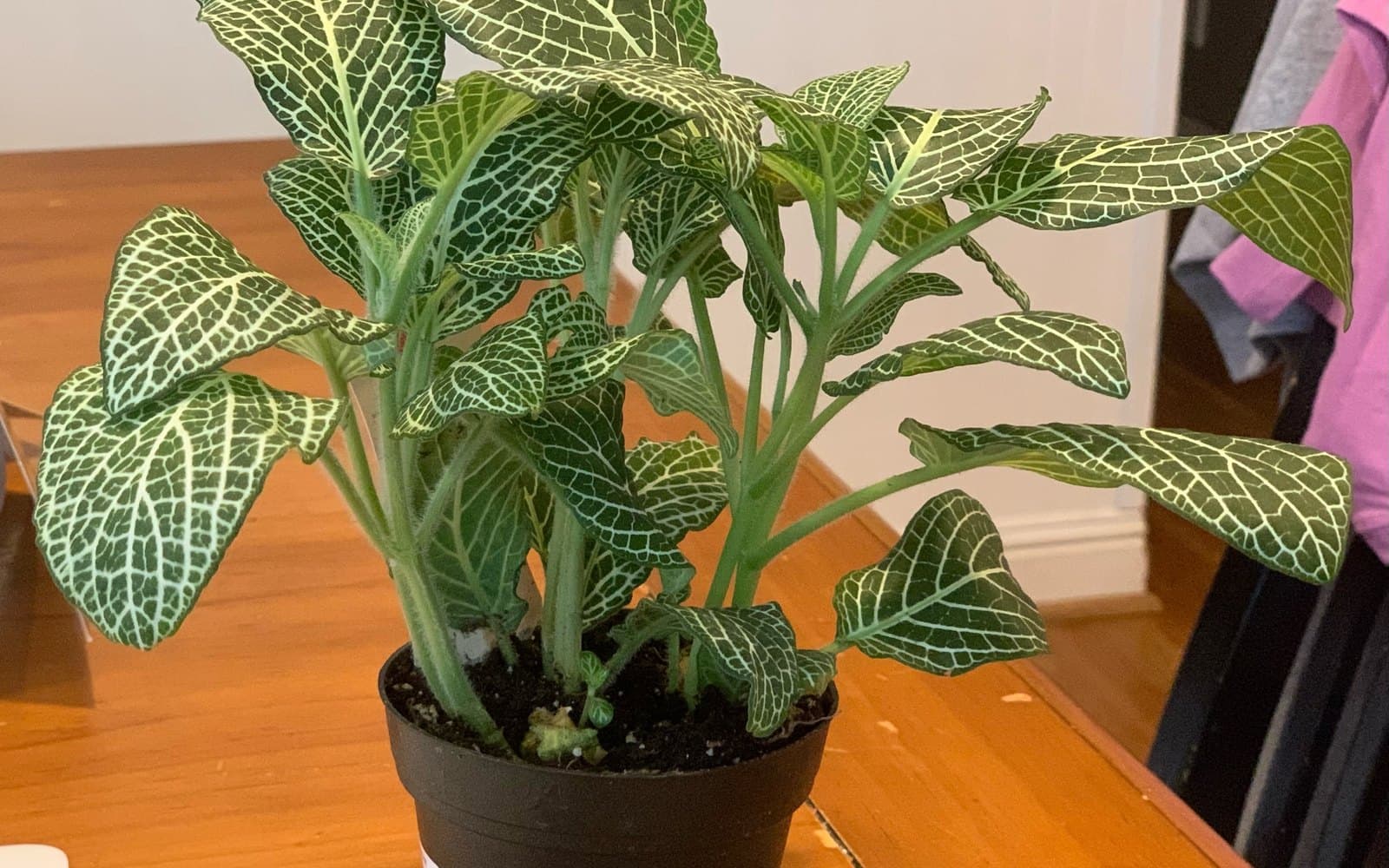
Fittonia is Fittonia albivenis. Labels may say nerve plant, mosaic plant, jewel plant, or silver fittonia. Same URL. Older names include Fittonia argyroneura and Adelaster albivenis. Family Acanthaceae.
NCSU, UNL, WSU, UAEX, and Missouri Botanical Garden all name stem cuttings. UAEX ranks terminal cuttings best and also lists single-eye and division as yes. Seed and leaf cuttings are no on the UAEX Fittonia row. Creeping stems root at nodes on NCSU and Mobot, as habit rather than a separate indoor how-to.
Distinct from Episcia, African violet (Saintpaulia / Streptocarpus ionanthus), and polka-dot plant (Hypoestes). NCSU notes non-pubescent leaves help separate it from Episcia or Saintpaulia.
For mix, see soil propagation. Water lives on water propagation.
Stem cuttings
NCSU Recommended Propagation Strategy is stem cutting. Mobot: propagate by stem cuttings.
UNL NebGuide G1853 lists Fittonia under stem cuttings. Tip cuttings are generally 3 to 5 inches. Swedish ivy, pilea, and fittonia root best with three or four leaves. Push cuttings about 1 inch into medium. Rooting room 60° to 70°F, plastic bag for humidity, avoid direct sun under the bag.
UAEX FSA-2095: terminal cuttings are best for Fittonia; single-eye is yes. Ideal terminal cutting is 2- to 4-inch with four to six leaves. Rooting bag timing in that publication is 4 to 6 weeks. Leaf, seed, cane, and air layer are no for Fittonia on that table.
WSU PNW Gardener's Handbook Chapter 14 lists Fittonia (mosaic plant, nerve plant) under stem cuttings. General stem-cutting protocol there: cut just below the third or fourth leaf pair, remove lower leaves, optional rooting hormone, plastic bag humidity, warm bright light without direct sun. Rooting mix example: half perlite and half peat or coir (or vermiculite with peat or coir). Check with a spatula; do not pull.
Iowa State's general stem-tip how-to (Fittonia is not on that page's short best list) uses stems 3 to 6 inches with at least 2 nodes, roots often 3 to 6 weeks, air 65–75°F, optional heat mat 75–80°F. Cite only as general technique, not a Fittonia-only recipe.
Do not invent water-only timelines or leaf-cutting success. UAEX says leaf no and seed no.
Creeping stems and division
NCSU: the creeping stems will root. Mobot: outdoors as ground cover, stems root at the nodes when they touch the ground. Treat as natural habit, not a pegging schedule.
UAEX lists division yes for Fittonia, not best. Opened pages give no Fittonia-specific crown-split steps, so do not invent them.
Common mistakes
- Inventing water-propagation day counts or hormone brands for Fittonia.
- Treating leaf cuttings or seed as standard methods. UAEX: leaf no, seed no.
- Merging Hypoestes polka-dot methods onto this Fittonia page.
- Copying African violet leaf-cutting culture onto nerve plant.
- Inventing a detailed indoor layering protocol beyond NCSU and Mobot's node-rooting habit notes.
People also ask
Can I propagate fittonia from stem cuttings?
Yes. NCSU, UNL, WSU, UAEX (terminal best), and Mobot all support stem cuttings.
Does fittonia root from creeping stems?
NCSU and Mobot say creeping stems root at nodes. That is habit language, not a full indoor step list on the opened pages.
Can I grow fittonia from seed or leaf cuttings?
UAEX marks seed no and leaf no for Fittonia. Stick to stem cuttings (and optional division as table yes only).