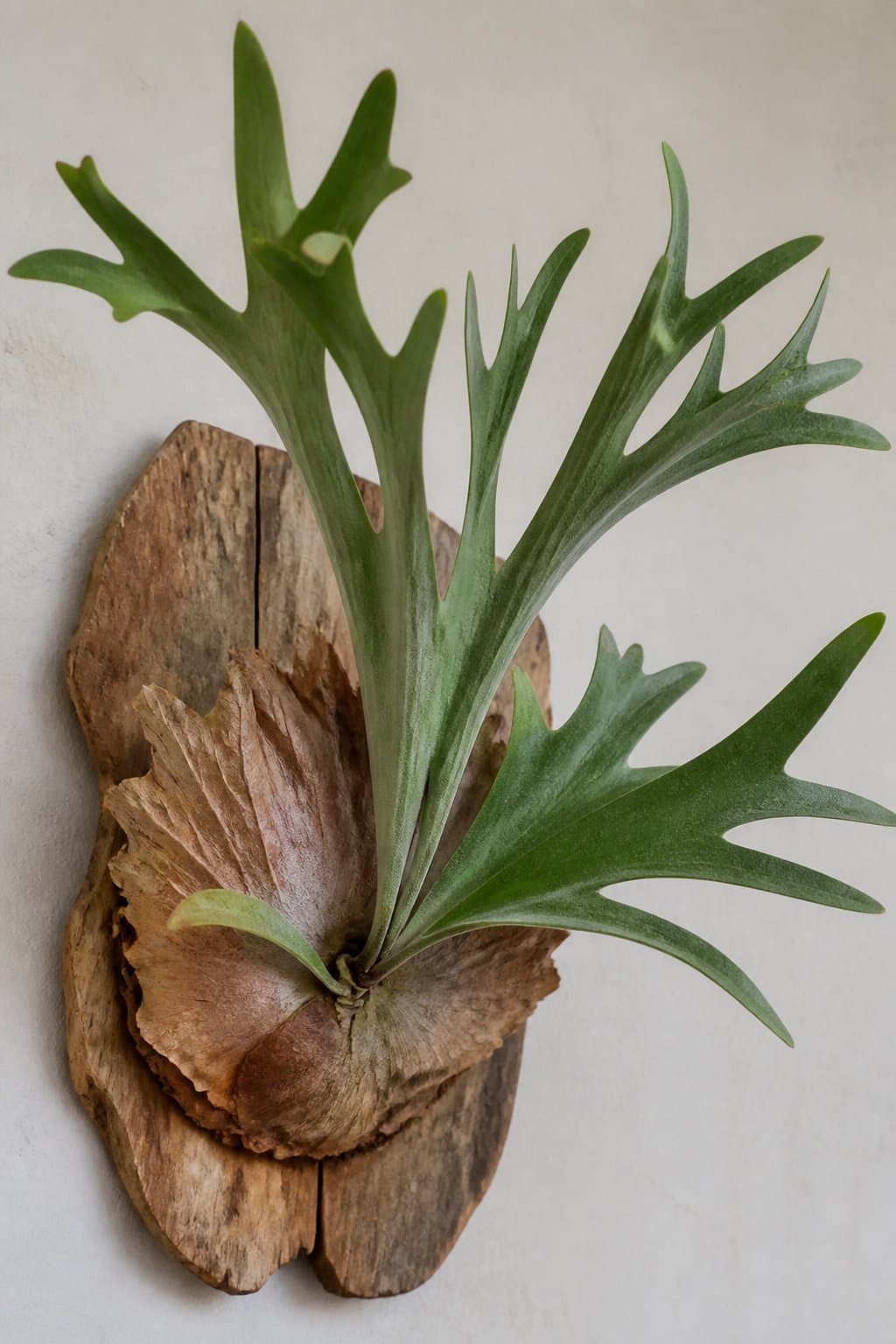
Staghorn fern is Platycerium, usually Platycerium bifurcatum indoors. Labels may say elkhorn fern. Those names belong here. It is an epiphyte in the polypod family. Boston fern and asparagus fern are different plants.
Wisconsin Horticulture and UF/IFAS call bifurcatum the common easy houseplant. Fronds come in two kinds: sterile basal shields that clasp the mount, and fertile antler fronds. Brown shields stay on until they fall. UKY and Wisconsin: do not strip them while they protect the crown.
NCSU Recommended Propagation Strategy is division. Wisconsin, UF/IFAS, ENH36, UAEX, and RHS name pups, offsets, or plantlets. Spores are possible and slow. None of these sources names frond cuttings.
Indoor / remount focus. Outdoor landscape stays off.
For mounting materials, see soil propagation only as a related drained-media note if you use a basket mix. Air layering is not a staghorn method.
Division and pups
Wisconsin: large plants make suckers or pups. Remove a piece with fertile fronds, sterile fronds, and roots. Establishment may take a long time.
UF/IFAS Gardening Solutions and the mounting tutorial: divide mature plants. Separate different basal fronds carefully. ENH36: remove pups that have root systems, wrap in damp sphagnum, tie to a mount. The sterile frond eventually grips.
NCSU: large plants can be divided; small pups form from rhizomes under the shields. UAEX: cut the sterile hubcap-shaped frond that has a new plantlet free. RHS: detach plantlets.
Sources do not give a minimum pup diameter or weeks-to-root.
Wisconsin and ENH36: Platycerium superbum and some solitary species do not pup. Those stay on spores.
Mounting the division
Wisconsin: sphagnum or peat on wood or bark. Fasten over dead brown shields, not over soft green fronds.
UF/IFAS: several handfuls of sphagnum or another well-drained medium in a circular mound. Basal fronds in contact. Plastic strips, nylon hose, or wire that is not copper. The mounting tutorial soaks sphagnum a couple of hours and prefers pantyhose over fine wire.
ENH36: a few handfuls of peat, compost, or rich potting soil slightly below center. Wire not copper. Light 600 to 2000 foot candles on that sheet.
UKY HortFacts: untreated cedar, fir, cypress, or redwood board. Sphagnum nest 4 to 6 inches wide for a small plant. Nylon fish line. Basket option: about 4 by 12 by 12 inches of wire mesh, or an 8 inch wire basket, lined with 1 to 1 1/2 inches moist long-fiber sphagnum, filled 1 part wood chips to 1 part sphagnum to 1 part light organic potting soil. Place the plant about one-third of the basket height from the bottom.
RHS under glass for bifurcatum: equal parts coarse leaf mould, loam, and charcoal on the plant page. The epiphytic-ferns guide: two parts peat-free ericaceous compost, one part perlite, one part medium orchid bark, or orchid compost alone. Do not merge those mixes.
Small plants can sit in a drained container (Wisconsin, NCSU, Mobot). IFAS and NYBG prefer a mount for mature plants.
Light while propagating
No source gives a separate light step for a freshly mounted pup or division. Wisconsin, NCSU, UF/IFAS, and RHS describe light for the growing fern, not a rooting recipe.
Bright indirect light. Wisconsin and NCSU both name bright indirect light. RHS suggests a west- or east-facing window. In a south-facing room, RHS puts the fern behind sheer curtains or away from the window and calls a bright bathroom ideal. Wisconsin agrees a bathroom works when the light and air circulation are right.
Shade. Most staghorns thrive best in partial shade, the equivalent of 600 to 2000 foot candles, according to UF/IFAS ENH36. NCSU gives Platycerium bifurcatum dappled sunlight to partial shade. Very low light produces slow growth and more disease and insect problems, ENH36 adds.
Direct sun. The sources disagree here. NCSU says direct light can bleach or blotch the fronds, and RHS lists sun scorch from too much direct light as one possible cause of brown leaves. Wisconsin says the fern tolerates more direct sun when humidity and temperatures are high, but then it needs more water. Wisconsin also calls P. veitchii more sun tolerant.
Summer outside. A staghorn grown as a houseplant and moved outdoors for the season should get used to the higher light gradually, Wisconsin says.
Check a spot with the propagation light DLI calculator.
Spores
Wisconsin: sexual cycle from spores is slow. ENH36: slow and difficult, not practical for most gardeners. NCSU genus: very slow and difficult. Mobot: home propagation by spores can be difficult. UAEX author could not grow from spores. RHS: sow spores when ripe, or detach plantlets. None gives a Platycerium-specific week count.
Common mistakes
- Expecting a set pup size or rooting time. Extension sources do not give one.
- Stripping brown basal shields while they still cover the crown.
- Fastening through soft green shields. Wisconsin: wrap over dead brown shields.
- Copper wire on the mount. IFAS and ENH36: not copper.
- Using Boston fern or asparagus fern methods on this plant.
- Promising pups on solitary species such as Platycerium superbum.
Staghorn fern and common elkhorn sold as Platycerium bifurcatum belong here.
People also ask
Can I root a frond cutting?
None of these sources names staghorn frond cuttings as a method.
Pot or mount?
Small plants can start in a drained epiphytic mix. Wisconsin, IFAS, ENH36, and NYBG treat a wood or basket mount as the usual home for a larger plant.
How long until a pup establishes?
Wisconsin: may take a long time. No source gives a week count.