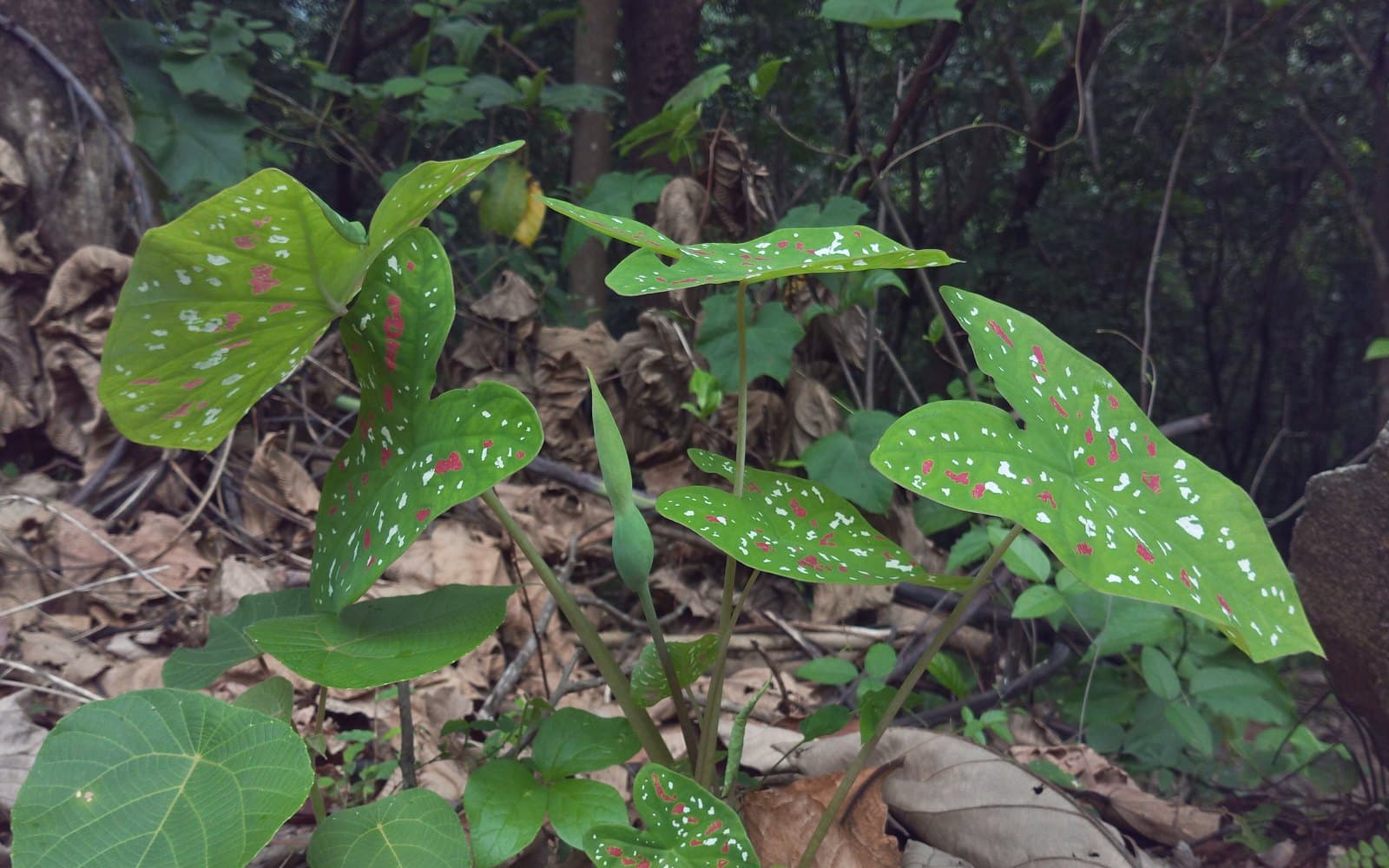
Caladium is Caladium bicolor, sometimes listed as Caladium × hortulanum. Labels may say angels wings or elephant ears. Same URL. Family Araceae. Fancy-leaved and strap or lance-leaved types both belong here.
Wisconsin Horticulture warns not to confuse caladiums with Alocasia, Colocasia, and Xanthosoma, which share the elephant ears common name. Caladium leaves rise on long petioles from an underground tuber or corm; there is no above-ground stem.
Wisconsin, UF/IFAS, and UNL name division. TAMU Aggie Hort names detaching small tubers. UF/IFAS says seed is rare. Stem cuttings, leaf cuttings, and water prop are not extension methods for this plant.
De-eyeing the central bud is foliage densifying culture, not a propagation method.
For mix, see soil propagation.
Tuber and corm division
Wisconsin Horticulture: propagate by dividing the corms in spring before potting them up. Cut corms into pieces that contain at least one eye or knob. Allow the cut pieces to dry for a few days to callous over before planting. Structure is botanically a corm; garden literature often says tubers. Plant knobby side or eyes up. Both roots and shoots come from the top. Barely cover indoors. Warm room at least 70°F. Outdoors after frost when soil is at least 70°F; plant depth outdoors 1½ to 2 inches.
UF/IFAS FPS83: propagation is usually by division of the tubers and rarely by seed. Planting depth on that page: tubers 3 to 5 inches deep, space 8 to 12 inches.
UNL NebGuide G1853 Table I: Caladium = division.
Clemson HGIC: soil at least 70°F before planting; plant 1½ to 2 inches deep, 8 to 14 inches apart, eyes up. After dig, dry 1–2 weeks; store dug tubers dry peat, perlite, or vermiculite, not touching, at least 50°F; never refrigerator.
UF/IFAS storage: dry dug tubers about 10 days in semi-shade; store dry peat or vermiculite at 50–60°F. Wisconsin: store lifted corms mild 55–60°F up to five months; never let pot-held dormancy fall below 55°F.
Detach small tubers
TAMU Aggie Hort Ornamental Production: methods of propagation include small tubers detached from the parent and potted when growth starts. Ornamental leaves are noted as 12 to 15 inches on that page.
Seed
UF/IFAS: rarely by seed. Not the home default. Do not invent seed temperatures from other crops.
Common mistakes
- Treating Alocasia, Colocasia, or Xanthosoma as this Caladium page.
- Inventing stem cuttings, leaf cuttings, or water propagation for Caladium.
- Presenting de-eyeing (⅛ to ¼ inch into the corm per Wisconsin) as propagation.
- Averaging Wisconsin's 1½ to 2 inch outdoor depth with UF's 3 to 5 inch figure into one invented depth.
- Inventing seed-sowing recipes when UF only says rarely by seed.
People also ask
How do I divide a caladium tuber?
Wisconsin: cut corms in spring into pieces with at least one eye or knob, dry a few days to callous, then plant eyes up. UF and UNL also name division of tubers.
Can I detach baby tubers?
TAMU: small tubers can be detached from the parent and potted when growth starts.
Is caladium the same as elephant ear Alocasia or Colocasia?
No. Wisconsin says do not confuse caladiums with Alocasia, Colocasia, and Xanthosoma even though the common name elephant ears is shared.